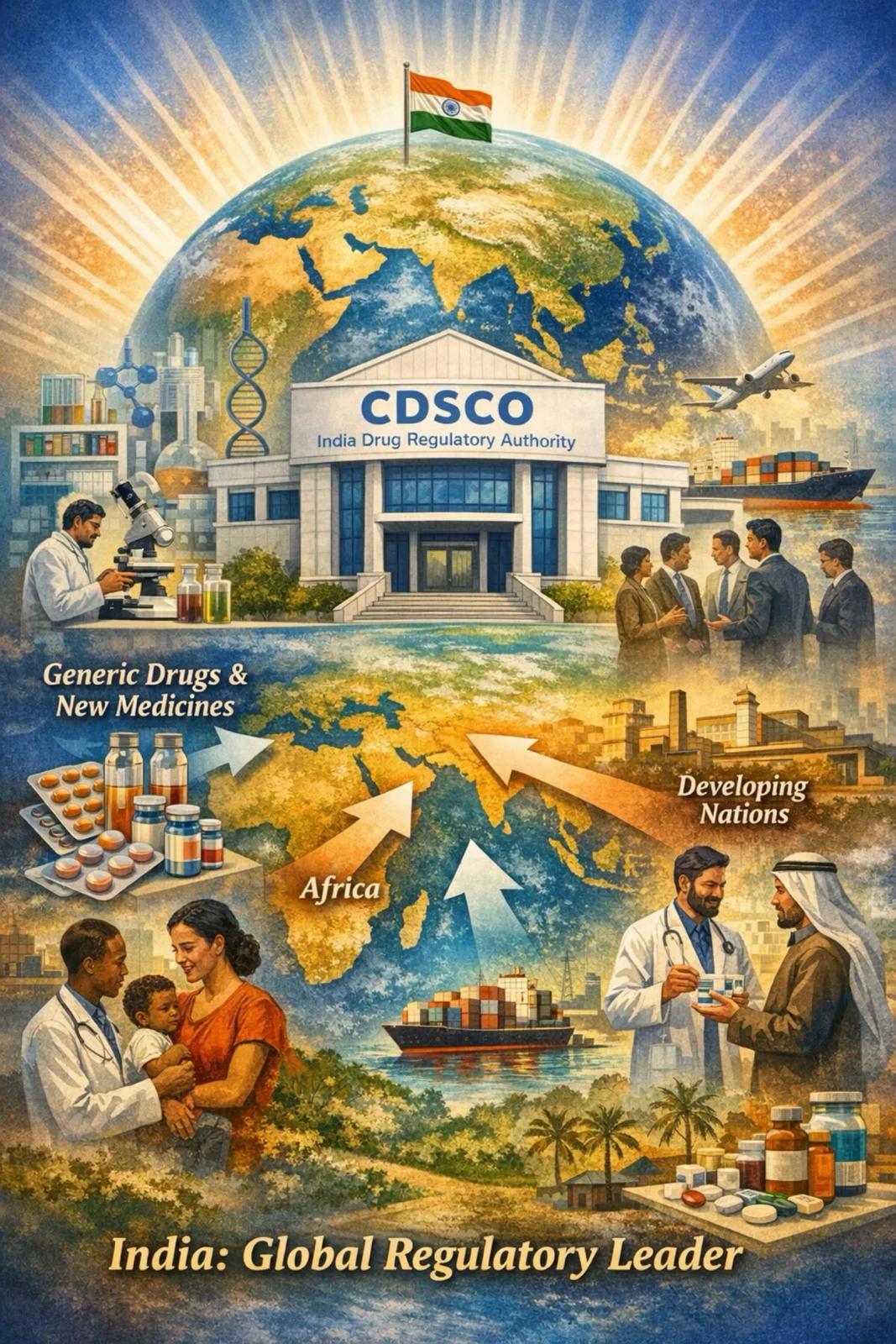
From National Regulator to Global Reference Authority
Author: Dr. Anirban Sadhu
India’s pharmaceutical sector occupies a paradoxical position in the global health ecosystem. The country is the world’s largest supplier of generic medicines and vaccines by volume, yet it plays a limited role in shaping global regulatory decisions that determine how and when medicines reach patients. This asymmetry constrains India’s ability to influence innovation pathways, attract early-stage research, and project scientific leadership commensurate with its industrial scale.
At a time when drug development is becoming more complex and regulatory expertise increasingly concentrated in a handful of advanced economies, India has a strategic opportunity to upgrade its regulatory institutions — particularly the Central Drugs Standard Control Organisation (CDSCO) — into a scientifically credible reference authority. Such a transformation would not only strengthen India’s domestic pharmaceutical ecosystem but also position the country as a regulatory partner of choice for much of the developing world.
Regulatory Capacity as a Driver of Innovation and Growth
In modern life sciences, regulatory agencies are no longer mere approval bodies. They
are central nodes in the innovation ecosystem. Early scientific advice, predictable approval timelines, and deep technical engagement between regulators and developers materially influence where pharmaceutical research, clinical trials, and advanced manufacturing are located.
Countries with strong regulators attract upstream investment. Those without them remain downstream suppliers.
India’s pharmaceutical growth over the past three decades has been achieved largely despite regulatory constraints, not because of regulatory leadership. As India seeks to move from volume-driven generics to value-driven innovation — including biosimilars, complex generics, and novel therapies — regulatory capability becomes a binding constraint.
The Global Context: Concentration and Reliance
The scientific complexity of contemporary drug development — spanning biologics, cell and gene therapies, and advanced delivery platforms — has concentrated regulatory expertise in a small number of agencies, most notably the US FDA and the European Medicines Agency (EMA). Most countries, including many fast-growing markets, lack the internal capability to independently evaluate such products and therefore rely on decisions taken elsewhere.
This reliance has two consequences:
1. Delayed access to medicines in developing regions, often by 18–36 months
2. Structural dependence on external regulatory institutions India, despite its scale and talent, remains largely a regulatory taker in this system.
A Regional and Transnational Regulatory Vision
Just as the EMA serves as a centralized scientific authority for the European Union, a
revitalized CDSCO could evolve into a transnational reference regulator for:
• South and Southeast Asia
• Africa
• Parts of the Middle East and other developing regions
Many of these regions face similar constraints: limited regulatory science capacity, fragmented approval systems, and heavy reliance on external reference authorities.
India is uniquely positioned — by virtue of talent, cost efficiency, and pharmaceutical
credibility — to provide a shared regulatory backbone for these markets.
Such a role would allow India to influence not only which medicines are approved,
but how health outcomes are shaped across a large proportion of the global population.
Scope of Authority: Innovation and Generics
Importantly, this regulatory leadership would extend beyond innovative medicines.
A strengthened CDSCO could offer:
• Scientific evaluation of new chemical and biological entities
• High-quality, accelerated review of generic medicines and biosimilars
• Lifecycle management, variations, and pharmacovigilance services
Given that generics and biosimilars form the backbone of medicine access in the
developing world, regulatory leadership in this area would have immediate and tangible
public health benefits while reinforcing India’s existing industrial strengths.
A Conservative Financial Model
A key advantage of this proposal is that it is financially modest and scalable.
Consider a conservative scenario:
• Eight new medicines filed annually for approval from partner countries
• Regulatory review fee of USD 100,000 per application
This alone would generate approximately USD 800,000 annually.
Extending this across multiple regions and programs, even a limited portfolio could reasonably generate USD 2 million per year from new product approvals. In addition, lifecycle management activities — such as post-approval variations, safety updates, and renewals — could conservatively add another USD 2–3 million annually.
In total, this suggests a potential USD 4–5 million annual revenue stream at an early
stage, with scope for significant expansion as reliance pathways mature. These revenues could be ring-fenced and reinvested into scientific capacity, digital
infrastructure, and reviewer training, reducing long-term dependence on budgetary
allocations.
Alignment with National Policy Priorities
This proposal aligns closely with the Modi government’s strategic priorities.
• Atmanirbhar Bharat: Regulatory self-reliance is a critical but underappreciated dimension of industrial sovereignty.
• Soft Diplomacy: Providing regulatory expertise to developing countries is a form of non-coercive influence that builds long-term partnerships.
• Ease of Doing Business: Predictable, science-based regulation improves India’s attractiveness as an R&D destination.
Institutions such as NITI Aayog, with their cross-ministerial mandate and focus on long term structural reform, are ideally placed to conceptualize and coordinate such an initiative.
Governance and Credibility Safeguards
For this model to succeed, credibility is paramount. Key safeguards would include:
• Clear separation between fee collection and scientific decision-making
• Publication of detailed assessment reports
• Fixed-term appointments for senior scientific leadership
• Parliamentary or independent oversight mechanisms
These measures are essential to prevent regulatory capture and to maintain trust — both domestically and internationally.
Conclusion
Transforming CDSCO into a globally credible reference authority is not an abstract aspiration. It is a practical, phased, and fiscally sound reform that builds on India’s existing strengths. By combining regulatory science, economic logic, and diplomatic intent, India can move from being a supplier of medicines to a shaper of global health outcomes.
In an era where scientific institutions increasingly define national power, regulatory leadership represents one of India’s most underutilized strategic assets. The opportunity now is to recognize it — and act
Financial Annex
Indicative Revenue Model for a Revamped CDSCO as a Regional / Transnational Reference Regulator
Purpose of this Annex
This annex presents a conservative, illustrative financial model to demonstrate how
a strengthened Central Drugs Standard Control Organisation (CDSCO) could partially fund its enhanced scientific and regulatory capabilities through fee-based services, without compromising regulatory independence.
The figures below are directional, not aspirational, and are intentionally modest to avoid
overstating fiscal impact.
A. Key Assumptions
ParameterAssumptionRationaleGeographic scopeSelect developing markets in Asia &AfricaPilot phase, not full global rolloutNew medicines reviewed annually applicationsVery conservative; excludes genericsFee per new medicine reviewUSD 100,000Significantly lower than US FDA / EMALifecycle management activitiesVariations, renewals, safety updatesStandard regulatory functionsLifecycle fee rangeUSD 50,000–75,000 per activityConservative midpointRegulatory independenceFees ring-fencedPrevents regulatory capture
B. Annual Revenue Model (Illustrative)
1. New Medicine Approvals
ItemValueNumber of new medicine applications8Fee per applicationUSD 100,000Annual revenue (new approvals)USD 800,000
Note: This assumes only a very small pipeline from partner countries. In practice,
volumes could be materially higher once reliance pathways mature.
2. Lifecycle Management Activities
Lifecycle management includes:
• Post-approval variations
• Label updates
• Manufacturing changes
• Periodic safety updates
ItemConservative EstimateNumber of lifecycle activities30–40 annuallyAverage fee per activityUSD 60,000Annual revenue (lifecycle management)USD 2.0–2.4 million
3. Total Indicative Annual Revenue
Revenue StreamAnnual Value (USD)New medicine approvals0.8 millionLifecycle
management2.0–2.4 millionTotal (early steady state)~2.8–3.2 million Rounded conservatively in the main article to USD 4–5 million to account for additional advisory services, scientific consultations, and scaling over time.
C. Cost and Sustainability Perspective
Key Observations
• This revenue does not aim to fully fund CDSCO, but to:
• Supplement government funding
• Finance scientific hiring and training
• Invest in digital review infrastructure
• Even USD 3–5 million annually can support:
• 40–60 senior scientific reviewers
• Continuous international training programs
• Modern assessment and pharmacovigilance systems
D. Benchmarking Context (for Policymakers)
AgencyTypical Review Fee (Approx.)US FDA (PDUFA)USD 3–4 millionEMAEUR 300,000
400,000Proposed CDSCO (pilot)USD 100,000
The proposed CDSCO fee structure is:
• Order(s) of magnitude lower than advanced regulators
• Aligned with the cost sensitivity of developing markets
• Designed to encourage adoption, not exclusivity
E. Policy Alignment
This financial model is consistent with:
• Atmanirbhar Bharat: Regulatory self-reliance as industrial sovereignty
• Soft diplomacy: Export of institutional expertise, not capital
• Fiscal prudence: Partial self-financing without privatization Institutions such as NITI Aayog are well placed to refine, pilot, and scale such a model through inter-ministerial coordination.
F. Key Takeaway
Even under highly conservative assumptions, a revamped CDSCO can:
• Generate meaningful, recurring revenue
• Reinvest in scientific excellence
• Enhance credibility and independence
• Support India’s emergence as a regulatory reference authority
This is institution-building, not profit-seeking — and that distinction is crucial.