The Books
Words for a world
between worlds.
Indian civilization, art, science and the wandering life of the mind.
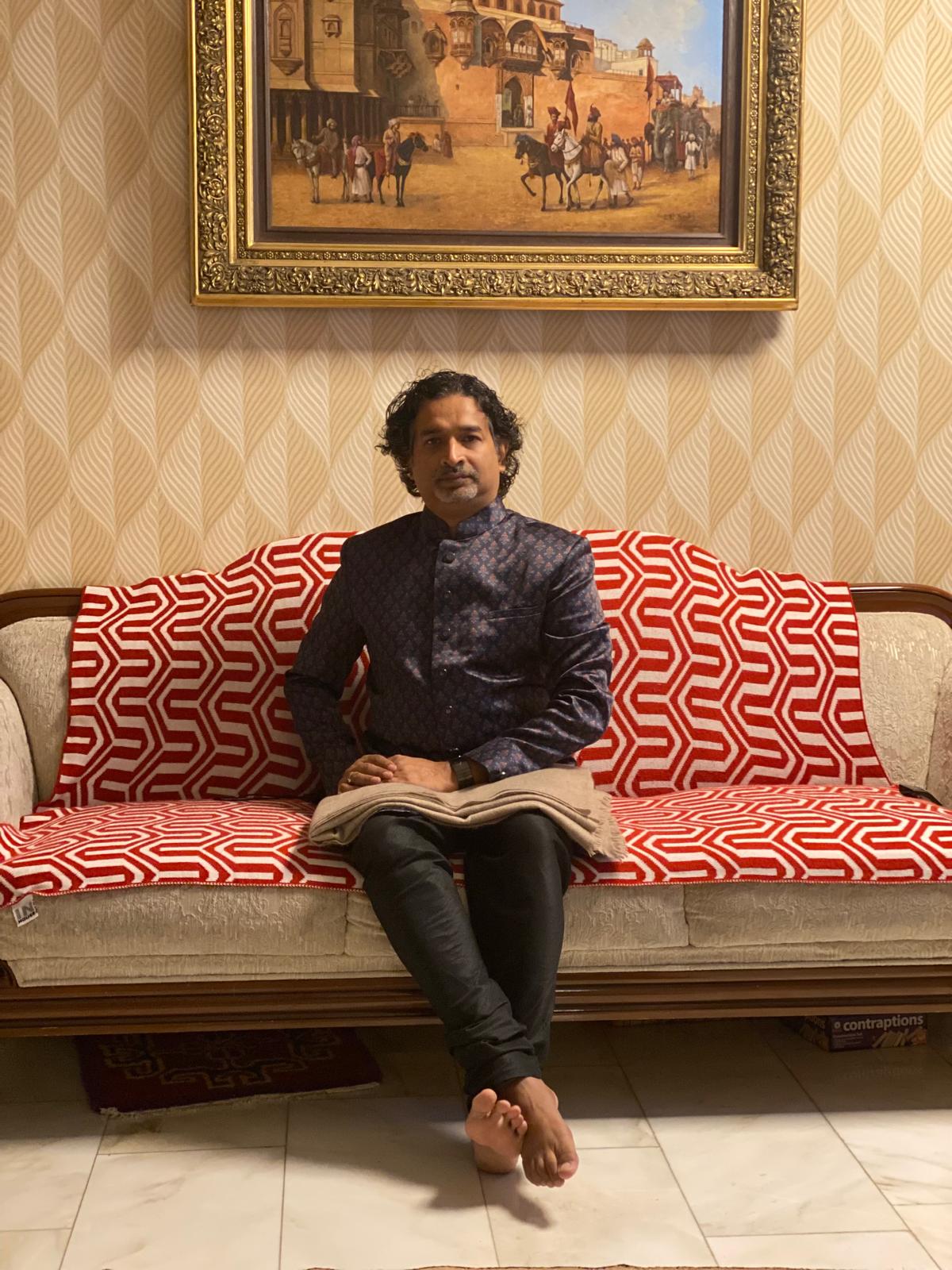
Narrator of Timeless Indian Art
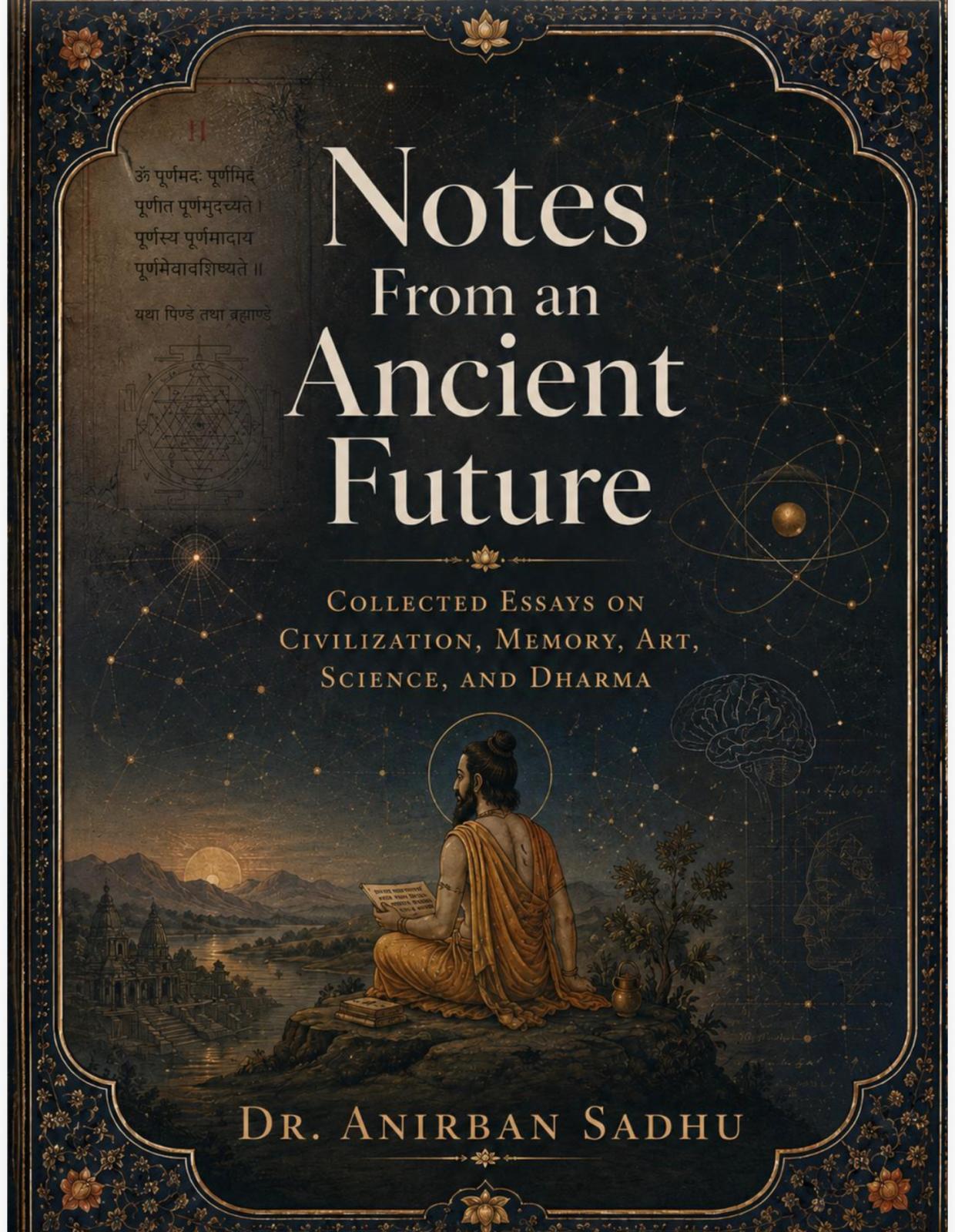
Notes From an Ancient Future
Collected Essays on Civilization, Memory, Art, Science, and Dharma
Coming Soon..
There are books that look backward. There are books that look forward. This book attempts something slightly different: it looks into the past in order to ask what the future has forgotten.
Notes From an Ancient Future began as a long private conversation with Indian civilization — with its stories, silences, scriptures, myths, arguments, images, wounds, and astonishing acts of imagination. Over time, that conversation became a collection of essays on some of the oldest and most urgent questions human beings continue to face. What is truth? What is duty? How should one live with uncertainty? What does mythology know about family, marriage, desire, power, grief, and dignity? What can the Bhagavad Gita say to an age of probability, risk, artificial intelligence, ecological crisis, and moral exhaustion? Why do figures such as Nachiketa, Hanuman, Radha, Chaitanya, Kapila, Shiva, Parvati, Sita, Draupadi, and Bhishma still feel so startlingly alive?
This is not a book of academic Indology. Nor is it a work of simple nostalgia. I have no interest in treating Indian civilization as a museum, a slogan, or an inherited decoration. A living civilization is not honored by embalming it. It is honored by making it generative again. The essays in this book therefore do not merely retell old stories. They ask what those stories are trying to tell us now.
The book moves across five broad landscapes.
The first section, Voices from the Sacred Past, returns to some of the deep figures and voices of India’s civilizational archive: the feminine voice of the Vedic hymns, the teenage moral courage of Nachiketa, the disciplined strength of Hanuman, the devotional mystery of Radha, the ecstatic courage of Chaitanya, and the metaphysical audacity of Kapila. These are not relics. They are living presences. Each of them contains a way of thinking about human life that remains uncannily modern.
The second section, Myth as a Manual for Modern Life, reads mythology not as fantasy, but as psychological truth expressed through story. The Ramayana and Mahabharata are explored not merely as epics, but as civilizational frameworks for understanding duty, ambition, loyalty, humiliation, power, family, and moral complexity. The essays on Sita, Draupadi, Gandhari, Kunti, Shiva, Sati, and Parvati ask what myth reveals about the emotional architecture of human life — about marriage, dignity, desire, in-laws, grief, discipline, and the difficult art of becoming worthy of what one loves.
The third section, Dharma, Science, and Uncertainty, moves into the terrain where ancient thought and modern questions begin to meet. The Gita’s idea of daivam is read alongside probability, complexity, management, science, and decision-making under uncertainty. The Mahāmrityuñjaya Mantra becomes a meditation on mortality and detachment. Kapila’s Sankhya is approached as one of humanity’s earliest grand attempts to understand manifestation itself. The essays on artificial intelligence, quantum computing, and Kalki ask whether old civilizational imaginations may still offer language for technological futures we barely understand.
The fourth section, Civilization, Ecology, and Power, turns toward the world we are building — and perhaps damaging. Here the ancient idea of yajña becomes a framework for ecology, reciprocity, and responsibility. Modern civilization has become astonishingly good at extraction, but often dangerously poor at gratitude. We take from soil, water, forests, families, institutions, and cultures, but do not always ask what must be returned. These essays ask whether the future can survive without recovering some older grammar of restraint.
The final section, India, Identity, and the Modern State, enters more difficult territory: language, empire, colonialism, identity, civilizational memory, and modern India. These essays are deliberately provocative because civilizations remain alive only when they retain the courage to argue with themselves. India is not merely a nation-state born in 1947. It is also a long civilizational continuum — wounded, plural, argumentative, sacred, regional, artistic, philosophical, and endlessly self-renewing. To speak honestly about India is to resist both easy glorification and easy dismissal.
At a personal level, this book also brings together parts of my own life that are often kept separate. I have spent much of my professional life in science, medicine, regulation, evidence, risk, and decision-making under uncertainty. I have also spent much of my inner life with Indian texts, art, philosophy, mythology, and civilizational memory. For a long time, these appeared to be separate worlds: the laboratory and the temple, the boardroom and the archive, the clinical trial and the Sanskrit verse, the miniature painting and the modern essay. Increasingly, I have come to feel that they are not separate at all. They are different languages for the same human search: how to see clearly, act responsibly, and live meaningfully in a world that exceeds our control.
Notes From an Ancient Future is written for readers who believe that the past is not dead simply because it is old, and that modernity is not wise simply because it is recent. It is written for those who sense that technology alone cannot answer the deepest human questions. It is written for readers interested in India not as exotic spirituality, but as a civilization of profound intellectual, moral, aesthetic, and psychological architecture.
The future will not be built by technology alone. It will require older disciplines: restraint, courage, memory, humility, reciprocity, devotion, imagination, and the ability to live with uncertainty. These are not obsolete virtues. They are survival tools.
The past is not behind us in the way we imagine.
Sometimes, it waits ahead of us.
These are notes from that waiting future.
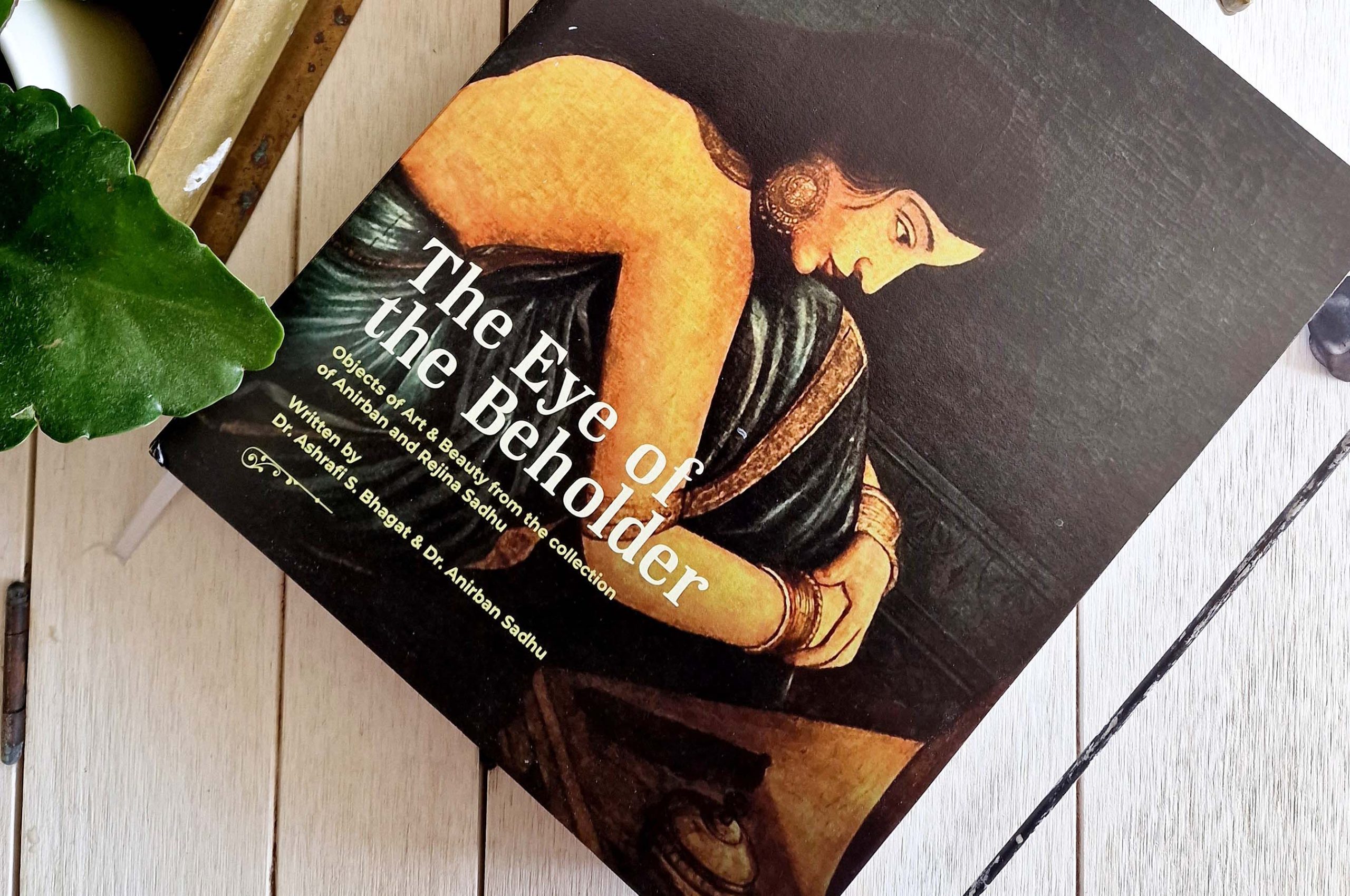
The Eye of the Beholder - Objects of Art & Beauty from the collection of Anirban and Rejina Sadhu
Revisiting 2500 years of Indian art history
asel, in Switzerland, known globally as a scientific and pharmaceutical hub, is an unlikely destination for an Indian art collection to be located. Yet, the collection featured in the poignantly named book “Eye of the Beholder” is based in Basel. The book is a compilation of a part of the private collection of two Doctors – Dr. Anirban and Dr. Rejina Sadhu, based in Basel, Switzerland. A substantial portion of the collection comprises paintings and sculptures- most of which are featured there. In addition, the Sadhu collection contains other objects of historic and cultural importance like rare books, manuscripts, historically important coins, natural history curiosities like Taxidermy etc.
It is a narrative of 2500 years of Indian art history told through the objects in the private collection of Dr. Anirban and Rejina Sadhu. The book appeals to a diverse audience. In its approach, it is partly scholastic, partly informative, but wholly entertaining. It is designed to arouse interest from a reader with an itinerant fascination for Indian art, as much as from the one with a dedicated and sustained interest. A common theme underlies the apparent diversity of focus of the collection. All the objects have strong resonance with the history of India.
Dr. Anirban and Rejina have been calling Switzerland their home for the last 23 years, though India resides in their heart, thought and lifestyle. Originally from India, both are alumni of the prestigious Tata Institute of Fundamental Research, and neurobiologists by academic training. Today, they hold senior positions in the international pharmaceutical industry in the field of drug development. For Anirban, vocation and passion have been twin pillars providing sustenance, succor and fulfillment to life. And the passion in their lives has always been India.
Unlike many other collections that have received recognition in the recent past, the Sadhu collection distinguishes itself in being primarily academic focused. “I never buy anything that I fully understand” – says Anirban, “and in that sense I am proudly old fashioned”. The collection arose out of the couple’s interest in Indian history and culture. As a result, the collection mirrors the chronology of Indian history, without any regard for prevailing trends, fashion or investment potential.
The earliest pieces date from the dusk of pre-history – a set of clay pottery from the Indus valley civilization, originating from Mehrgarh. Following close in the heels is a stunning basalt bust of a Buddhist Avalokiteshwara in the Gandhara style from the Indo Greek period from the region around Swat and Afghanistan. Other objects representing the flowering of Indian civilization in successive centuries and dynasties represent the rest of the collection – a gold coin (Mohur) from the Maurya dynasty, another representing the Kushan Dynasty, a 15th century miniature painting as a testament to the emergence of the art in India, successive schools of miniature paintings in India, Colonial Indian art, Bengal school paintings representing the Swadeshi movement, and paintings representative of important movements in the post-independence era. There are few other private collections that can claim to represent 10,000 years of cultural achievements of the Indian subcontinent.
Accumulated over a period of 20 years, and sourced from private dealers, auction houses and galleries all over the world, the pursuit of art has taken Anirban all over the world and forged friendships and spawned mysteries. There are so many hilarious anecdotes, nail-biting suspenses and tales of chance discoveries that a sequel to the ‘Art of the Beholder’ is already in the planning. All objects in the collection have been painstakingly researched, published and cataloged. Over the years, some objects have left the collection, and today find a place of eminence in prestigious art galleries and important sovereign collections.
“India occupies all of our lives”, Anirban says sitting in his garden next to a lifesize Shiva and Parvati from Mahabalipuram. “As we discover more, there is more that beckons us. At 15, my daughter has been training in Indian classical music for the last many years. At the age of 12, my son can recite chapters from the Bhagavad Gita effortlessly and is training formally to be a Sanskrit scholar. Both of them take a keen interest in the collection, and weigh in with their input on decisions related to acquisition and de-accessioning.”
There is so much that is wonderful and collectible in the world. Did they ever venture into collecting something else? “Yes, there have been some occasional obsessions with other things” – Anirban says, pointing to a grand complication Patek Philippe watch on his wrist. Watches and clocks fascinate me. Some years ago, I bought a ‘repeater’ wall clock from the 1840s from a very precious pedigree in Vienna. Before the era of electronic wall clocks, these were among the most precise mechanical clocks in the world. I love the workmanship that goes into complicated watches – represented by the kinds of Rolex and Patek Phillippe, and own a few. “But”, he says musingly as an afterthought, “a watch is after all a machine. Art is where the Heart is.”
This book is the culmination of two decades of collecting. It is intended to be a testament to the genesis of the collection – partly autographical, partly scholastic, and partly entertaining – wholly interesting. I started collecting when I had hardly any income, no disposable income at all, and no wall to hang the paintings on. My first acquisition was a painting bought for 25 shekels while loitering the streets of Tel Aviv in the year 2000. Perhaps this is the reason why unlike many other collectors, I have made fewer mistakes while building up my collection. Chronic shortage of acquisition funds meant that I had to spend a lot of time contemplating and researching a purchase before actually going ahead with it. Twenty two years on from that first acquisition in Israel, I look back on this journey with considerable nostalgia and pride. It has taken me to different parts of the world in search of paintings, introduced me to interesting and knowledgeable people and enabled interesting discoveries. Kushan sculptures in backrooms of galleries in Beijing to Indian miniatures deep down in London basements or iconic pieces in vernissages in Old Bond Street – these moments of discovery and thrill will never really leave me! Perhaps another book is needed for narrating the discoveries in flea markets, or that of finding a Daniell Print from Oriental Scenery behind another one on opening the picture frame. One important feature of this collection is that it was put together from a purely academic standpoint, with scant regard for trends or prevailing fashion.
Each piece has been assiduously studied, vetted against expert opinion, and in many cases researched and published. I take this opportunity to thank the numerous dealers, galleries, academics and specially the two dealers that I have had a chance to work with closely. Through this connection the idea of a book came to fruition. My belief is that this book will appeal to a diverse audience. Those interested in a serious understanding of Indian art history will be able to do so through the academic rigour of the academic writing. Others that have a passing interest in the subject will be able to treat themselves to a history of Indian art told through 100 objects, and the anecdotal inputs by me.
The Eye of the Beholder is a recently published book on Indian Art.
Peregrinations
Peregrinations: Prejudices and Opinions of an Impressionable MindPeregrinations is a collection of reflections that grew out of fleeting moments—scribbled during long flights, hurried car rides, and quiet early mornings when a thought refused to be forgotten. Written by a neuroscientist who spends his professional life in the pharmaceutical industry, the book gathers together observations on life, purpose, and the curious relationship between means and ends.
As the author wryly notes, “When Sudip was young, he had set out to change the world; but subsequently decided to leave it as it was.” That gently humorous self-awareness runs through the pages of the book. The short essays and notes capture the musings of a mind that looks at the world with curiosity, irony, and philosophical reflection.
At once personal and contemplative, Peregrinations invites readers to pause and consider the small questions that quietly shape the larger journey of life. Written in an accessible and often playful style, the book offers not conclusions, but moments of reflection—glimpses into the wandering thoughts of an impressionable mind.