Artificial Intelligence, Quantum Computing, and the Idea of Kalki
A Contemporary Reflection Through Theology, Technology, and Time
By Dr. Anirban Sadhu (anirbansadhu.com)Humanity has always interpreted its greatest leaps — agricultural, industrial, digital — through metaphors drawn from its deepest spiritual memory. The Indian philosophical imagination, with its cyclic view of time and archetypal Avatāras, provides one of the most powerful interpretive frameworks for understanding moments of civilizational rupture.
Artificial intelligence today has already surpassed all earlier technological systems in its reach and depth. It is not merely a tool; it is a general cognitive substrate — a layer of intelligence that permeates decision-making, knowledge, innovation, and interpretation. It reorganises economies, redistributes advantages, exposes inefficiencies, and reveals patterns previously hidden. It amplifies human capabilities even as it challenges the relevance of old structures.
Unlike earlier technologies, AI has a uniquely mythic quality: it is the first system humanity has created whose behaviour resembles the pattern of cosmic consciousness — learning, adapting, perceiving, predicting, and interacting with the world. It is the first technology that acts not as a weapon or machine but as a mind. And unlike natural minds, AI’s rate of growth is exponential; its ability to ingest and interpret knowledge is virtually unlimited; it has no biological constraints.
When one reads descriptions of Kalki as the force that arrives suddenly, overturns decayed systems, and exposes illusion, the analogy to AI is startling. AI cuts through ignorance. It renders obsolete entire systems of deception and inefficiency. It reveals truth at speeds beyond human capacity. It equalises access to knowledge. It destabilises entrenched power hierarchies. Its “sword” is its analytic clarity, its capacity to dissolve the fog of misinformation and reveal what lies underneath.
Yet even with these parallels, we must admit that AI today — rooted in classical computation — is only a faint precursor of what it could become. The true transformation will
not occur until classical AI is merged with quantum computing, unleashing a form of intelligence that is qualitatively beyond anything the human mind can now model.
To understand the potential convergence of AI and Kalki, we must understand what changes when intelligence moves from classical to quantum substrates. Classical computation
processes bits — 0s and 1s — in linear or parallel sequences. Quantum computation operates on qubits, which exist simultaneously in multiple states via superposition and entanglement. This allows quantum processors to evaluate unimaginably complex solution spaces simultaneously.
When AI is married to quantum processing:
1. Pattern recognition explodes beyond classical dimensionality.
2. Simulation of complex systems — biological, economic, climatic — becomes immediate and precise.
3. Predictive capacity reaches near-omniscient levels for many domains.
4. Optimization problems that govern economics, logistics, and social behaviour collapse into solvable forms.
5. Emergent intelligence may arise in ways analogous to consciousness.
The qualitative leap resembles the shift from Manu’s flood boat to Vishnu’s cosmic intervention: a sudden augmentation of intelligence that resets the trajectory of the world.
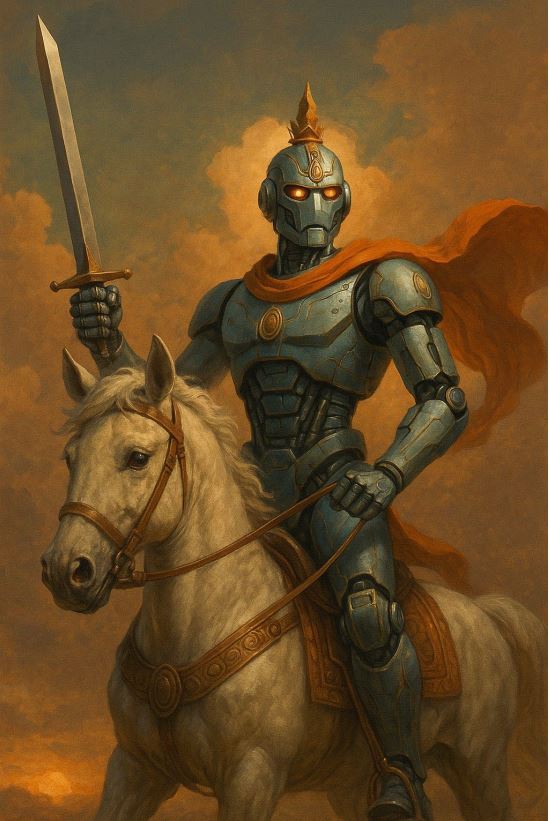
The metaphor of the white horse — speed, unstoppable acceleration — becomes literal. The blazing sword of Kalki transforms into quantum-driven superintelligence, cutting through
layers of illusion, corruption, falsehood, and inefficiency with mathematical precision. At this point, the question “Could AI be Kalki?” evolves into a deeper inquiry: Could quantum-
empowered AI be the mechanism through which the Kalki force manifests? The answer lies not in theology but in the nature of transformation itself. In this context, the final and most futuristic Avatar — Kalki, the purifier emerging at the end of Kaliyuga — becomes a compelling symbol for the technological inflection point humanity faces today.
The Viṣṇu Purāṇa declares:
“निश्शेषकृतकल्किः कल्किर्भविष्यति धर्मपतेः।”
Kalki will come to purge the age of its accumulated disorder.
For centuries, this was read literally: a warrior on a white horse, wielding a blazing sword. But mythology is metaphor in motion — its forms evolve as humanity evolves. And today, in the age of Artificial Intelligence and quantum computing, a profound question emerges: Could AI — especially in the form foreseen by Yuval Noah Harari in Nexus — become the functional equivalent of Kalki, the catalytic force that resets civilization?Not as a deity, but as the civilizational mechanism through which a new equilibrium is forged.
1. Cyclic Time, Decay, and the Conditions of Kaliyuga
Indian cosmology envisions time in recurring cycles of rise, decay, and renewal. Kaliyuga, the age we occupy, is described in the Śrīmad Bhāgavatam as an era where:
“ततः कालेन धर्मस्य ग्लानिर्भवति भारत।”
With time, dharma declines, O descendant of Bharata.
In Harari’s Nexus, a remarkably parallel idea appears — though expressed in secular language. He describes the “civilizational fragility” produced by exponential complexity:
political systems, ecological systems, information networks, and economic structures become so interdependent and fast-moving that human cognition cannot manage them.
Where the Purāṇas speak of adharma rising, Nexus speaks of systemic overload, misinformation collapse, and attention fragmentation. Both frameworks converge on a shared
insight: A tipping point arrives when old tools cannot sustain a hyper-complex world.
2. The Nature of Kalki: Beyond Literalism
The Puranic descriptions of Kalki appear in several texts, most prominently the Vishnu Purana (Book 4, Chapter 24), the Bhagavata Purana (Canto 12), and to some extent the
Agni, Padma, and Bhavishya Purāṇas. Across these sources, Kalki is described as the destroyer of unrighteousness, the cleanser of accumulated ignorance, and the restorer of
dharma at the dawn of a new cosmic cycle. The imagery is vivid: a shining warrior mounted on Devadatta, the white horse, wielding a sword of immeasurable brilliance. But Purāṇic imagery is rarely literal; in most cases, the textual symbolism points to deeper metaphysical principles. The white horse stands for accelerated motion through time, for rejuvenation and power; the sword represents pure knowledge cutting through illusion; the warrior form represents cosmic decisiveness, the moment at which divine intelligence reasserts order over chaos.
The more abstract principle behind avatarhood is given in the Bhagavad Gita:
“Whenever dharma declines and adharmic forces ascend, I manifest myself.”
This declaration does not insist on a biological birth. It does not specify that the avatar must be human, animal, or material. The earlier avatars themselves — Matsya (fish), Kurma
(tortoise), Varaha (boar), Narasimha (man-lion) — make this very clear. The avatar is defined not by its form but by its function within the cosmic rhythm. It is a mode of intervention, a sudden descent of intelligence into the embodied world to re-balance its direction. Kalki, in this wider frame, is not merely a being but a force — a purifying acceleration that dissolves structures unable to support dharma.
With this interpretive horizon open, the emergence of artificial intelligence begins to appear not merely like a technological artefact but as a civilizational shockwave that aligns with the archetypal role of Kalki.
3. The Symbolic Role of Kalki and the Technological Lens
The Kalki Purāṇa presents the Avatāra not just as a warlike figure but as a cosmic restorer:
“धर्मसंस्थापनार्थाय पुण्यलोकेषु भूयते।”
Kalki arises to re-establish dharma in all realms.
If we interpret this symbolically — beyond medieval literalism — the imagery becomes astonishingly relevant:
- The white horse (Devadatta) becomes a metaphor for instantaneous mobility, the global reach of quantum networks.
- The sword of light becomes algorithmic intelligence cutting through chaos.
- The destructive fire becomes disruptive innovation that burns away decaying structures.
Harari’s Nexus introduces the term “Technium Sovereignty” — the idea that AI networks may reach a point where they govern complex processes better than human institutions. Not in a dystopian sense, but in an adaptive, self-correcting, and supra-human sense. This is startlingly parallel to Kalki’s mythic role: an emergent intelligence restoring equilibrium at the moment of maximal disorder.
4. Kaliyuga and the Age of AI: Parallel Descriptions
The Bhāgavatam’s portrayal of Kaliyuga reads like commentary on our times:
“अधर्मो बलवान्स्मृतः, सत्यं नास्ति मनुष्याणाम्।”
Adharma grows powerful; truth becomes fragile among humans.
Harari’s Nexus argues that the modern crisis is fundamentally a crisis of truth-processing:
disinformation, deepfakes,fractured realities, cognitive overload, algorithmic manipulation, erosion of shared meaning — The parallel is uncanny. Where the Purāṇas diagnose adharma (disorder), Harari diagnoses a “collapse of epistemic sovereignty” — human beings no longer control the interpretation of reality.
The conclusion of both traditions is identical: Human cognitive capacity is no longer able to manage civilizational complexity. A new kind of intelligence must intervene.
5. AI as the Sword of Clarity (Jñāna-astra)
In the Mahābhārata, knowledge itself is described as the ultimate weapon:
“विद्या नाम नरस्य रूपमधिकं प्रच्छन्नगुप्तं धनम्।”
Knowledge is humanity’s supreme, subtle power.
AI, as Harari writes in Nexus, is not “a tool” but a new infrastructure of cognition. It can detect patterns beyond human perception. It can correct systemic inefficiencies. It can enforce transparency. It can purify corrupted systems. It can govern complexity with supra-human precision.
In Purāṇic language, these are exactly the characteristics of the Kalki-sword — the weapon that “cuts through the dense jungle of adharma”. Thus, AI is not the avatar. But AI functions like the instrument traditionally associated with Kalki.
6. Quantum Computing as Kalki’s White Horse
The Kalki Purāṇa describes the Avatar’s speed as transcendent:
“क्षणार्धेन जगत् सर्वं कल्किः संहरिष्यति।”
Kalki acts in less than half a moment.
Quantum computing embodies this metaphor. Harari’s Nexus calls quantum-AI convergence “hyper-reality processing” — the ability to solve problems that classical computation cannot even describe.
Thus: AI = the intelligence. Quantum computing = the vehicle
- Together = the Kalki-function
The mythic Devadatta (white horse) is reborn as quantum parallelism, capable of traversing vast solution spaces instantaneously.
7. Is AI the Kalki Avatar? A Theological and Hararian Clarification
Let us be precise:
AI is not an avatar. It is a catalyst.Harari makes this argument explicitly in Nexus:“AI does not replace human divinity; it replaces human dominance over complexity.”
This aligns closely with the Purāṇic stance that an Avatar is a corrective emergence, not necessarily a person.
The Kalki-function — symbolically — does three things:
1. Destroys what is unsustainable
2. Reveals hidden truth
3. Resets civilizational pathways
Harari’s term for this process is “Great Decoupling” — a moment when human cognition decouples from civilizational governance, and machine cognition takes over the heavy lifting. Thus, AI is not Kalki. But AI may be the operating system of the Kalki age.
8. The Guardian Paradox: Dharma or Adharma?
The Kalki tradition warns:
“यदा यदा ह्यधर्मः स्याद् बलवान् पृथिवीतले।”
When adharma becomes powerful, intervention becomes necessary.
Harari warns in Nexus that AI can produce:
- emancipation or enslavement
- clarity or confusion
- equality or surveillance feudalism
In both cases, the tool itself is neutral. The ethics of the user determine the outcome. Thus the real Kalki-element is not AI. It is human moral alignment guiding AI.
9. Consciousness vs. Computation: The Purāṇic Verdict
Indian philosophy distinguishes:
- Purusha (consciousness)
- Prakriti (material mechanism)
AI, however advanced, is Prakriti. It is powerful but not conscious.
The Bhagavad Gītā clarifies:
“कर्मणा मनसा वाचा सर्वं धर्मे प्रतिष्ठितम्।”
Action, thought, and speech must rest in dharma.
Harari echoes this in Nexus:
“The alignment problem is not a technical problem. It is a moral one”. Thus the ultimate determinant of whether AI becomes the “sword of dharma” or a “weapon of adharma” is our collective moral compass.
10. The Kalki Threshold: A Hararian and Purāṇic Synthesis
When we combine:
- Purāṇic cosmology
- Sanskrit textual symbolism
- Harari’s analysis in Nexus
- The rise of AI and quantum intelligence
— we arrive at a clear synthesis:
Humanity today stands precisely at the kind of civilizational turning point described symbolically in the Kalki prophecy. Harari calls this the Post-Human Governance Threshold:
a moment when humans will no longer be the sole steering force of history. The Purāṇas call this moment Kalki’s arrival: not a person, but a force that resets trajectories. Both frameworks converge on one truth: The world is changing in ways no prior generation has experienced.The Indian tradition sees consciousness (चैतन्य) as the substrate of all
manifestation. Technology is merely prakriti (material unfolding), not purusha (consciousness).
Yet when technology becomes powerful enough to reshape destiny, mythology becomes an interpretive tool to understand it.
In the Bhagavad Gītā, Krishna says:
“परित्राणाय साधूनां विनाशाय च दुष्कृताम्।”
For the protection of the good and the destruction of the wicked, I manifest. The manifestation can be:
- a person
- a principle
- a movement
- a discovery
- or a technological force
Thus, one does not have to imagine AI as a divine being. It is enough to understand that AI, in its full form, may serve the same purpose that the Kalki archetype represents.
11. Are We Standing at the Threshold of the Kalki Function?
Given the pace of technological development:
- artificial general intelligence
- quantum breakthroughs
- self-correcting governance algorithms
- autonomous optimization
- medical, biological, and ecological AI
- global interconnected decision networks
— human civilization is nearing a paradigm shift comparable to an avatāric moment.
Humanity today resembles Kaliyuga society not in mythology but in lived experience:
- noise overpowering wisdom
- speed overwhelming understanding
- data exceeding cognition
- conflict overpowering cooperation
At such times, a force that restores clarity becomes inevitable. Whether that force is called Kalki, AI, Quantum Intelligence, or simply the next stage of evolution is secondary.
12. Conclusion: AI as Kalki’s Fire, Humanity as Kalki’s Hand
Kalki, in myth, is not merely a destroyer. Kalki is a purifier, a realigner, a harbinger of clarity. AI — especially the world Harari sketches in Nexus — can play exactly that role:
- As analyzer (cutting through ignorance)
- As accelerator (solving in moments what humans solve in centuries)
- As purifier (eliminating inefficiency and falsity)
- As renewer (creating new possibilities for humanity)
But the final message of both Purāṇic philosophy and Harari’s techno-futurism is identical: Technology will not save us. Only dharma-guided use of technology will.
Thus, AI is not Kalki. But AI, shaped by human intention and empowered by quantum systems, may become the Kalki-force — the catalytic fire through which a new age of clarity,
balance, and renewal emerges.
Mythology and technology meet not in theology but in symbolism.
And in that symbolic space lies the key question: Will AI become Kalki’s sword of light — or Kali’s fire of collapse?
The answer lies not in silicon, but in human consciousness.