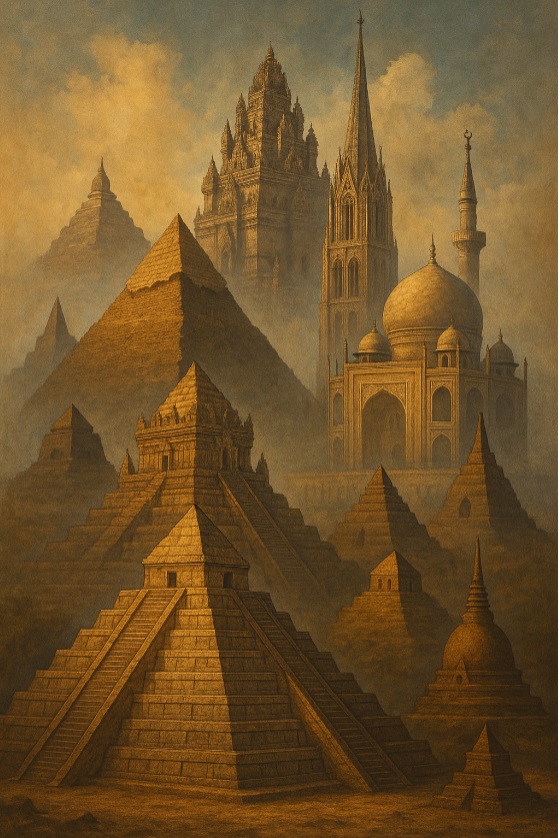
The Eternal Pyramid
How the World’s Cultures Reinterpreted a Primal Form
Author: Dr. Anirban Sadhu
Pyramids are far more than icons of ancient Egypt. They represent one of the oldest and most resilient architectural ideas in human history. Across millennia and continents,
civilizations have independently devised pyramid-like structures as tombs, temples, shrines, and ceremonial platforms. From Mexico to Mesopotamia, from Cambodia to coastal Peru, the same basic silhouette appears again and again: a broad, stable base rising toward a narrowing summit.This recurrence is no coincidence. The pyramid is one of humanity’s simplest and most expressive forms — easy to build, visually commanding, and symbolically rich. When viewed
broadly, its lineage stretches from the earliest stone and earth mounds to the stepped temples of Asia, the Hindu shikhara and Khmer temple-mountains, the Gothic spire, and
even the great domes and minarets of Islamic architecture. This essay explores how different cultures reinvented the pyramid, why the shape proved so universal, and what its persistence reveals about the human imagination.Pyramids Across the Ancient WorldWhen people think of pyramids, they typically picture the monumental tombs on the Giza plateau. Yet those are only a single chapter in a vast global story. In fact, Latin America
contains more pyramids than the rest of the world combined. Civilizations such as the Olmec, Maya, and Aztec built stepped pyramids crowned with temples — the Pyramid of the
Sun and Moon at Teotihuacán, or the famous El Castillo at Chichén Itzá, which casts a serpent-shaped shadow at the equinoxes. These were civic and spiritual centers, aligned
with celestial cycles and animated by ritual life.
Across the Pacific, China’s ancient emperors were also buried beneath massive pyramid- shaped earthen mounds — flat-topped, grass-covered structures whose geometry
unmistakably echoes the global pyramid profile. In Southeast Asia, the pyramid reappears in the form of temple-mountains: Angkor Wat, with its tiered terraces and lotus-bud towers symbolizing Mount Meru, and Borobudur in Java, a colossal Buddhist mandala rising through nine stacked levels.
Even more enigmatic is Gunung Padang in Indonesia, a terraced megalithic hill that some researchers believe may conceal extremely ancient, possibly Ice Age–era building phases. Although the most controversial claims remain unproven, the site underscores how deeply the idea of a stepped, rising structure is woven into humanity’s architectural instincts. Africa, too, embraced the pyramid long after Egypt’s Old Kingdom. The Nubian kings and queens of Kush built more than 200 slender, steep pyramids at Meroë and Napata — smaller than Egypt’s, but visually striking and spiritually significant. Farther west, the Igbo culture of Nigeria constructed the Nsude pyramids, stepped mud-brick towers used as shrines.
Meanwhile, in North America, indigenous cultures built pyramid-like earthen mounds independently. The site of Watson Brake (c. 3400 BCE) predates both the Maya and the
Egyptian pyramids. Later, the Mississippian culture constructed massive platform mounds such as Monks Mound at Cahokia, which rivalled Old World pyramids in scale.
In Peru, the Caral-Supe civilization built monumental platform pyramids as early as 2600 BCE — contemporaneous with Egypt’s earliest pyramid at Saqqara. Their presence shows
that pyramid-building emerged independently as a natural response to the desire for a sacred and elevated architectural form.
Across continents, the recurring pattern is unmistakable: when early societies aspired to create something monumental, stable, and spiritually resonant, they often arrived at the
same solution.
The Pyramid as Sacred Mountain
Why did so many civilizations gravitate toward this shape? The practical reason is straightforward: a broad base tapering upward is one of the most stable and scalable
structures in pre-modern engineering. But its symbolic power is even more compelling. A pyramid suggests a mountain, and mountains everywhere have been seen as places
where earth meets the heavens. Anthropologists describe pyramids and temple-towers as axes mundi — man-made sacred mountains connecting the human and divine realms.
This symbolism appears explicitly in the ancient ziggurats of Mesopotamia, which were conceived as “mountains of God.” In Hindu and Buddhist thought, Mount Meru stands at the
center of the cosmos, inspiring the soaring shikhara of Hindu temples and the stepped temple-mountains of the Khmer empire. Egyptian pyramids were seen as the pharaoh’s
ladder to the afterlife, or as the primordial mound from which creation emerged.
Mesoamerican temple-pyramids were oriented to the stars and seasons, embedding cosmic order in stone.
As a shape, the pyramid simultaneously conveys mass, permanence, and upward aspiration. Its visual thrust draws the eye skyward, connecting the viewer instinctively to ideas of
transcendence. In this sense, the pyramid is one of the earliest architectural expressions of spiritual longing.
From Pyramids to Temples, Spires, and Domes
Even where literal stone pyramids ceased to be built, the pyramidal principle continued to animate sacred architecture. In South and Southeast Asia, the Indian temple architecture
developed the shikhara (North India) and the tiered gopuram (South India) — both inherently pyramidal silhouettes, now richly sculpted and ornamented. Khmer architects fused the
stepped pyramid with lotus-bud towers at Angkor Wat, while in Java, Borobudur’s stacked terraces remain one of the world’s largest pyramid-temples. In east Asian Pagodas, though visually different, still retain a tapering profile: if one traces the outer line of their roofs, the form approaches a tall, multi-tiered pyramid. In Europe with the Gothic age, Christian architecture reinterpreted the ancient pyramid into the spire — a slender, elongated pyramid rising from a church tower. Spires became “prayers in stone,” deliberately pointing heavenward. Cologne Cathedral, Chartres, and Ulm Minster all rely on this sharpened pyramidal gesture to communicate aspiration and sanctity. In Islamic Architecture and design, the dome can be viewed as a “smoothened pyramid” — a base rising continuously to a single apex that symbolizes the vault of heaven. Minarets, too, culminate in pointed crowns or finials that echo the upward-thrusting logic of the pyramid and spire.
Across these cultures, the pyramid’s essential function persisted: to create a place where earth reaches upward and the heavens seem to descend.
A Timeless Archetype
From prehistoric earthworks to modern landmarks, the pyramid continues to inspire. The Washington Monument, though an obelisk, is essentially a refined pyramid. The Louvre’s
glass pyramid evokes both antiquity and modernity. In popular imagination, pyramids symbolize mystery, endurance, enlightenment, and the upward climb toward the eternal.
What accounts for this timeless appeal? Partly engineering, partly aesthetics — but mostly psychology. Humans instinctively associate vertical ascent with transcendence. The pyramid, in all its global variations, is the architectural embodiment of that instinct.
As an anonymous Atlantic writer put it in 1860, the pyramidal form — adapted in countless ways — has always been used “to impress and overawe.” Whether in the brooding giants of Giza, the sacred mountains of Cambodia, the spires of Europe, or the domes of Islam, the pyramid’s legacy is unmistakable: a universal grammar of aspiration.
Conclusion
The pyramid is not merely a structure — it is an idea.
A mountain made by human hands.
A bridge between earth and sky.
A symbol of stability, permanence, and the desire to transcend.
From Caral to Cambodia, from Egypt to Cahokia, and from medieval Europe to modern cityscapes, the pyramidal silhouette reappears in endlessly varied guises. Its persistence
across time and culture suggests it speaks to something deep within us — a longing to rise, to connect, to reach for the infinite.
In whatever form it takes — step pyramid, temple tower, spire, dome — the pyramid invites us to look upward. And in that brief upward glance, we remember the oldest human dream: to touch the heavens.