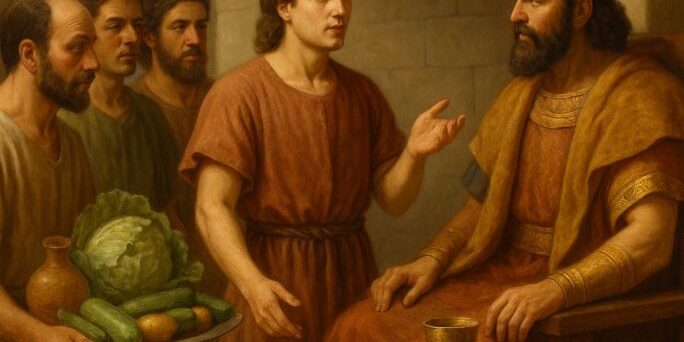
The First Clinical Trial… In a Palace Kitchen
Author: Dr. Anirban Sadhu
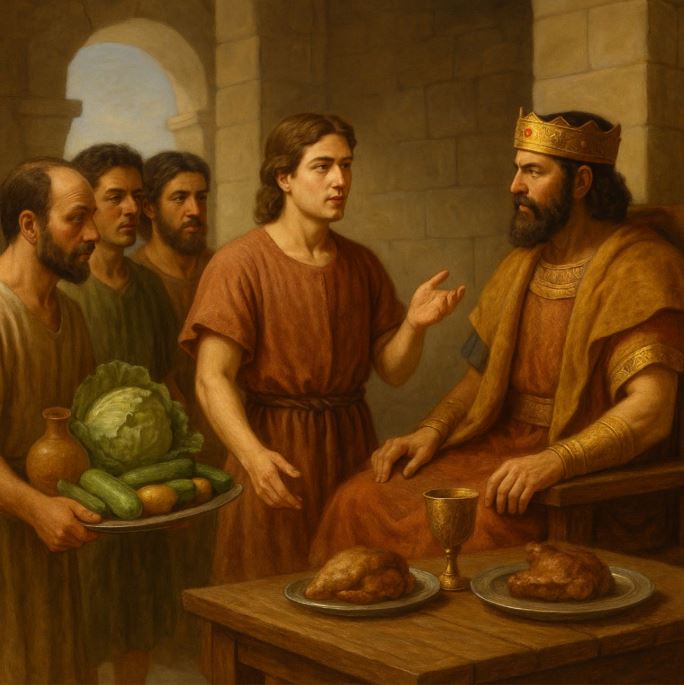
If you think clinical trials began with fluorescent-lit laboratories, white-coated researchers arguing about p-values, and statisticians sighing into their spreadsheets, allow yourself to travel back—far back—to the 6th century BCE. Long before regulatory agencies, IRB approvals, or PowerPoint presentations on adverse event reporting, the world’s first recorded controlled dietary experiment was conducted not by a physician, not by a philosopher, but by a teenage exile named Daniel in the heart of Babylon.
Daniel was no ordinary teenager. He was a young Hebrew noble, forcibly taken from Jerusalem after King Nebuchadnezzar II—Babylon’s formidable and famously uncompromising emperor— conquered Judah. Nebuchadnezzar was the sort of king who built the Hanging Gardens, expanded an empire, and reorganized conquered societies with a precision that today’s HR departments would envy. His plan for promising young captives? Educate them, refine them, feed them lavishly, and train them to serve in the imperial court.
Daniel was chosen for this prestigious program because he was intelligent, well-mannered, attractive, and adaptable. What Nebuchadnezzar didn’t anticipate was that Daniel also
possessed an ironclad commitment to his dietary and spiritual principles—a commitment strong enough to spark what historians now recognize as the earliest documented clinical trial in human history.
I. Babylon: Where Cuisine, Conquest, and Science Collided
To understand the audacity of Daniel’s request, we need to appreciate the grandeur of Nebuchadnezzar’s Babylon. This was a city where luxury was a public language. The palace
kitchens alone were an empire within an empire—teeming with cooks, bakers, brewers, spice masters, and food artisans who prepared dishes rich enough to make a modern cardiologist faint dramatically.
Imagine slow-cooked lamb soaked in date wine, honey pastries dripping with syrup, breads scented with sesame and coriander, and stews thick with animal fat. Babylonian cuisine was the haute gastronomy of its time—decadent, fragrant, and nutritionally… well, questionable.
Into this world stepped Daniel: intelligent, pious, and deeply committed to Jewish dietary laws.
When the royal steward placed before him a banquet of meats and wines forbidden by his traditions, Daniel quietly and politely refused. Instead of staging a protest or sermonizing about purity, he offered something far more elegant:
A trial. A simple experiment. A 10-day test comparing diets to see which produced visibly healthier outcomes. It was, in essence, a proto–Phase 1 study, set not in a laboratory but in a palace dining chamber.
II. The First Study Protocol: Daniel the Accidental Principal Investigator
Let us momentarily imagine Daniel presenting his idea to a modern regulatory agency. His study design was, by today’s standards, astonishingly simple: He and his three companions would consume a diet of vegetables and water for ten days. Their Babylonian peers would continue eating the king’s lavish food. After this short period, their physical appearance and vitality would be compared.
This was a far cry from today’s elaborate protocols, which include sample size justifications, statistical analysis plans, multi-country recruitment strategies, and at least thirty-seven
appendices. Yet for its era, Daniel’s design was profoundly innovative. It featured clearly differentiated groups, a defined intervention, a set timeline, and observational assessment— nothing randomized, nothing blinded, nothing peer-reviewed, but unmistakably experimental.
The royal steward, understandably anxious, feared that if Daniel and his friends looked malnourished at the end of the trial, Nebuchadnezzar would interpret it as insubordination and respond with… decisiveness. Babylonian job security was notoriously fragile.
Daniel, however, was unfazed. “Test us,” he said. “See for yourself.” This quiet confidence—part faith, part reason—was enough to convince the reluctant steward to cooperate.
Thus began history’s earliest documented controlled human study.
III. The Ten-Day Test: No Spreadsheets, No Amendments, No Beheadings (Hopefully)
The extraordinary thing about this trial is not only its existence but its simplicity. There were no electronic case report forms, no site initiation visits, no procurement issues, and no queries from data management. No one needed to file an SAE report or clarify whether cabbage was allowed under the intervention arm.
For ten days, Daniel and his companions ate only vegetables and drank only water. Meanwhile, the rest of the trainees enjoyed the palace cuisine—rich meats, pastries, wine, and stews. One imagines the steward watching anxiously, murmuring small prayers to the gods of the Tigris and Euphrates:
“Please don’t let them look sick. Please don’t let them look sick…”. At the end of the ten days, the results were dramatic and immediate. Daniel and his friends looked healthier, brighter, stronger, and more radiant than all their counterparts.
Radiant—on vegetables! The Babylonians had never seen “plant-based glow” before. But they saw it that day.
Nebuchadnezzar nodded approvingly. The steward exhaled in relief. Daniel said nothing— because when you’re right, you don’t need words.
The vegetable group had triumphed.
IV. What Makes This a Clinical Trial?
Before moving on, a brief detour:
What exactly is a clinical trial, and why is this story such a charming example of one?
A clinical trial, in modern terms, is a structured investigation designed to test the safety, effectiveness, or biological impact of an intervention—usually a drug or device. This involves multiple stages, from early safety testing (Phase 1) to large-scale efficacy trials (Phase 3), each with their own statistical demands and regulatory complexities.
Trials are essential because without systematic testing, treatments are based on guesswork or tradition rather than evidence. But trials are also challenging: they require funding, volunteers, ethical oversight, logistical coordination, and a frightening amount of documentation.
By contrast, Daniel’s trial had:
• A clear research question
• Distinguished groups
• A defined intervention
• A fixed timeline
• Measurable outcomes
• And a risk-benefit calculation (involving diet, but also—let’s be honest—the risk of execution)
It was simple, direct, elegant, and carried out with observational honesty. For the 6th century BCE, this was ground breaking.
V. The Palace Steward: History’s First Nervous Operations Manager
Every clinical researcher knows the importance of the person who tries to keep everything on schedule while keeping everyone alive. In modern trials, this is the Clinical Operations Manager, the unsung hero who juggles timelines, monitors compliance, and prays that nothing goes wrong during data lock.
In Babylon, this role was played by the palace steward. Torn between imperial authority and Daniel’s unwavering principles, he navigated a situation that could have ended with either scientific insight or palace drama. His cooperation is one of the earliest examples of ethical flexibility: he agreed to respect Daniel’s dietary integrity, even though the stakes were personally dangerous. Without the steward, the first clinical trial would never have taken place.
VI. Why Daniel’s Trial Was Brilliant—Even by Today’s Standards
Looking back, Daniel’s design seems almost modern in its clarity. He established a testable hypothesis: that his simple plant-based diet would lead to better health outcomes than the rich Babylonian cuisine. He set up a comparative structure. He specified a timeframe. He suggested an endpoint based on observable metrics. He executed the trial without deviation.
Even though he lacked statistical tools, he had common sense—arguably the most valuable currency in clinical research. And what’s more: the trial was replicable. People have repeated Daniel’s diet for centuries, often reporting benefits. The fact that a 10-day experiment from antiquity still forms the basis of modern fasting and detox diets is proof of its lasting influence.
VII. What Modern Regulators Would Say (If They Were Feeling Mischievous)
Had Daniel submitted this protocol today, the response from regulatory agencies would be a polite but firm rejection. The FDA would demand 200 participants. The EMA would request validated endpoints.
The ethics committee would probably object to the complete removal of wine, arguing it infringes on quality of life. A statistician would ask where the power calculation was. Health Canada might approve it—cautiously, and with paperwork.
Yet despite these imagined objections, the real-world evidence has endured for millennia. Perhaps simplicity is sometimes the most elegant science.
VIII. Nebuchadnezzar: The First Unintentional Sponsor of Clinical Research
For Nebuchadnezzar, the trial wasn’t about science. It was about grooming educated administrators who wouldn’t collapse during palace duties. The king’s interest was
administrative, not nutritional. Still, by allowing the trial, Nebuchadnezzar inadvertently became history’s first sponsor of a dietary experiment. He funded the food, provided the facilities, and evaluated the results. It was the most straightforward clinical partnership imaginable.
Compared with modern sponsors—who demand multi-country recruitment, risk-based monitoring, and weekly status updates—Nebuchadnezzar’s attitude seems refreshingly
pragmatic.
IX. Why the Daniel Trial Matters: Food, Faith, and Evidence
The story of Daniel is not just about vegetables. It is about autonomy, identity, courage, and empirical observation. His diet was more than a nutritional choice; it was a spiritual statement. Yet Daniel did not rely solely on faith or argument. He relied on demonstrable, visible evidence.
Instead of protesting or preaching, he simply said: “Let us test and see.”
That simple phrase represents the seed of the scientific method. And the results convinced even the king of the world’s most powerful empire.
X. The Aftermath: Diet as Philosophy and Identity
After the trial, Daniel and his companions were recognized as healthier, wiser, sharper, and more capable than all the other trainees. Babylon’s educational program became, unexpectedly, a testament to the power of disciplined living. Whether the diet directly caused their intellectual brilliance is a philosophical question. But in the narrative, dietary integrity symbolizes clarity, moral strength, and resilience.
Daniel’s trial becomes an allegory about how personal choices—especially difficult ones—shape destiny.
XI. If Daniel Lived Today, He’d Own a Wellness Empire
It’s impossible not to imagine Daniel’s market potential in the modern world:
“The Daniel Diet: 10 Days to Radiance.”
A bestselling book.
A documentary.
A subscription meal service.
A TED Talk (“Listen to Your Vegetables”).
A Babylon-themed cleanse endorsed by celebrities.
Daniel might not approve, but Silicon Valley surely would. Even Nebuchadnezzar, stern as he was, might invest.
XII. Limitations, Laughs, and Lasting Lessons
Of course, from a scientific perspective, Daniel’s study has its imperfections: a tiny sample size, subjective endpoints, no blinding, an undefined vegetable menu, and a short duration. Yet its strength lies not in methodological rigor but in symbolic clarity.
It is simple, memorable, and profoundly human. And unlike many trendy diets, it produced results compelling enough to enter scripture and persist for 2,600 years. That longevity
surpasses most peer-reviewed publications.
XIII. Conclusion: A 10-Day Vegetable Test That Became a 26-Century Legacy
The world’s first clinical trial did not involve chemistry, pharmacology, or genetics. It involved a bowl of vegetables, a cup of water, and the courage of a teenager insisting on fidelity to his values. Daniel was not trying to make history. He simply wanted to live with integrity in a foreign land. In doing so, he introduced the idea that beliefs can be tested, that health can be observed, and that evidence—even simple, everyday evidence—can persuade kings.
So the next time you choose water over wine, or salad over steak, remember: you are participating in a tradition of evidence-based self-experimentation that began with a quiet,
determined young man who changed Babylonian policy without raising his voice. And that, in its own way, is the most elegant clinical trial ever conducted.