The School That Never Leaves You
Reflections on Vidyapith’s 100 Years
Author: Dr. Anirban Sadhu
Old institutions are not just buildings; they are living archives of ideas, values, and excellence — roots that keep the future from drifting. Great nations are not built overnight;
they are sustained by their oldest institutions, where generations learn not just what to think, but how to think. The walls of an old school do more than echo voices — they forge character, carry memory, and remind each new mind that brilliance has lineage. Institutions endure because they institutionalize wisdom: they preserve continuity amid change and transform individual learning into civilization’s progress. And in the case of Ramakrishna Mission Vidyapith, Deoghar, that continuity has been something deeper — a quiet guardianship of tradition, values, and spiritual strength. For the last hundred years, Vidyapith has stood as a sanctuary of ideals, a place where education is not merely about knowledge, but about becoming.
It all struck me one lovely spring morning in 2007 at Windsor, just outside London. I was there to meet the Headmaster of Eton College — that legendary boys’ school which had just celebrated its 450th birthday and had even appeared in a Harry Potter film. As I wandered through Eton’s chapel, library, and classrooms, it dawned on me that one never really leaves school; one merely stops wearing the uniform. The institution remains within, shaping one’s thoughts, instincts, and sense of belonging.
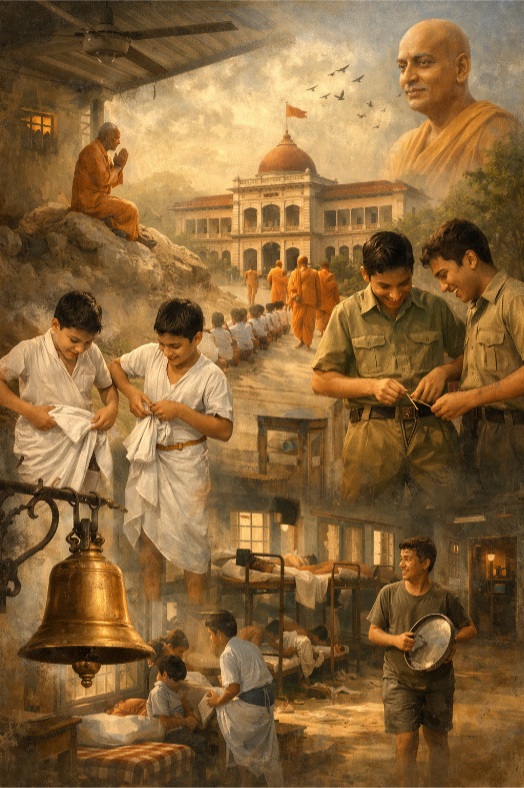
Speaking of uniforms, Vidyapith had its own milestones in fashion evolution. During our years there, we received two upgrades to our existing uniform. The dhoti, once reserved for special religious and cultural occasions, suddenly became our daily prayer attire when we entered Class 8 in 1989. We adapted to this new sartorial demand with surprising agility — a skill that continues to serve me well. To this day, I like to boast that I can tie a dhoti in under two minutes flat. It wasn’t unusual to see us frantically wrapping ours while shuffling forward in the prayer-hall queue, trying not to trip over our own creations. The other great fashion revolution came around the same time — the introduction of zippers in trousers for senior students. This might sound trivial today, but back then it caused quite a stir in our little world. While the juniors were still managing buttons on their shorts, we seniors had entered the modern age of zipper technology. Unfortunately, many of us had no prior experience with this innovation, and there were a few painful incidents involving sensitive parts of our anatomy before we learned the fine art of zipping up safely. In retrospect, even those misadventures were part of our “character-building” journey.
Life at Vidyapith was ruled not by clocks, but by the Bell — the great regulator of our existence. This was a world before the internet, before mobile phones, and even before most
of us had ever used a telephone. Our connection to the outside world consisted of the occasional handwritten letter from home, awaited with the anticipation of a festival. Someone once calculated that the bell tolled about twenty times in every twenty-four hours. Since students were not allowed watches, it dictated everything — from waking to eating, studying, praying, and sleeping. The day began with the rising bell at 5 a.m., followed by the prayer bell, the breakfast bell, and a whole symphony of others that carried us through to the sleeping bell at 9 p.m. The surest way to throw Vidyapith’s rhythm into chaos was to silence the bell — something close to heresy. This never happened in our time, but legend has it that a few daring successors once stole it to protest against the cruel fate of waking up at 5 a.m. in winter. Their triumph, however, was short-lived. The boy responsible for ringing the bell simply improvised, walking around the dormitories and banging a steel plate with a glass — waking everyone up anyway. If nothing else, it proved that innovation at Vidyapith was alive and well.
Old institutions are like family homes — you don’t notice their greatness until you leave. They are silent keepers of stories, invisible mentors that shape generations without ever raising their voice. Vidyapith had its share of legends that we accepted without question. One involved a ghost that supposedly haunted the generator room. Another concerned the origins of the “George Quarters,” which in our time served as a guest house, and its connection to World War II. The third, and most likely true, story involved Swami Sivananda, one of Sri Ramakrishna’s direct disciples. Near the gymnasium stood an outcrop of rock where Swami Sivananda was said to have stood and prayed. Since he did visit Vidyapith on multiple occasions, this story carried a particular weight of authenticity, even if we didn’t fully grasp its significance then.
What amazes me most, looking back, is not the strictness of Vidyapith life, but how thoroughly it prepared us for the world without our realizing it. We learned teamwork not from
management workshops, but from living together in close quarters. We learned resilience from report cards that didn’t always match our self-esteem. We learned endurance and
ingenuity by surviving sweltering summers without fans and bone-chilling winters without hot water. Our main grievance, however, wasn’t the absence of fans in the hostel rooms — it was the fact that the cows in the Goshala had them. Their large ceiling fans whirred lazily while we roasted in the dormitories. When we raised this with the Chief Warden, we were told, with great solemnity, that the cows were Holstein — European, not Indian — and therefore required fans for their delicate constitution. We, on the other hand, were Indian men-in-the-making, being forged in the Spartan fires of man-making and character-building education. It was hard to argue with logic of that magnitude.
The idea of “man-making” was not just a phrase we heard in assemblies; it was woven into our daily lives. It shaped our friendships, our habits, and even our dreams. For some of my closest friends, that ideal took a profound turn — three of them chose to dedicate their lives entirely to the spiritual path and joined the Ramakrishna Order as monks. I still remember the quiet conviction with which they made that decision, as if it were the most natural continuation of all that Vidyapith had taught us. For a while, my friends even believed that I might follow them down the same path. Looking back, I understand why — Vidyapith had left a deep spiritual imprint on all of us. Though my life took a different turn, a part of that inner discipline and devotion still anchors me to this day.
The spiritual influence of Vidyapith was never imposed; it was absorbed silently, through example. The monks who guided us lived lives of quiet dignity — disciplined yet deeply
compassionate. They taught us that strength was not aggression, humility was not weakness, and service was the highest form of self-expression. The morning prayers, the
resonant chanting of the Shanti Mantras, and the evening Arati created an atmosphere that shaped our inner rhythm long before we understood its meaning. Even the smallest rituals, repeated day after day, planted seeds of reflection and reverence that continue to grow quietly within.
As the years pass, one realizes that the true strength of institutions like Vidyapith lies in their ability to stay rooted while evolving. A hundred years — older than most of our grandparents, older even than the very idea of modern India. Few things last that long, and fewer still remain as alive. Its walls have witnessed empires fall, ideologies shift, and generations of students come and go. Yet the essence — that peculiar mix of discipline, laughter, and mischief — has never faded. Old institutions endure not because they resist change, but because they carry something timeless: a sense of belonging, of purpose, of shared memory.
Looking back now, I realize how much we owe to those formative years. The lessons we absorbed went far beyond textbooks. They shaped not just what we know, but who we
became. Today, as Vidyapith celebrates a hundred glorious years, one cannot but marvel at how this institution has quietly yet powerfully shaped generations of young minds. More than a school, it has been a living embodiment of Swami Vivekananda’s vision of “man-making and character-building education.” Its mission has never been confined to academic excellence alone; it has sought to nurture the head, the heart, and the hand in perfect harmony — producing individuals who think deeply, feel compassionately, and act selflessly.
Generations have changed, uniforms have evolved, and blackboards have given way to smart screens, but the essence remains unchanged — Vidyapith’s ability to inspire, to nurture, to challenge, and to shape. We, its alumni, are fragments of that spirit — scattered across the world, yet bound by the same morning chant that once began our day. Rooted in the timeless teachings of Sri Ramakrishna, Holy Mother Sarada Devi, and Swami Vivekananda, Vidyapith continues to imbue its students with spiritual strength and moral clarity. In a world often distracted by material pursuits, the school stands firm as a sanctuary of values — discipline, humility, truth, and service.
Its alumni — teachers, scientists, thinkers, leaders, and monks — carry with them the quiet strength and integrity instilled within those sacred walls, serving society not for recognition but from a sense of duty and gratitude. And as we look back on a hundred years of this noble institution, we see not merely a school, but a movement — one that continues to shape character, inspire excellence, and uphold the ideal of education as the highest form of service to humanity. Perhaps that is Vidyapith’s greatest gift to all of us — the realization that while we may have left its gates decades ago, Vidyapith never really left us. It lives quietly within — in our values, our laughter, our friendships, and in that inner bell that still rings, calling us to rise.