The Making of an Eye - A Collector’s Journey
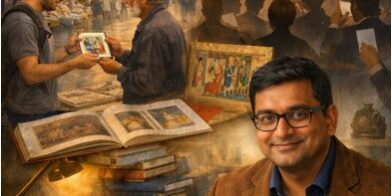
Author: Dr. Anirban Sadhu

The Unlikely Beginning
Certain passions arrive in one’s life with the quiet inevitability of destiny. Others appear more like eccentric visitors—unexpected, slightly mysterious, and met with raised eyebrows by everyone around you. My life as an art collector belongs firmly to the second category.
I grew up in middle-class India in the late twentieth century, in an environment where art collecting was not simply uncommon—it was almost conceptually absent. People collected sensible things. Fixed deposits. Stainless steel utensils. Government savings certificates. Perhaps stamps or coins if one had a hobby that was considered respectable and harmless.
But paintings?
Paintings were things one saw in museums, palaces, or perhaps in the homes of mysterious Europeans. They were not objects that ordinary middle-class families bought and displayed.
So when I began showing an unusual curiosity about art, the reactions around me were predictable. Friends were amused. Some were puzzled. A few suspected I had developed an unnecessarily complicated hobby.
Even my parents, who were otherwise extremely supportive of my academic ambitions, could not quite understand why anyone would spend time—and worse, money—on paintings.
In fairness to them, I was supposed to be studying science, pursuing a career in neuroscience, and eventually making my way into research and medicine. Art was not part of that trajectory.
Yet passions rarely consult career plans.
Twenty-Five Shekels in Tel Aviv
The first artwork I ever bought came into my life in the most modest way imaginable.
It was the year 1999. I was a student in Tel Aviv living on a scholarship and carefully rationing every shekel. Life was simple and meticulously budgeted.
One afternoon I came across a street artist selling small paintings. They were modest works, painted quickly and sold to passing pedestrians. One particular piece caught my attention. I stood there longer than necessary, looking at it.
The price was twenty-five shekels. Now twenty-five shekels was not an insignificant amount to me at the time. In fact, it was exactly my daily allowance.
Buying the painting meant that I would have to skip food that day. For reasons that still seem perfectly rational to me, I bought it. And so that evening a slightly hungry student walked back to his room holding his first painting.
I still own that piece today. In monetary terms it may not be remarkable, but in sentimental value it is priceless. It represents the moment when something irreversible began.
The Eye Begins to Form
For several years thereafter art remained an intermittent fascination. My primary life revolved around science. I moved to Switzerland to pursue my PhD and immersed myself in neuroscience.
Yet in the background another intellectual life was quietly unfolding.
During those early years in Switzerland I developed what can only be described as a voracious appetite for studying Indian art. Auction catalogues became bedtime reading. Museums became weekend destinations. Books on miniature painting, the Bengal School, and early modern Indian artists began to accumulate on my desk in growing piles.
My scientific training turned out to be unexpectedly useful.
Science teaches patience. It teaches careful observation. It teaches you to question assumptions and search for patterns.
These habits translate beautifully into art connoisseurship. Gradually the eye begins to develop.
You start noticing subtleties others miss—the rhythm of a brushstroke, the handling of pigment, the stylistic signature of a particular school. A painting begins to speak in ways it previously did not.
And slowly, quietly, confidence grows.
Discoveries in the Auction Rooms
Already in those early years I began making small discoveries.
At auctions—often obscure sales overlooked by serious dealers—I occasionally encountered works that had slipped through the cracks of the market. Sometimes the cataloguing was incomplete. Sometimes the attribution was uncertain. Sometimes the works simply did not fit the categories collectors were actively seeking.
Trusting instinct more than reputation, I bought them.
Some cost very little. Double-digit dollars in certain cases.
Time, however, has a way of rewarding patience.
A decade later, several of those acquisitions were sold for astonishing returns—sometimes approaching ten thousand percent. Even today that number sounds slightly surreal when I say it aloud.
But the real satisfaction was not financial.
It was intellectual.
It meant that the eye had learned something.
Miniatures, Modernists, and an Expanding Collection
As the years passed the collection began to grow—not only in size but in depth.
Initially it consisted largely of modern and early modern works. But gradually it expanded to include important Indian miniature paintings, one of the most refined artistic traditions of the subcontinent.
Miniatures demand a very different kind of looking. They are worlds within worlds—tiny universes of narrative, symbolism, and color compressed into astonishingly small spaces.
Studying them deepened my understanding of Indian art immensely. Each miniature is like a philosophical text written in pigment.
Over time the collection evolved into something broader—a dialogue between modern Indian painters, classical miniature traditions, and overlooked artists whose contributions deserved greater recognition.
When the Market Starts Listening
Gradually something unexpected began to happen.
Dealers started calling me—not to sell me paintings, but to ask for my opinion.
They would sometimes seek my validation on the authentication or attribution of a work they were considering. A painting might circulate quietly among collectors and dealers before entering the market, and someone would ask:
“What do you think?”
Those moments were deeply humbling.
They were also slightly terrifying.
Because I quickly realized that a careless word from me could influence fortunes. In the art market a single authoritative opinion can validate years of investment—or quietly destroy them.
A wrong word could make or break fortunes and disrupt investments.
One learns very quickly to speak carefully.
Yet those conversations also signaled something important.
The eye had earned a certain degree of trust.
The Day My Name Became Provenance
Eventually works from my collection began appearing at major international auctions.
The first time one was sold at Sotheby’s was an unforgettable moment. Watching the bidding unfold felt strangely personal. The lot performed spectacularly well.
Soon thereafter another work appeared at Bonhams. Then again at Sotheby’s.
But the true inflection point arrived in a subtle way.
One day I was browsing a Sotheby’s catalogue when I noticed a line beneath the description of a painting: “From the Private Collection of Dr. Anirban Sadhu”.
In the art world, provenance is everything. For an auction house like Sotheby’s to use a collector’s name as provenance means the collection itself has acquired credibility.
That was the moment I realized something profound had happened. The boy who once spent his entire daily allowance on a small street painting in Tel Aviv had become part of the provenance chain of the international art market.
Since then Sotheby’s has consistently used my name as provenance when works from my collection appear in their catalogues.
When Paintings Begin Their Own Journeys
The journey of these artworks has not been limited to auction rooms.
Some have found their way into institutional and public collections.
A painting by the great Goan artist Antonio Xavier Trindade from my collection was acquired by the government of Portugal for a museum associated with Goa and the Algarve.
Another painting from my collection now adorns the iconic Taj Hotel near the Gateway of India in Mumbai.
Every time I imagine visitors from around the world walking past it—perhaps pausing for a moment to look—I feel a quiet sense of satisfaction.
It is a reminder that collectors are not merely owners. They are temporary custodians.
The Eye of the Beholder
At some point collecting naturally evolved into writing.
Over the years I had accumulated countless notes—observations about artists, reflections on auctions, anecdotes about the strange psychology of collecting.
Eventually those notes grew into a book.
The Eye of the Beholder took nearly five years to complete. It became a substantial and richly illustrated volume exploring the philosophy of collecting, the stories behind works in my collection, and the mysterious relationship between the artwork and the viewer.
The title reflects a truth every collector eventually learns: beauty in art is not merely an inherent property of the object. It emerges through the cultivated perception of the viewer.
In the same year the book was completed, I established an art trading company under the same name—The Eye of the Beholder.
Soon afterwards a website followed, showcasing my collection and sharing essays and reflections about the works it contains.
What had once been a private passion gradually became a public conversation.
Occasionally academic scholars now visit our home to study particular works from the collection, using them as references for their research.
Watching that process unfold is one of the most rewarding aspects of collecting.
TEFAF Maastricht
Another milestone now lies ahead.
For the first time, an iconic work by the Sri Lankan modernist George Keyt from my collection will be exhibited at TEFAF Maastricht in 2026 by Aicon Gallery.
TEFAF is widely regarded as one of the most prestigious art fairs in the world. Collectors, curators, scholars, and museums from across the globe converge there each year.
The thought that a painting from my walls will soon be viewed by the international art world in such a setting is both surreal and deeply gratifying.
A Collector’s Quiet Satisfaction
In the world of art collecting we often hear legendary stories of great collections assembled with patience and vision. The Heeramaneck collection of Indian art remains one of the most celebrated examples.
I would never presume to compare myself to such giants.
Yet when I look back at the journey—from a hungry student buying a twenty-five shekel street painting to seeing works from my collection appear in Sotheby’s catalogues, museums, hotels, and international art fairs—I cannot help feeling that the story has been rather remarkable.
And perhaps that is the true magic of collecting.
It begins with curiosity.
It grows through patience.
And one day, almost unexpectedly, you discover that the world has begun to see through your eyes.
The eye of the beholder, after all, is not born.
It is slowly—and sometimes expensively—cultivated.
7th March 2026.
Basel.