The Teenager We Forgot: Why Nachiketa Still Matters
Author: Dr. Anirban Sadhu

There is something deeply moving about the story of Rama. Not because Rama performs miracles, reveals hidden cosmic powers, or speaks in impossible metaphysical riddles. Rama resonates because he does something far more difficult: he keeps his word. That sounds almost embarrassingly simple in the modern world, yet perhaps that is precisely why the figure of Rama continues to endure across centuries, languages, kingdoms, and civilizations. Rama is not worshipped merely because he was powerful; he is revered because he was trustworthy.
And trustworthiness is one of the rarest human qualities.
This is why Rama continues to live so powerfully in the public imagination of India and much of Southeast Asia. Thousands of years after the composition of the Ramayana, people still instinctively invoke Rama when speaking about honour, integrity, morality,sacrifice, loyalty, and righteous conduct. Politicians quote him, grandparents narrate history to children, villagers sing his name, philosophers analyze his dilemmas, and ordinary people continue to regard him as the ultimate example of someone who stood by his commitments under impossible circumstances. Rama’s life has become so deeply woven into civilizational memory that he no longer feels like merely a literary or scriptural character. He feels archetypal. Familiar. Permanent.
And yet, fascinatingly, Rama was not the first great defender of truth in Indian civilization.
Long before Rama walked through forests in exile, long before the moral dramas of Ayodhya unfolded, and long before the great narratives of kings, wars, and dynasties came to dominate Indian storytelling, there was another figure who embodied an equally uncompromising commitment to truth. Not a king. Not a warrior. Not even an adult.
A teenager.
His name was Nachiketa. He was a teenager, barely 13 to 15 in my understanding, though the exact age is not mentioned anywhere.
And perhaps one of the great ironies of Indian cultural memory is that while almost everyone remembers Rama, very few remember Nachiketa with the same emotional immediacy, even though his story contains one of the boldest and most intellectually courageous acts in all ancient literature. If Rama teaches us how to live honourably within society, Nachiketa teaches us how to confront truth itself. Rama exemplifies moral steadiness; Nachiketa exemplifies moral courage. Rama teaches the discipline of dharma; Nachiketa teaches the fearlessness of inquiry.
Perhaps that is why Nachiketa feels astonishingly modern.
We live today in an age of strategic ambiguity, curated personalities, corporate euphemisms, political doublespeak, and personal convenience masquerading as morality. People increasingly say things not because they are true, but because they are useful, fashionable, advantageous, or safe. In such a world, the idea of a human being standing firmly by his word—even under unbearable suffering—appears almost superhuman. And perhaps in a world where performance often replaces sincerity and convenience replaces conviction, we need to remember Nachiketa more than ever before.
Nachiketa may be one of the most remarkable adolescents in world literature, not because he rebelled emotionally—teenagers do that routinely—but because he rebelled morally. That is much rarer. His story appears in the Katha Upanishad, one of the great philosophical texts of the Vedic world – a part of the Krishna Yajurveda. Unlike the sprawling political landscapes of the Ramayana or the Mahabharata, the setting here is intimate, almost domestic. A father is conducting a yajna, a sacred ritual involving charity and offerings. Outwardly, everything appears respectable and pious. But the boy notices something deeply disturbing.
His father is cheating.
The cows being donated are useless: old, barren, exhausted animals that can neither yield milk nor bear calves anymore. The Upanishad describes them with devastating precision:
पीतोदका ज्ሾतृणा दु्ሾदोहा निरि्ाियााः ।
pītodakā jagdhatṛṇā dugdhadohā nirindriyāḥ
“Those who have drunk water for the last time, eaten grass for the last time, yielded milk for the last time, and lost their vitality.”
In modern language, it is virtue-signalling. Appear righteous publicly while quietly protecting self-interest privately. Cutting corners when nobody is watching. The ritual survives, but the spirit dies.
What makes the story extraordinary is not merely that Nachiketa notices the hypocrisy. It is that he refuses to normalize it. Most societies do not collapse because evil suddenly erupts into existence. They collapse because ordinary people gradually become comfortable with compromise. Human beings possess an astonishing ability to rationalize small ethical failures until entire cultures begin rewarding cleverness more than honesty.
But the teenager sees clearly.
And then comes one of the most powerful reflections in ancient literature:
अिुप्ብ यथा पू्ብे ्ቚनतप्ብ तथाऽपिे ।
anupaśya yathā pūrve pratipaśya tathāpare
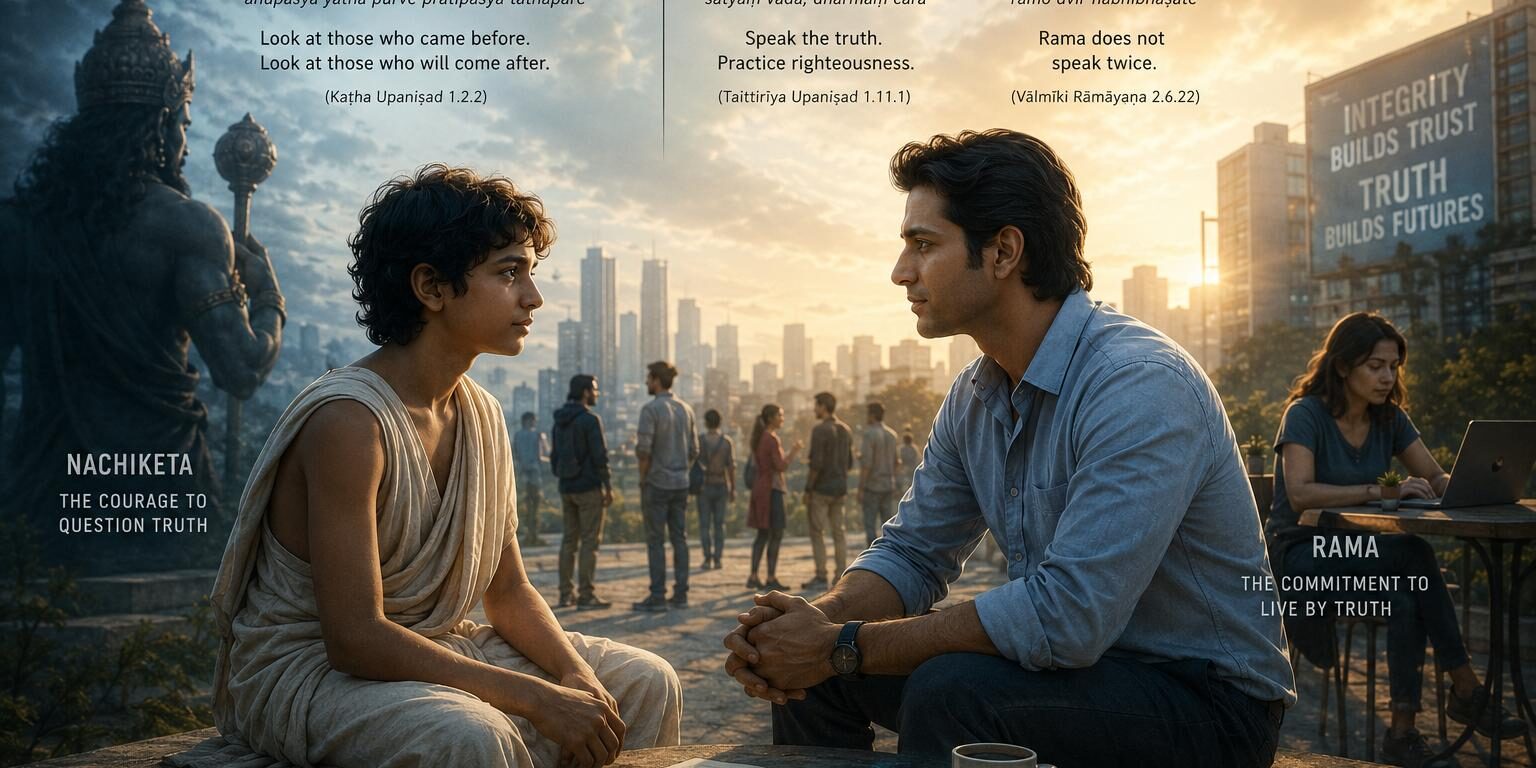
“Look at those who came before. Look at those who will come after.”
In a single sentence, the boy grasps civilizational continuity itself. Human conduct does not end with the individual. Every compromise echoes forward across generations. Every ethical failure becomes inheritance. Children learn morality not primarily from sermons but from observation. What one generation excuses, the next generation normalizes. What one generation normalizes, the next generation institutionalizes!
The boy understands something many adults never fully understand:
Ethics is contagious.
Disturbed by the hypocrisy, Nachiketa repeatedly asks his father, “To whom will you give me?” If genuine sacrifice is required, then offer something valuable. Offer me instead. Irritated and angry, the father finally blurts out: “I give you to Yama!”—the lord of death. In modern language, it roughly means: “Go to hell.”
Most children would dismiss such words as emotional exaggeration.
Nachiketa does not.
Because words matter.
Speech, in the Indian tradition, is never treated as disposable emotional noise. Words carry moral weight. Promises have consequences. Truthfulness is not merely social etiquette; it is woven into the structure of reality itself. The Taittiriya Upanishad famously declares:
स्ቓं ्ብद । ध्ां चि ।
satyaṃ vada, dharmaṃ cara
“Speak the truth. Practice righteousness.”
Without truthful speech, trust collapses. Without trust, institutions decay. Without integrity, civilization eventually fragments into cynicism and manipulation.
And this is perhaps the deepest link between Rama and Nachiketa. For both of them, speech is sacred. Rama honours his father’s promise even when it destroys his own future. He accepts exile without bitterness, protects those to whom he has pledged protection, and remains steadfast even in grief and adversity. That is why he became Maryada Purushottam—the supreme exemplar of ethical restraint, dignity, and honour. Rama’s greatness lies not merely in defeating Ravana. Countless heroes in mythology fight villains. Rama’s greatness lies in the astonishing consistency between what he said and what he did.
Once Rama spoke, his words became destiny.
The Ramayana repeatedly celebrates this quality. One famous verse describes Rama as:
िा्ाो नििाानििाषते ।
rāmo dvir nābhibhāṣate
“Rama does not speak twice.”
In other words: once Rama has spoken, his word is final.
Nachiketa embodies the same seriousness toward truth, but in a different form. When his father says, “I give you to Yama,” the boy takes the statement literally and proceeds toward death itself. Whether one interprets the story symbolically, psychologically, philosophically, or literally is secondary. The deeper point is unmistakable. This may be one of the earliest surviving stories in world literature about a teenager refusing to cooperate with hypocrisy and choosing truth over comfort.
That is an astonishingly modern idea.
In fact, Nachiketa may be one of the most modern figures in all ancient literature. Modern culture endlessly celebrates rebellion, but much contemporary rebellion is strangely shallow. It often seeks visibility more than truth, aesthetics more than wisdom, identity more than integrity. Nachiketa represents something far rarer: moral rebellion rooted in sincerity. He is not rebelling because rebellion is fashionable. He is rebelling because falsehood is intolerable.
And then the story reaches its philosophical climax.
When Nachiketa finally encounters Yama, the lord of death attempts to distract him with temptations: wealth, pleasure, luxury, music, long life, power, and worldly success. The teenager refuses them all. He asks only one question: what happens after death? What is ultimately real? What remains when everything temporary disappears?
The Upanishad captures this beautifully:
ि न्ብ्ቈेि तपाणीयो ्ािु्ቦाः ।
na vittena tarpaṇīyo manuṣyaḥ
“Man can never be satisfied by wealth.”
And elsewhere:
्ቦेय्ቐ ्ቚेय्ቐ ्ािु्ቦ्ाेताः ।
śreyaś ca preyaś ca manuṣyam etaḥ
“Before every human being stand two paths: the good and the merely pleasant.”
Imagine the audacity of this scene: a teenager standing before Death itself and saying, in essence, “I do not want comfort. I want truth.”
Not pleasure. Not status. Not entertainment. Truth.
This is why it is surprising that Nachiketa is not remembered in public imagination with the same force as Rama. Perhaps Rama became more emotionally accessible because his life unfolded within social dilemmas recognizable to ordinary people: family conflict, political duty, loyalty, grief, and sacrifice. Nachiketa belongs instead to the philosophical world of the Upanishads—quieter, subtler, more introspective, and more demanding. Rama teaches us how to conduct ourselves in society; Nachiketa forces us to confront
existence itself.
But perhaps the modern world urgently needs both.
We need Rama because public life desperately requires integrity. We need leaders whose words mean something, institutions that honour commitments, and individuals who do not abandon ethics under pressure. But we also need Nachiketa because modern civilization suffers from a different crisis altogether: distraction. We are drowning in stimulation yet starving for meaning. We possess more information than any previous civilization in history, yet often lack the courage to ask the deepest questions about truth, mortality, purpose, consciousness, and the nature of a meaningful life.
Nachiketa reminds us that the deepest questions of existence cannot be permanently silenced by entertainment.
Perhaps this is why the Indian tradition preserved these stories so carefully across
millennia. The word “Itihasa” itself is revealing:
इनत ह आस ।
iti ha āsa
“Thus indeed it was.”
But hidden within that phrase is a profound warning: if this is how human beings behaved then, this is how human beings will behave again. The Ramayana survives because human beings still struggle with ambition, betrayal, honour, exile, and duty. The Kathopanishad survives because human beings still fear death, tolerate hypocrisy, wrestle with meaning, and search for truth.
Technology evolves, but human psychology barely does. That is why these texts remain
alive.
And perhaps it is time that public memory made more room for Nachiketa alongside Rama—not instead of Rama, but beside him. Because civilizations require both kinds of moral force: the disciplined ethical steadiness of Rama and the fearless intellectual honesty of Nachiketa.
Rama teaches us how to keep our word. Nachiketa teaches us how to question falsehood. Rama teaches dignity in conduct. Nachiketa teaches courage in inquiry. Rama teaches responsibility toward society. Nachiketa teaches responsibility toward truth itself.
And maybe civilization survives only when both qualities exist together.