RĀTRI SUKTA: THE FIRST FEMINIST VOICE OF HUMANITY
Women, Wisdom, and the Forgotten Intellectual Power of Ancient India
Author: Dr. Anirban Sadhu
The Forgotten Fire
Most people today assume — almost instinctively — that ancient Indian or Vedic civilization must have been rigidly patriarchal, a world where men spoke, men taught, and men shaped the sacred. This assumption has been repeated so often that it now feels like common sense. But common sense is not always common truth. Because buried deep in the earliest layers of human literature — long before the rise of Athens, long before the Torah, long before Confucius shaped China — stands a woman’s voice, strong and unshaking, echoing across three millennia.
A woman who says “Aham.” I am!!
In one of the most ancient hymns known to humanity, preserved in the Rig Veda — the oldest living scripture in the world — a female sage steps forward and speaks as the cosmos itself. She does not whisper. She does not plead. She declares her presence, her intellect, her divinity.
अहं रुद्रेभिर्वसुभिश्चराम्यहमादित्यैरुत विश्वदेवैः।
अहं मित्रावरुणोभा बिभर्म्यहमिन्द्राग्नी अहं अश्विनोभि:॥
अहं सोमम् अहं त्वष्टारं दधाम्यहम् पूष्णं भगम् आहुः।
अहं दधामि द्रविणं हवेभ्यः सुप्रसन्ना मम यज्ञा यजन्ते॥
“Aham Rudrebhir vasubhiś carāmi…”
“I move with the Rudras and the Vasus…”
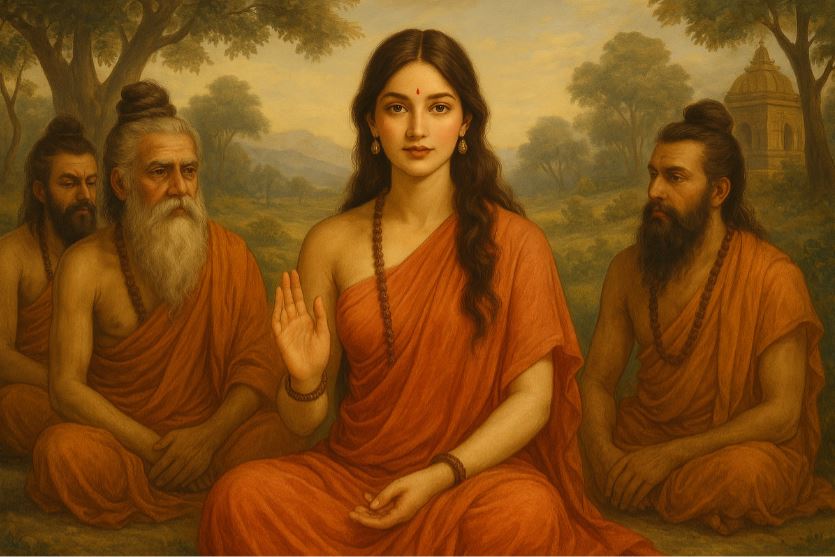
These are not the meek words of someone oppressed. These are the words of a woman who stands equal to gods. This woman was Vāk Ambhṛṇī, the daughter of the sage Ambhṛṇa. Her hymn — the Devi Sukta — is a thunderbolt thrown across time, a reminder that the feminine intellect, the feminine voice, and the feminine divine were not only accepted in ancient India — they were celebrated.
And she was not alone. Across Vedic and early Upanishadic memory walk other brilliant women: Gargi, who challenged India’s greatest philosopher in a royal court; Maitreyi, who
debated immortality with fearless clarity; Lopamudra, Ghosha, Apala, Vishvavara, and others who composed hymns still recited today. Their existence is not anomaly but
testimony — proof that the foundations of Indian civilization were not as male-dominated as modern retellings suggest.
Yet somehow, the world has forgotten this. Somehow, a civilization that allowed women to be philosophers, theologians, composers of scripture, a civilization that revered the Goddess as ultimate reality, is today simplistically labelled as “patriarchal.” This article is a journey into that forgotten memory — a rediscovery of the Ratri & Devi Sukta as perhaps the earliest feminist literature in the world, and an exploration of how women in Vedic India were entitled to high education, intellectual authority, and spiritual autonomy.
It is a story of female fire at the very dawn of civilization.
1. THE FEMALE SAGE WHO SPOKE AS THE COSMOS
Imagine a Vedic ritual gathering over 3,000 years ago. The Rig Veda — humanity’s oldest extant Sanskrit scripture — is being chanted around a sacred fire. Amid this predominantly
male world of priests and sages, a woman steps forward.
Her name is Vāk Ambhṛṇī. She raises her voice — not in submission, but in sovereignty. Her hymn, recorded as Rig Veda 10.125, known as the Devi Sukta or Vāk Sukta, begins with one of the most stunning first-person declarations in all of ancient literature:
अहं रुद्रेभिर्वसुभिश्चराम्यहमादित्यैरुत विश्वदेवैः।
अहं मित्रावरुणोभा बिभर्म्यहमिन्द्राग्नी अहं अश्विनोभि:॥
“Aham Rudrebhir vasubhiś carāmi…”
“I travel with the Rudras and the Vasus…”
In these opening words, she aligns herself with the greatest gods of the Vedic pantheon — Rudra, Varuna, Mitra, Indra, Agni, the Ashvins. But the hymn quickly becomes
more sweeping, more audacious:
अहं राष्ट्री संगमनी वसूनां चिकितुषी प्रथमा यज्ञियानाम्।
तां मा देवा व्यदधुः पुरुत्रा भूरिस्थात्रां भूर्यावेशयन्तीम्॥
“I am the Queen, the gatherer of treasures,
the first among those who are worthy of worship.”
“I bend the bow for Rudra… I give birth to the Father on the summit of the world.”
This is a woman declaring herself to be Cosmic consciousness. A source of divine power. The Mother of the universe — the energy behind the gods. Such a metaphysical
assertion — spoken by a woman — is unparalleled in ancient civilizations. In Greece, no female author stood at the level of Hesiod or Homer. In Mesopotamia, priestesses recited
hymns written by male scribes. In early Israelite tradition, prophetic books were written almost entirely by men. In China, Confucian texts offered little room for female theological
voice. But in India, the oldest surviving text in Indo-European languages preserves a woman’s voice as the embodiment of the universe. It is, without exaggeration, one of the
earliest feminist proclamations in human history.
2. THE RĀTRI SŪKTA AND THE FEMININE COSMOS
The Devi Sukta has a sister hymn: the Rātri Sukta (Rig Veda 10.127), dedicated to Rātri, the goddess of Night. Though the Devī Sūkta is more metaphysically expansive, the Rātri Sukta is equally significant in establishing the cosmic feminine.
“रात्र्यागात् हरिण्यग्नेव याती विशा स्थातृह्रीव वनान्यत्येति।
अथाब्रवीदुदिता सूर्यस्य छाएव यामनपतिर्नजानी॥”
And the famous invocation:
“अथाम्बा यामनुपश्य द्युम्ना रात्रि देवी नमसा वर्धमानाः।
वृणोति सृष्टा तमसो निवेशं प्राप्ता योनिं सवितुः सजोषाः॥”
Another key line often quoted:
“रात्रि व्यख्यद् वयम् अदीम घोषा
स्तुहि देव्या महि नामानि विश्वा।
याभि रात्र्यवसृजद् ज्योतिषा दधाति
तस्यै वयं नमताम् उद्यतायै॥”
Night appears as a protector of travellers; a guardian of villages; an embodiment of rhythm & order; and a comforter of the universe. In cultures where night symbolized terror, the Vedic world saw a goddess wrapping the cosmos in her gentle shawl of stars. Rātri is not feared; she is invoked, respected, adored.
Some traditions hold that the Rātri Sukta was also composed by a female rishika — possibly named Rātri. Whether this is historically precise or not, the theological orientation is clear: In the Vedas, the feminine is divine order, not chaos. Combined, the Rātri Sukta and Devi Sukta form a powerful early body of female-voiced spiritual literature — a rarity in the ancient world.
3. WOMEN SEERS OF THE RIG VEDA: THE FORGOTTEN AUTHORS
Vāk Ambhṛṇī was not an exception. The Rig Veda preserves hymns from more than two dozen female rishikas. Some of the most prominent include:
Lopāmudrā
A philosopher who composed Rig Veda 1.179 — a hymn of both spiritual depth and emotional intimacy.
Ghoṣā
Author of two hymns in Mandala 10, she prays to the Ashvins for healing and marriage, giving a rare personal female perspective.
Viśvavārā
Seer of Rig Veda 5.28, she offers oblations to Agni with confident authorship.
Apālā
Her hymn (Rig Veda 8.91) describes her healing encounter with Indra — again, uniquely narrated by a woman.
Śaśvatī, Romashā, Indrāṇī, Urvaśī , and others.
These women were brahmavādinīs — women who pursued lifelong Vedic study. They underwent upanayana, studied Vedic meters, grammar, rituals, philosophy. In today’s world,
calling them “philosophers” or “scholars” is accurate. They were not mythical symbols — they were real intellectuals.
4. MAITREYĪ AND GĀRGĪ: THE UPANISHADIC TITANS
The Upanishads — core philosophical texts of India — carry forward this legacy.
Maitreyi: The Philosopher of Immortality
In the Bṛhadāraṇyaka Upaniṣad, Maitreyi questions the sage Yājñavalkya on the nature of
the Self:
“किमहं तेन कुर्याम्?”
“Can wealth make me immortal?”
She then asks the immortal question:
“यद्यहं सम्पूर्णा पृथिवीमदयेयम् अर्थेन, न वै तेन अमृतत्वमशक्नोम् आगन्तुम्।
किमहं तेन कुर्याम् येनाहं न अमृता स्याम्?”
“If I were to obtain the whole earth full of wealth, I could not become immortal through it.
What shall I do with that by which I cannot become immortal?”
This is one of the greatest philosophical statements ever uttered by a woman in world literature. With this razor-sharp inquiry, she leads Yājñavalkya into one of the most profound
monologues on Brahman ever recorded. She is explicitly called a brahmavādinī — a woman expounder of Brahman.
Gargi Vachaknavī: The Challenger of Yājñavalkya
Gargi stands even taller in assertiveness. In King Janaka’s court, during a grand philosophical symposium, she challenges Yājñavalkya — India’s greatest knower of Brahman — with a series of metaphysical questions that stun the assembly.
“याज्ञवल्क्य, ये यदिदं सर्वं अप्सु प्रोतम्… तत् कस्मिन् پروतम्?”
“Yājñavalkya, that which they say is woven upon water — on what, then, is that woven?”
She then poses her most penetrating question:
“याज्ञवल्क्य, ब्रवीमि ते पृष्टिम् — यदिदं सर्वं द्यावापृथिव्योरन्तरिक्षे च प्रोतम्… किम् स्विद् तत्?”|
“Yājñavalkya, I ask you further:That which is woven across heaven, earth, and the space
between — what indeed is that?”
She presses him so deeply that he warns:
“मा मैमां पृच्छीः — मा अतिप्राक्षीः।”
“Do not question me further — do not overstep the limit.” A line rarely spoken in scripture — indicating her formidable intellectual power. A statement not of dismissal — but of
respect, even caution, toward her formidable intellect. Gargi’s presence in this scene is astonishing. Where else in the ancient world does a woman publicly debate metaphysics with the era’s foremost philosopher? Nowhere. Except in India.
5. EDUCATION FOR WOMEN IN THE VEDIC AGE
Contrary to common belief, women in early Vedic society could:
- Receive Vedic initiation (upanayana)
- Study sacred texts
- Participate in philosophical dialogue
- Compose hymns
- Perform rituals
- Live as independent scholars (brahmavādinīs)
Texts distinguish between:
- Brahmavādinīs — women devoted to Vedic learning
- Sadyovadhvās — women who studied until marriage
This classification alone proves that women’s education was institutionalized, not incidental.
6. THE FEMININE DIVINE: GODDESSES AS TEACHERS AND SOVEREIGNS
The Vedic tradition revered powerful goddesses:
- Uṣas — Dawn
- Prithvī — Earth
- Sarasvatī — Inspiration and Knowledge
- Rātri — Night
- Aditi — Infinity and Cosmic Mother
Later tradition elevated these into the grand Śākta vision of Śakti — the feminine energy that animates the cosmos. The Devi Sukta is the seed of this tradition. Only in India do we find:
- Knowledge personified as female (Sarasvati)
- Power personified as female (Durga)
- Wealth personified as female (Lakshmi)
- The cosmos personified as female (Adishakti)
This theological framework offered Indian women a symbolic legitimacy that many other civilizations lacked.
7. A CIVILIZATION MISUNDERSTOOD
Despite this heritage, the world often reads Indian civilization simplistically. Yes, India had periods of patriarchy. Yes, later social norms restricted women’s mobility. But the ancient
roots tell another story — one of female authority, female intellect, and female divinity. India produced Indira Gandhi, one of the world’s first female Prime Ministers, in 1966 — at a time when no major Western democracy had a woman leader; when Switzerland had not even granted women the right to vote (that came only in 1971).
How could a “patriarchal civilization” so naturally accept a woman leader of nearly half a billion people? Because the idea of female power — Shakti — is woven into India’s oldest
memory. The world often does not understand this, preferring tidy narratives over truth.
8. THE RĀTRI/DEVĪ SUKTA: EARLIEST FEMINIST LITERATURE
When Vāk Ambhṛṇī proclaims:
“Aham.” “I am.” She is not asserting ego — she is asserting existence, agency, divine sovereignty. Her hymn is philosophical, poetic, mystical, feminist (in the truest sense: a
woman defining reality in her own voice). There is no earlier surviving text in world literature where a woman speaks in the first person, claims cosmic authority, identifies herself with divine consciousness, instructs humanity, stands intellectually equal (or superior) to men. This is why the Ratri/Devi Sukta can rightfully be seen as the world’s first feminist scripture.
Conclusion: The Female Flame at the Dawn of Civilization
At the dawn of human thought, a woman spoke.She spoke not in fear, not in concealment, but in cosmic thunder. Her voice — the voice of Vāk, the voice of Ratri, the voice of
Devi — reminds us that Indian civilization was never merely patriarchal. It was always more complex, more layered, more open to feminine wisdom than simplistic interpretations allow.
By honoring these ancient voices, we reclaim a forgotten truth: Women in India were not silent in antiquity — they were luminous. And the fire they lit — in the Ratri Sukta, in the Devi
Sukta, in the dialogues of the Upanishads — still burns today.