The Molecular Biology of Looks
Why Every Face Is Unique, Every Body Unequal, and Why This Question Still Astonishes Us
Author: Dr. Anirban Sadhu
Modern biology has every reason to be confident. In little more than a century, it has moved from speculation to precision, from metaphor to molecule. We can read entire genomes, compare them across species, manipulate them with astonishing finesse, and watch cellular processes unfold in real time. We understand how cells divide, how organs form, how immune systems recognize threats, and how diseases emerge when molecular order falters. Few areas of human inquiry have advanced with such speed or authority.
And yet, amid all this progress, there remains a question so immediate and universal that it almost escapes notice: why does every living being look the way it does?
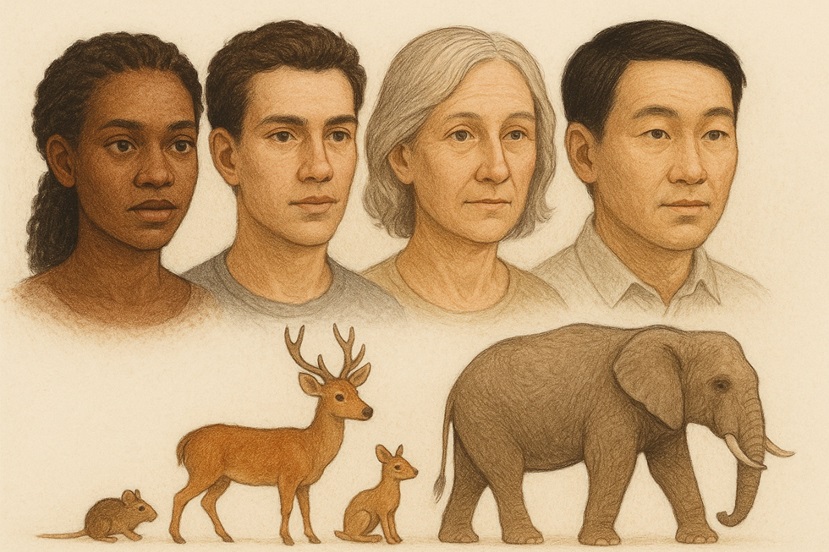
Every human who has ever lived looks different from every other. This is not a poetic claim but a biological fact. No two faces, no two bodies, no two patterns of movement or posture are ever exactly the same. Even identical twins — nature’s closest approximation to replication — are only nearly identical, never perfectly so. Their faces diverge subtly, their expressions acquire distinct signatures, and over time their bodies bear different marks of age, health, and experience.
Extend the question beyond humans and the puzzle deepens. Why is an elephant immense and a mouse minute, when both are mammals, built from the same molecular building blocks? Why do different species of deer resemble one another so closely — clearly belonging to the same visual family — yet differ so dramatically in size, strength, and presence? Why does evolution preserve recognizable forms while endlessly varying their details?
This is not a marginal curiosity. Appearance is biology made visible. It is the most immediate expression of life’s inner workings, the interface between molecules and meaning. And yet, despite its centrality, there is no well-defined discipline one might confidently call the molecular biology of looks. The question is scattered across genetics, developmental biology, evolutionary theory, anthropology, and even computer science, never quite claiming a unified home. That absence is itself remarkable — and revealing.
Seeing Difference Before Understanding It
Long before we understand biology, we recognize difference. Infants distinguish faces within days of birth. Adults recognize individuals instantly, even after decades of separation. A face glimpsed briefly in a crowd can trigger recognition faster than conscious thought. Appearance is processed with extraordinary efficiency, often bypassing language and deliberation entirely. There is something faintly overwhelming about this ubiquity of difference. We take it for granted, yet it is among the most statistically improbable outcomes imaginable. That millions of humans can be constructed from the same molecular components and yet remain visually distinct is not merely interesting — it borders on the astonishing.
The poet Rainer Maria Rilke once wrote, “For beauty is nothing but the beginning of terror, which we are still just able to endure.” The terror here is not fear but scale: the realization that endless individuality emerges from repetition. The same four nucleotides, the same twenty amino acids, the same cellular machinery — reused endlessly, yet never producing the same result twice.
Science is adept at explaining repetition. Variation is harder.
Form as a Question Older Than Biology
The mystery of appearance did not begin with genetics. Long before molecules were imagined, philosophers were preoccupied with form. Aristotle spoke of morphē — the organizing principle that gives matter its shape. For him, form was not accidental; it was the realization of purpose. A horse looked like a horse because that was what it meant to be a horse. For centuries, this essentialist view dominated thought. Species were assumed to possess fixed, ideal forms. Variation was treated as deviation, imperfection, or noise. Bodies were approximations of an underlying essence.
This worldview shattered with Charles Darwin. Evolution by natural selection replaced timeless forms with populations of individuals, each slightly different, each subject to survival and reproduction. Variation was no longer error; it was necessity. Without variation, evolution could not occur. Yet Darwin himself was uneasy. He could explain why variation mattered, but not fully where it came from or why it followed certain patterns. Why did variation cluster around recognizable forms? Why did bodies remain coherent as they changed? Why did evolution stretch and reshape forms rather than dissolving them entirely?
Darwin opened the door to the question of appearance — but did not close it.
Genes and the Seductive Simplicity of a Blueprint
The discovery of DNA tempted us into believing the mystery had finally been solved. Appearance, we assumed, must be “in the genes.” Identical twins looked alike because they shared the same genome; siblings resembled one another because they shared half their genes.
This intuition is not wrong — but it is profoundly incomplete. Genes do not encode faces the way architects draw buildings. There is no gene “for” a nose, a jawline, or a particular curvature of the cheek. Genes encode proteins, and proteins participate in networks of interactions that unfold over time. Development is not a script but a process — responsive, adaptive, and surprisingly sensitive to context.
A fertilized egg does not contain a miniature face waiting to expand. It contains the capacity to generate one, through a complex choreography of signals, movements, and constraints. Small differences early in development — timing, position, molecular fluctuations — can be amplified into visible differences later. This is why identical twins are never truly identical. The genome sets boundaries, but within those boundaries, development improvises. To be born is already to be different.
Goethe, Development, and Frozen Motion
Few thinkers grasped this dynamic view of form more intuitively than Johann Wolfgang von Goethe, who moved effortlessly between poetry and natural science. “The form,” he wrote, “is a frozen movement.” What we perceive as a stable face or body is, in reality, the arrested outcome of a long developmental motion.
Beneath every visible feature lies history: cell divisions, migrations, mechanical tensions, chemical gradients, and feedback loops that once flowed and now rest. Appearance is not a static fact but a dynamic result — a moment in an ongoing process briefly held still. This insight anticipates modern developmental biology, which shows that form emerges from interactions rather than instructions. The same genes can produce different outcomes depending on when and where they are activated. The genome does not dictate; it negotiates.
The Polygenic and Distributed Nature of Looks
One reason the molecular biology of looks has resisted consolidation is that appearance is profoundly polygenic. Traits like height, facial structure, body proportions, and skin tone are influenced by thousands of genetic variants, each contributing a minuscule effect. Genome-wide association studies have identified regions associated with particular features, but these explain only fractions of the total variation.
There is no master gene for beauty, no central switch for stature. Appearance arises from collective behavior, not singular causes. This distributed causality frustrates simple storytelling. It does not lend itself to dramatic discoveries or single explanatory mechanisms. But it also reveals something profound: individuality is not localized. It is emergent.
Epigenetics and the Memory of Becoming
Beyond genes lies another layer of influence: epigenetics. Chemical modifications to DNA and its associated proteins influence which genes are active, when, and where. These modifications are shaped by development, environment, nutrition, stress, and chance. Epigenetics introduces a subtle but transformative idea: appearance is not only inherited; it is remembered. The body carries molecular traces of its developmental journey. Two identical genomes can diverge because they are read differently over time. This helps explain why identical twins grow less similar as they age, why early-life conditions influence adult stature, and why bodies bear the imprint of experience long after the experience has passed.
Appearance is biography written in flesh.
Size, Scale, and the Puzzle of Magnitude
If faces puzzle us, size astonishes us. Why is an elephant immense and a mouse minute? The difference is not merely one of scale but of organization. Larger animals live longer, move differently, and experience time at a different rhythm. Yet at the molecular level, they are built from the same components.
Growth is regulated by networks of genes and hormones that sense nutrition, cellular stress, and density. Evolution modifies these regulatory systems rather than inventing new ones. The result is astonishing consistency within species and dramatic divergence across them. A mouse does not grow into a small elephant, no matter how ideal its conditions. Growth is tightly constrained by evolutionary history. William Blake once wrote of seeing “a world in a grain of sand.” Modern biology might say the same of a mouse: compressed within its small body is the same molecular universe that unfolds more slowly and more massively in an elephant.
Family Resemblance Without Identity
The case of deer illustrates another subtle principle. Red deer, roe deer, elk, and moose share a recognizable aesthetic — a family resemblance that transcends size. This reflects a conserved body plan inherited from a common ancestor.
Evolution tends to modify existing forms rather than invent new ones. It stretches, compresses, thickens, and thins. Limbs elongate, necks extend, antlers diversify. The result is variation within constraint. This balance between sameness and difference is one of evolution’s quiet triumphs. It explains why species remain recognizable even as they diverge, why appearance evolves slowly even when size changes dramatically.
Why This Question Still Lacks a Name
Why, then, has the molecular biology of looks not emerged as a unified discipline?
Part of the answer lies in fragmentation. Genetics, developmental biology, evolutionary theory, anthropology, and computational modeling each address fragments of the puzzle, but no single framework binds them. There are also cultural hesitations. Appearance has long been entangled with race, aesthetics, and social hierarchy — areas where science must tread carefully. There is also a methodological challenge. Appearance is multidimensional, continuous, and context-dependent. It resists clean measurement. It is easier to study a disease endpoint than a face. Yet none of this diminishes the legitimacy of the question. If anything, it highlights its depth.
Appearance as Emergence
Perhaps the deepest reason this problem endures is that appearance is emergent. It arises from interactions across scales: molecules influence cells, cells shape tissues, tissues define bodies, and bodies move through environments. No single level contains the answer. This demands a kind of explanation biology is only beginning to embrace — one that accepts complexity without surrendering rigor.
The Final Wonder
Every face is a biological event that has never occurred before and will never occur again. Every body is a negotiation between inheritance and history. Genes provide possibility, development gives direction, and time leaves its trace.
Octavio Paz wrote, “We are made of time.” Appearance, then, is time made visible — momentarily stabilized, briefly recognizable, and endlessly varied. That we do not yet have a complete molecular biology of looks is not a failure of science. It is an invitation: to integrate disciplines, to ask deeper questions, and to recover a sense of wonder that was never truly lost — only waiting to be noticed.