There are, broadly speaking, two methods by which a young person may be introduced to civilization.
The first consists of exposing him to the world in all its bewildering plenitude—its commerce, politics, entertainments, ambitions, distractions, scandals, and advertisements for products nobody requires but everybody somehow purchases.
The second consists of sealing him behind monastic walls and permitting reality to reach him only after it has passed through several layers of spiritual filtration.
My childhood belonged emphatically to the latter category.
Until the age of sixteen I lived in what was, for all practical purposes, a monastery that happened to contain children.
Officially, it was a school. Technically, it was a boarding institution. Administratively, it possessed classrooms, teachers, laboratories, libraries, examination halls, and all the other apparatus conventionally associated with education.
Spiritually and psychologically, however, it was a small republic governed by monks, bells, and ancient ideals.
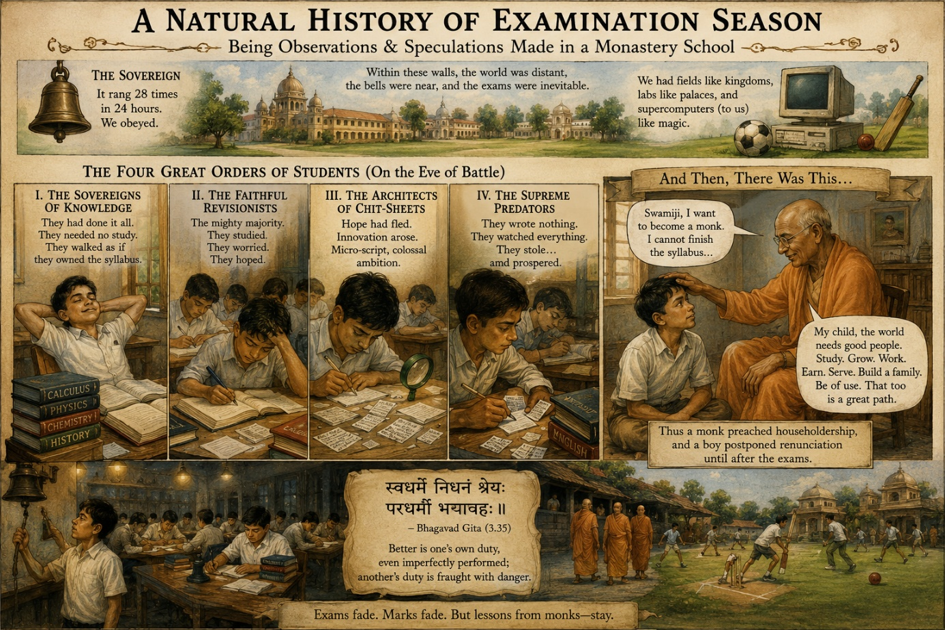
The bell, in particular, deserves mention. The bell was not merely an instrument. It was a metaphysical principle. It rang twenty-eight times every twenty-four hours and regulated human existence with a thoroughness that would have impressed both Plato and the Prussian General Staff.
It informed us when to awaken, when to bathe, when to pray, when to study, when to exercise, when to eat, when to return to study, when to stop studying, and finally when to surrender consciousness altogether and retire to bed.
The external world remained largely hypothetical.
There were no mobile phones because humanity had not yet devised a method by which every individual could carry a portable apparatus for distraction in his pocket.
There was no internet. There was no social media.
Television existed somewhere beyond the horizon, like a distant empire whose existence one accepted on authority but never directly experienced.
We knew astonishingly little about contemporary events. Governments could rise and fall. Presidents could be elected or assassinated. Wars could begin. Peace treaties could be signed. Entire economies might collapse. We remained serenely unaware.
Had Martians invaded Europe, the information would probably have reached us sometime after the half-yearly examinations.
Yet our lives were not deprived. Indeed, in many respects, we were extravagantly privileged.
Our playing fields stretched toward the horizon with an almost feudal abundance. We possessed cricket grounds, football fields, gymnasiums, libraries, laboratories, and equipment of a quality that many fashionable urban schools would have regarded with envy.
Most remarkably, we had personal computers at an age when large sections of the Indian population still regarded computers as mysterious Western devices capable of either solving all human problems or causing them.
Academically, the institution was formidable. A number of my classmates possessed intellects of such alarming potency that ordinary students regarded them with a mixture of admiration, suspicion, and theological curiosity.
One boy, I distinctly recall, solved calculus problems while the rest of us were still trying to figure out whether algebra was mathematics or some kind of striped animal.
At an age when most children were drawing cricket bats in the margins of their notebooks, he was discussing mathematics that appeared to have been imported directly from another dimension. At some point NASA took an interest in him. This did not surprise anybody.
Indeed, there was a widespread feeling that NASA had merely recognised what we already knew: namely, that the boy was operating under different standards. For the rest of us—the ordinary infantry of the educational system—examinations inspired somewhat less confidence.
The evening before a major examination was among the most fascinating spectacles in the natural history of adolescence.
As twilight descended upon the hostel, a profound transformation occurred. The atmosphere acquired the solemnity of a monastery preparing for judgment day. Corridors grew quieter. Conversations became sparse. Pages turned feverishly. Heads bent over books. Anxiety floated through the dormitories with almost sacramental intensity.
Over time I concluded that the student body divided itself into four distinct civilizational strata. The first category was tiny in number but immense in confidence. These were the Olympians. They had completed their preparation long ago. The syllabus lay conquered beneath their feet. Formulae obeyed them. Historical dates arranged themselves neatly in their memories. Chemical equations balanced voluntarily in their presence.
While ordinary students revised frantically, these creatures wandered about with expressions of mild amusement, as though examinations were charming social customs observed primarily for the entertainment of lesser mortals.
The second category comprised the overwhelming majority, among whom I must honestly place myself. These were the respectable middle classes of academia.
They studied earnestly, worried continuously, revised obsessively, forgot strategically, and prayed intermittently. Theirs was the ancient path of diligence combined with panic.
The third category had reached a different conclusion. Having surveyed the available evidence, they determined that conventional preparation no longer offered a realistic prospect of success. Perhaps they had postponed study. Perhaps they had misplaced several months. Perhaps they had simply discovered too late that hope, unlike energy, is not conserved.
In any event, they abandoned scholarship and embraced engineering. These were the architects of the underground economy. They manufactured cheat sheets. Not ordinary cheat sheets, but masterpieces of miniaturized information technology. Entire chapters appeared upon fragments of paper scarcely larger than postage stamps.
Definitions, equations, diagrams, historical dates, and literary quotations were compressed into dimensions that would have impressed medieval manuscript illuminators. The labour involved was extraordinary. Indeed, had these young men devoted the same effort to studying, they might have passed honestly. But such observations are easy in hindsight.
The fourth category occupied the apex of the evolutionary pyramid.
These were not merely lazy. Laziness is too pedestrian a word. These were strategic minimalists. Philosophers of delegated effort. Visionaries of non-participation. They had transcended even the labour involved in preparing cheat sheets.
Why manufacture when one could acquire? Why toil when one could appropriate? Why create intellectual capital when one could simply nationalize it?
While the third category laboured deep into the night producing their illicit manuscripts, the fourth category observed with the detached interest of venture capitalists evaluating potential acquisitions. Then, when the appropriate moment arrived, they simply stole the finished product.
One particular incident remains vivid after all these years.
A member of the third category had spent the entire evening manufacturing an extensive portfolio of examination contraband. Hours of labour had gone into the enterprise. Every likely question had been anticipated. Every conceivable answer had been prepared.
His collection represented a substantial investment in both ingenuity and dishonesty. Unfortunately, it also attracted the attention of a practitioner from the fourth category.
Sometime during the night the entire collection vanished. The owner discovered the catastrophe shortly before the examination.
An uproar ensued. Accusations flew through the hostel with the velocity of artillery shells. Moral indignation suddenly appeared in abundance. The alleged thief, however, remained perfectly tranquil. Indeed, he exhibited the serenity usually associated with advanced meditators and retired diplomats.
Finally the victim confronted him.
"You stole my chits."
The accused reflected briefly.
"Possibly."
"I know you stole them."
"That is one interpretation."
"I shall complain."
At this point the accused smiled.
It was not a large smile. It was not even a particularly clever smile. It was merely the smile of a man who had grasped a crucial procedural detail.
"Please do."
A silence followed.
The victim suddenly recognised the difficulty. Any official complaint would necessarily begin with an explanation of how he had acquired several dozen expertly prepared cheating aids. The legal position was delicate. He was effectively proposing to report the theft of evidence against himself. It resembled a burglar reporting the disappearance of his burglary tools.
The case collapsed immediately. Justice, deprived of jurisdiction, retired from the field. The stolen chits proceeded toward the examination hall under new management.
Yet the greatest story of examination season concerned neither scholarship nor cheating. It concerned renunciation.
One year a particularly anxious young boy, confronted by the terrifying discrepancy between the available time and the unfinished syllabus, arrived at a conclusion of breathtaking originality.
He decided to become a monk.
Not eventually. Not after philosophical reflection. Not after years of spiritual practice. Immediately.
The matter was perfectly logical. Monks, after all, did not sit for school examinations.
Accordingly, he approached one of the senior monks of the Order and announced his desire to renounce the world. The monk was a venerable soul, advanced in age, wisdom, and compassion.
He listened patiently.
Then he seated the child beside him, gently ran his fingers through the boy's hair, and began to speak. What followed remains one of the most extraordinary conversations I have ever witnessed.
The monk did not encourage renunciation. Nor did he dismiss the child.
Instead, he explained the dignity of ordinary life. He spoke of study, responsibility, work, family, service, and usefulness. He told the boy to grow into a good man, earn an honest living, support others, and contribute to society.
Thus occurred one of the more delightful inversions in religious history. A lifelong monk spent an afternoon persuading a frightened schoolboy of the virtues of marriage, parenthood, and financial stability.
The boy was advocating renunciation. The monk was advocating worldly engagement. Neither wished to occupy the role conventionally assigned to him.
At the time we found the entire episode amusing. Today I find it moving. For only much later did I realise the extraordinary privilege that had surrounded us.
We lived among men who had voluntarily surrendered wealth, ambition, comfort, prestige, and worldly success in pursuit of something they regarded as higher.
As children we scarcely noticed.
Children quickly become accustomed to miracles.
The monks inspected dormitories, supervised prayers, settled disputes, encouraged studies, and occasionally rescued young aspirants from premature monasticism brought on by examination anxiety.
Only decades later did their significance become apparent.
I have forgotten almost every mark I ever obtained. I remember very few examination questions. The precise contents of those famous stolen chits have vanished irretrievably into the abyss of history.
Yet I still remember that monk and that frightened little boy. Perhaps because, hidden beneath all the comedy, there was a truth.
The bells taught us discipline. The teachers taught us knowledge. The examinations taught us humility. But the monks taught something deeper, though we scarcely understood it then.
As the Bhagavad Gita says:
स्वधर्मे निधनं श्रेयः परधर्मो भयावहः ॥
Better is one's own duty, even imperfectly performed; another's duty is fraught with danger.
Bhagavad Gita 3.35
The terrified child wished to escape into the life of a monk.
The monk gently directed him back toward the life that was meant to be his.
And that, I suspect, was one of the finest lessons taught in that monastery—though it never appeared on any examination paper.