Among the most persistent stories inherited from the ancient world is the story of a great flood. It appears in Mesopotamia, in the Hebrew Bible, in the Vedic tradition of India, and in numerous other cultures across the world. The similarities between these stories have been noticed for generations: a catastrophic inundation, the destruction or near-destruction of humanity, a chosen survivor, a vessel, the preservation of life, and the eventual emergence of a renewed human world.
But one element deserves perhaps more attention than it usually receives.
In several of the most important flood traditions, the catastrophe is known in advance.
The survivor does not simply happen to escape the flood. He is warned.
And, even more strikingly, he is warned sufficiently far in advance to undertake preparations of considerable complexity.
In ancient Mesopotamia, Utnapishtim—or, in an earlier version of the tradition, Atrahasis—is warned by the god Ea or Enki that a catastrophic flood is coming. He is instructed to construct a vessel capable of preserving human beings and animals.
In the Hebrew Bible, Noah is explicitly informed by God that the earth is to be overwhelmed by water. He is given detailed instructions for constructing the Ark.
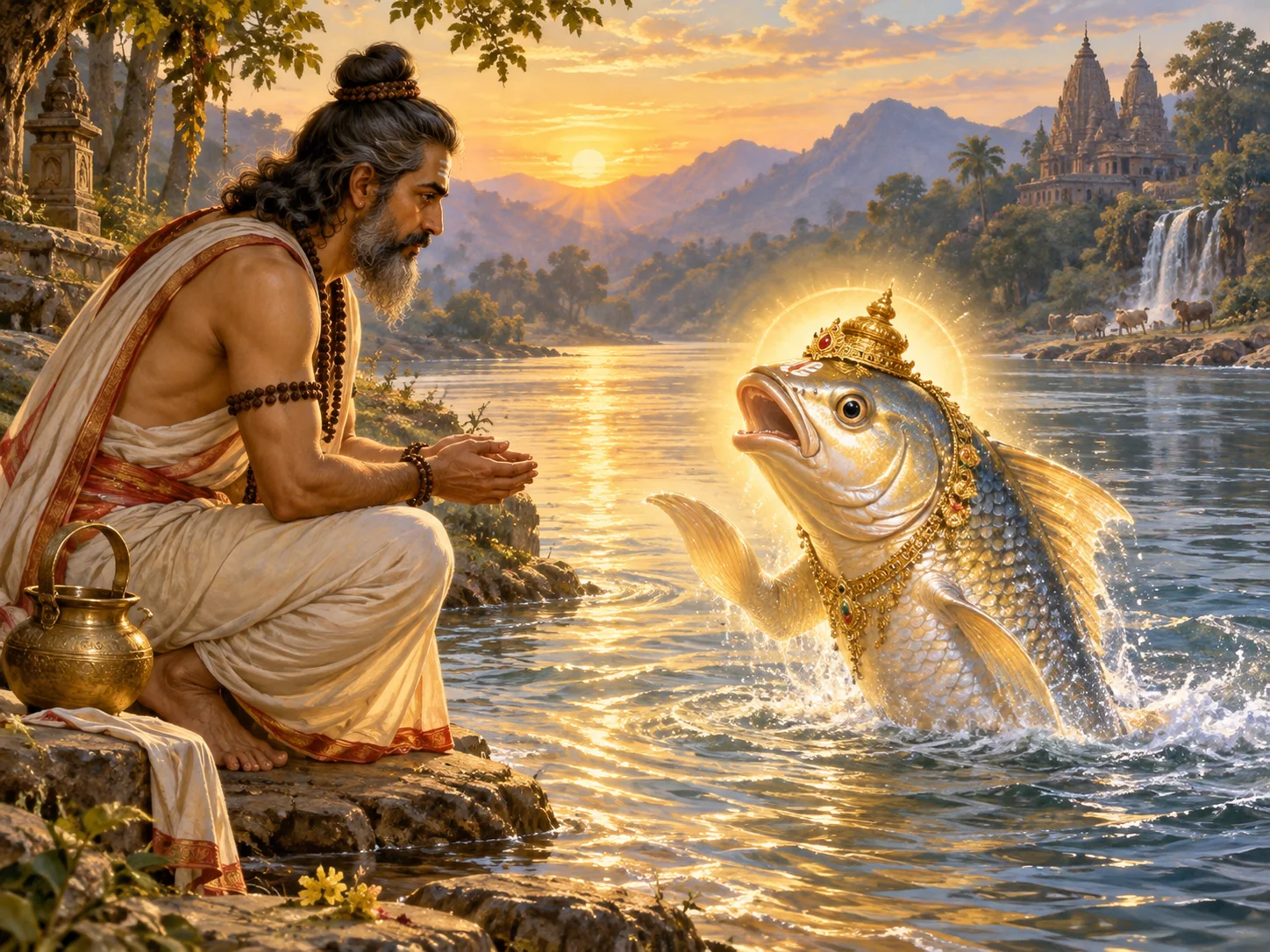
In ancient India, Manu is warned by a mysterious fish that a flood will destroy living creatures. The fish tells him that in a particular future year the flood will come and instructs him to prepare a ship. The earliest surviving version of this story occurs in the Śatapatha Brāhmaṇa. There, the fish says essentially: a flood will carry away these creatures; prepare a ship, and when the waters rise, enter it.
Whatever one thinks about the historical basis of these stories, the structure is remarkable.
It is not merely: There was a flood and somebody survived.
It is: There was a flood. Someone knew it was coming. The knowledge was communicated. A vessel was built. Life was preserved.
That distinction opens an extraordinary question.
The recurring pattern of foreknowledge
Consider the three narratives side by side.
In the Mesopotamian tradition preserved in the Epic of Gilgamesh, the gods decide to destroy humanity by flood. Ea covertly warns Utnapishtim and tells him to build a boat. Utnapishtim acts before the storm begins. His family, craftsmen and living creatures enter the vessel before the catastrophe.
In Genesis, Noah is warned before the Flood and is given specifications for constructing the Ark.
And in the Śatapatha Brāhmaṇa, Manu's warning is especially intriguing because the fish indicates that the event will occur not immediately, but in a specified future year. Manu therefore has time to prepare his vessel. When the flood rises, the fish returns and guides him to safety.
The details differ enormously.
The theology differs.
The cultural meanings differ.
Yet the narrative architecture remains unexpectedly similar:
foreknowledge → warning → preparation → vessel → inundation → survival → renewal.
It is tempting to dismiss this as simply a literary motif. Perhaps it is. Once one culture develops a compelling narrative, stories can travel astonishing distances and survive for millennia.
But another possibility deserves consideration.
What if some of these traditions preserve, however distortedly, memories of real environmental catastrophes?
If so, the most intriguing question is no longer simply:
What caused the flood?
It becomes:
How could anyone have known that it was coming?
________________________________________
The world really did drown after the Ice Age
The geological background is not speculative.
During the Last Glacial Maximum, roughly 20,000 years ago, enormous quantities of Earth's water were locked inside continental ice sheets. Global sea level stood approximately 120–130 metres below its present level.
The geography of the planet therefore looked radically different.
Large areas that are now seabed were habitable land.
Britain was connected to continental Europe.
Southeast Asian islands formed part of the enormous landmass known as Sundaland.
The Persian Gulf was largely dry land.
Large stretches of what are now the continental shelves of India, Arabia, Southeast Asia and the Mediterranean were exposed.
Then the Ice Age ended.
Over thousands of years, the ice sheets retreated and oceans rose approximately 120 metres.
But this rise was not perfectly gradual.
There were periods of dramatically accelerated melting.
The best-known is Meltwater Pulse 1A, approximately 14,600 years ago.
Recent estimates indicate that global mean sea level may have risen somewhere around 10–20 metres in perhaps 500 years or less during this episode. A 2025 reconstruction describes a complex cascade of ice loss involving Laurentide, Eurasian and West Antarctic ice, while earlier reconstructions disagree over the exact proportions contributed by different ice sheets.
A rise of 20 metres over several centuries is not a Hollywood-style wall of water engulfing the planet overnight.
But for people inhabiting low-lying coastal plains, river deltas and continental shelves, it would have been transformative.
Places inhabited for generations would disappear.
Coastlines would retreat.
Freshwater systems could become saline.
Estuaries would move inland.
Entire landscapes associated with ancestors, hunting territories and sacred places could vanish beneath the sea.
And deglaciation was not necessarily experienced only as gradual sea-level rise.
Large glacial lakes could burst.
Ice dams could collapse.
Coastal regions could experience tsunamis.
River systems could change suddenly.
Local communities might therefore experience truly catastrophic floods against the background of a world in which sea levels were already steadily rising.
That makes it entirely reasonable to ask whether ancient flood traditions may contain extraordinarily distant cultural memories of the end of the Ice Age.
We cannot presently demonstrate that they do.
But the geological world in which such memories could have originated certainly existed.
________________________________________
Zecharia Sitchin and the Antarctic hypothesis
Zecharia Sitchin proposed a much more dramatic interpretation.
Sitchin argued that the Biblical and Mesopotamian Deluge reflected a genuine global catastrophe around the end of the last Ice Age. He suggested that instability of the Antarctic ice sheet culminated in a massive slippage of ice into the ocean, producing an enormous tidal wave.
His official archive summarizes his position as a Deluge caused by a major Antarctic ice-sheet slippage associated with the abrupt termination of the Ice Age.
There is an important distinction to make here.
Sitchin's specific reconstruction is not the accepted scientific explanation of the Biblical Flood, and there is no established geological evidence for a single Antarctic ice sheet suddenly sliding wholesale into the ocean and creating one global tsunami corresponding to Noah's Flood.
However, the broader physical principle underlying his intuition is not absurd.
Ice sheets really can become unstable.
Marine-based ice sectors can retreat rapidly.
Their collapse can contribute very large amounts of water to the world's oceans.
The geological evidence for episodes of rapid deglaciation is robust.
Research on Meltwater Pulse 1A suggests that vulnerable sectors of major ice sheets could collapse over only a few centuries. One reconstruction of the Eurasian Ice Sheet concluded that major marine sectors lost enormous volumes of ice over approximately 300–500 years.
Modern research also continues to debate how much Antarctica contributed to these episodes. Recent models differ substantially regarding the exact source distribution.
So Sitchin's precise scenario remains speculative.
But the more general proposition— that rapid destabilization of Ice Age ice masses could cause dramatic flooding and sea-level change — is entirely consistent with modern glaciology.
And that brings us back to the extraordinary question of warning.
________________________________________
If the catastrophe was natural, how could anyone predict it?
Suppose, purely as a thought experiment, that one or several flood traditions preserve memory of an actual Late Pleistocene catastrophe.
Suppose further that the tradition is correct in remembering that some people received advance warning.
What kinds of knowledge would have been required?
Here we have to resist a tempting assumption.
It does not necessarily follow that predicting a flood would require satellites.
Humans can recognize environmental warning signs without advanced instruments.
A society living near glaciers might observe:
• unusually rapid ice retreat,
• increasing meltwater,
• changes in river discharge,
• growing glacial lakes,
• unusual cracking or movement of ice,
• repeated minor floods,
• changes in ocean level,
• seismic activity,
• abnormal tides,
• changes in animal behaviour.
Communities living for generations in the same environment can accumulate extraordinarily detailed empirical knowledge.
A modern meteorologist possesses instruments.
A traditional society possesses generations of observation.
Those are not equivalent, but traditional environmental knowledge should not be underestimated.
A community might recognize that a glacial lake was approaching failure, for example, without understanding glaciology mathematically.
Likewise, people living downstream from an ice dam might learn from previous events that certain combinations of temperature, meltwater and cracking preceded catastrophic floods.
In that case, “the gods warned us” could be the mythologized memory of something much more human:
specialists recognized environmental danger and ordered evacuation.
Priests, astronomers, elders or other knowledge-holders might subsequently become divine figures in collective memory.
________________________________________
But what if the warning was much more precise?
The problem becomes more intriguing if we take the ancient narratives literally.
Manu is not merely told that floods sometimes happen.
He is told that in a particular year, a flood will come.
Utnapishtim receives enough warning to build a substantial vessel.
Noah likewise receives extensive construction instructions.
If these details preserve actual memories rather than later narrative elaboration, we would be dealing with something more sophisticated than noticing rising water.
Predicting the catastrophic collapse of a remote ice mass would require understanding:
• the condition of the ice sheet,
• rates of melting,
• structural instability,
• temperature trends,
• oceanic conditions,
• perhaps seismic conditions,
• and the downstream consequences of failure.
Today we study those things using:
satellites, radar, GPS, ice cores, ocean buoys, remote sensing, seismic instruments and computer models.
Therefore the question becomes provocative:
Could a prehistoric society somehow have possessed an observational system vastly more sophisticated than we currently attribute to it?
There is presently no archaeological evidence for prehistoric satellites, advanced remote sensing or an industrial technological civilization before the end of the Ice Age.
That must be stated plainly.
Nothing presently discovered requires such an explanation.
But there is another possibility between the two extremes of “primitive people guessed” and “an advanced civilization had satellites.”
Perhaps the ancient world possessed networks of observation and knowledge transmission that we have underestimated.
________________________________________
A civilization does not need satellites to monitor a continent
Imagine a widely connected Late Pleistocene culture.
Not an industrial civilization.
Not spaceships.
Not electronics.
Instead imagine:
• coastal navigation,
• astronomical observation,
• permanent or semi-permanent settlements,
• long-distance trade networks,
• specialist knowledge-holders,
• messenger systems,
• accumulated records maintained orally or symbolically,
• generations of climatic observations.
Such societies could potentially recognize patterns over enormous territories.
Information might travel between groups.
One community reports unusual ice retreat.
Another reports rising coastal waters.
Another records abnormal river levels.
Knowledge-holders compare these observations.
A warning emerges.
To us, centuries later, this might become:
“Ea knew that the Flood was coming.”
Or:
“God warned Noah.”
Or:
“The fish told Manu that the Flood would come in such-and-such a year.”
Myth compresses complexity.
Institutions become gods.
Processes become events.
Centuries become days.
Knowledge becomes revelation.
That possibility is much harder to dismiss than prehistoric satellite systems because we already know that prehistoric humans maintained surprisingly extensive networks of exchange.
________________________________________
The fish of Manu becomes particularly interesting
The Indian version contains an intriguing symbolic feature.
The warning comes from a fish.
Normally this is interpreted religiously. In later Hindu traditions the fish becomes Matsya, an incarnation of Viṣṇu.
But imagine reading the story from an environmental perspective.
What creature would be associated most directly with changes in water?
A fish.
Fish populations respond dramatically to:
• salinity,
• temperature,
• water levels,
• river flows,
• oxygen conditions,
• migration barriers.
Could “the fish warned Manu” preserve some distant symbolic association between unusual aquatic phenomena and an impending flood?
We cannot know.
It may simply be mythology.
But myth frequently preserves observations by converting them into memorable narrative forms.
The fish says:
Protect me and I will protect you.
Manu cares for it.
It grows.
Eventually it tells him that the waters will destroy the world.
Whether historical or symbolic, the fish becomes a mediator between humanity and the changing hydrological world.
That is an extraordinarily sophisticated image.
________________________________________
Did multiple cultures inherit one original flood memory?
There is another possibility.
Perhaps the similarities between Mesopotamian, Biblical and Indian traditions do not indicate three independently predicted floods.
Perhaps they descend from one extraordinarily ancient narrative tradition.
The relationship between the Mesopotamian and Biblical accounts is particularly close.
The Mesopotamian flood tradition predates the surviving Biblical text by many centuries. Utnapishtim releases birds after the flood; Noah releases birds. Both vessels survive a catastrophic inundation. Both heroes offer sacrifice after emerging.
Cultural transmission between Mesopotamia and ancient Israel is therefore entirely plausible.
India presents a more complicated problem.
The Śatapatha Brāhmaṇa's flood narrative is unquestionably ancient, although dating its oral antecedents is difficult.
The shared motif could have travelled across ancient exchange networks connecting Mesopotamia, Iran and the Indian subcontinent.
But another possibility is that the traditions ultimately derive from much older memories circulating among populations before the emergence of literate civilizations.
If those memories originated near the end of the Ice Age, then what we possess today could be the final literary descendants of narratives transmitted orally for thousands of years.
Is oral memory capable of surviving that long?
Sometimes, surprisingly, perhaps.
Researchers studying Indigenous traditions in Australia and elsewhere have argued that some oral traditions may encode memories of ancient sea-level rise and landscape changes extending many millennia into the past.
Such claims are difficult to prove precisely, but they demonstrate that we should not automatically assume that memory disappears after a few generations.
A spectacular catastrophe would be particularly likely to persist.
Imagine an ancestral story repeated every generation:
Our homeland once extended beyond the horizon.
The waters came.
Our ancestors were warned.
They built boats.
They survived.
Never forget.
After two thousand years, that is history transformed into myth.
After five thousand years, the ancestors become heroes.
After ten thousand years, the warning intelligence becomes divine.
________________________________________
What does “the gods knew” actually mean?
This may be the deepest question.
Modern readers instinctively divide explanations into two categories:
natural or supernatural.
Ancient people did not necessarily think that way.
A god could simultaneously represent:
• a natural force,
• inherited knowledge,
• cosmic intelligence,
• political authority,
• ancestral memory,
• religious revelation.
Therefore when a text says:
Ea warned Utnapishtim
we cannot simply translate that into modern categories.
Did this mean a supernatural deity physically spoke?
Was Ea the mythic representation of priestly knowledge?
Was a historical individual later divinized?
Was it an astronomical or natural phenomenon interpreted as divine communication?
Or was it always simply a theological story?
All remain possibilities at different levels of interpretation.
The same is true of Matsya.
The question is not necessarily:
“Was there literally a gigantic talking fish?”
The more interesting historical question might be:
“What kind of information did the fish symbolize?”
________________________________________
The temptation of the technological explanation
This is where Sitchin becomes fascinating and dangerous at the same time.
His interpretation takes the ancient texts far more literally than conventional archaeology does.
The gods are technologically advanced beings.
Their knowledge is technological knowledge.
Their ability to foresee catastrophe implies superior observation.
From that perspective, advance warning of ice-sheet collapse becomes evidence of an advanced civilization—or extraterrestrial visitors—possessing capabilities comparable with modern monitoring systems.
It is an internally coherent interpretation.
But coherence is not evidence.
The archaeological problem is severe.
If a civilization possessed:
• orbital technology,
• advanced geology,
• global meteorological monitoring,
• sophisticated engineering,
we would expect traces.
Industrial materials.
Mining.
Energy systems.
Manufactured components.
Chemical signatures.
Infrastructure.
Waste.
Nothing presently found in securely dated Late Pleistocene contexts demonstrates such a technological system.
Therefore we cannot presently move from:
“the myths contain advance warning” to: “someone had satellites.”
That would transform an interesting question into a conclusion unsupported by evidence.
But rejecting satellites does not require rejecting the underlying mystery.
________________________________________
The more powerful possibility
Perhaps the real lesson is not that prehistoric humanity possessed our technology.
Perhaps it is that we have underestimated their technology.
There is a tendency to equate technology with electronics.
But technology means organized knowledge applied to practical problems.
Navigation is technology.
Astronomy is technology.
Hydrology is technology.
Oral data storage is technology.
Boat-building is technology.
Seasonal prediction is technology.
Landscape management is technology.
Institutional memory is technology.
A society capable of observing nature for many centuries might possess predictive abilities that leave almost no archaeological signature.
Imagine a hereditary group charged with watching:
stars, tides, glaciers, rivers and seasons.
For 400 years they maintain observations.
They know where the coastline stood in their grandfathers' time.
They know which river floods accompany warm periods.
They know that certain glacial lakes periodically burst.
They compare astronomical cycles with seasonal conditions.
Eventually they conclude:
Something unprecedented is happening. Leave the lowlands. Build boats. Move inland.
Ten thousand years later, humanity remembers: The gods warned us.
That possibility requires no satellites.
And yet it would still profoundly change our view of prehistoric civilization.
________________________________________
Perhaps “civilization” itself is the wrong category
The whole problem may arise because we look backward using categories created in nineteenth-century archaeology.
We expect civilization to mean:
cities + writing + kings + monuments + agriculture.
But perhaps Late Pleistocene societies could develop sophisticated knowledge networks without any of these.
A maritime society might leave very little evidence because its principal settlements now lie beneath 50 or 100 metres of water.
A knowledge tradition carried orally leaves no library.
Wooden boats disappear.
Fiber ropes disappear.
Wooden instruments disappear.
Coastal settlements disappear beneath rising seas.
After twelve thousand years, what remains?
Stone.
Occasionally bone.
Perhaps mythology.
Our archaeological sample may therefore systematically underestimate cultures whose technologies were predominantly organic and whose populations lived along vanished coastlines.
This does not prove a forgotten advanced civilization.
But it creates a legitimate epistemological humility.
________________________________________
The flood stories may contain several historical layers
My own view is that we should resist demanding a single explanation.
The great flood traditions could contain multiple layers accumulated over thousands of years.
At the deepest layer may lie genuine memories of catastrophic flooding during deglaciation.
Above that may be memories of regional floods in Mesopotamia and river civilizations.
Above that came cultural transmission.
Then theology.
Then literary development.
Then symbolic elaboration.
Thus Noah's Flood need not correspond neatly to one geological event.
Neither must Manu's flood.
A story may combine:
Ice Age memory + later local flood + theological meaning + literary borrowing.
That is often how myths grow.
The remarkable thing is that underneath all those layers, one pattern survives:
Someone knew.
________________________________________
But what exactly did they know?
That remains the irresistible question.
There are at least four possibilities.
The simplest is literary necessity. A hero must be warned so that the story can proceed. The warning has no historical significance.
The second is ordinary environmental forecasting. Ancient observers recognized signs of impending floods in rivers, glacial lakes or coastal systems.
The third is institutional knowledge. Sophisticated prehistoric societies maintained environmental observations over long periods and were capable of forecasting unusually large climatic events.
The fourth is the Sitchin-like possibility: a technologically advanced external or forgotten civilization possessed knowledge far beyond what conventional archaeology allows.
At present, the evidence strongly supports neither the fourth possibility nor any prehistoric satellite system.
But the first explanation should not automatically close discussion of the second and third.
And it is the third possibility that I find particularly intriguing.
Because every major archaeological discovery of recent decades—from Göbekli Tepe to increasingly complex evidence of prehistoric navigation and long-distance exchange—has reminded us that ancient human beings were considerably more capable than simplistic evolutionary narratives once assumed.
________________________________________
The warning may ultimately be more important than the Ark
When people discuss Noah, attention naturally goes to the Ark.
Was it real?
Where did it land?
Could the Durupınar formation be its remains?
How many animals could it carry?
Those are fascinating questions.
But perhaps the intellectually deeper mystery lies several steps earlier.
Before anybody constructed the Ark, someone had to decide that an Ark was necessary.
Before Manu built his ship, the fish had already told him that the flood would come.
Before Utnapishtim sealed his vessel with bitumen, Ea already possessed knowledge of the catastrophe.
Before Noah gathered the animals, God had already announced the coming inundation.
Across three great civilizations, the same narrative principle survives:
The catastrophe was not completely unexpected.
Someone possessed knowledge.
Someone communicated it.
Someone listened.
And because someone listened, something survived.
That may be why these stories endured.
Their deepest lesson may not actually be about punishment or destruction.
It may be about knowledge preceding catastrophe.
________________________________________
A final speculation
Imagine for a moment that some archaeological discovery fifty years from now reveals a sophisticated maritime culture living on the continental shelves 14,000 years ago.
Suppose we find submerged settlements stretching from the Persian Gulf through western India.
Suppose they possessed advanced navigation, astronomical knowledge and long-distance information networks.
Nothing about such a discovery would violate physics.
It would merely require us to redraw our picture of human social evolution.
Then the old stories might suddenly look different.
Ea's warning.
Noah's revelation.
Matsya's prediction.
Perhaps these would no longer appear merely as coincidental literary devices.
Perhaps they would look like the extraordinarily transformed remnants of a very old human memory:
that at the end of the Ice Age, people watched the world changing;
that some understood the danger better than others;
that warnings were issued;
that populations moved;
that boats were prepared;
and that the survivors told their children what had happened.
Those children told theirs.
Eventually the observers became sages.
The sages became gods.
The evacuation became an Ark.
The inundations of generations became one Great Flood.
And empirical knowledge became revelation.
We have no evidence yet that this reconstruction is true.
But it is scientifically a much more interesting proposition than either extreme—than insisting that every ancient flood story is mere fantasy, or declaring without evidence that prehistoric humanity possessed satellites.
The right question is not: “Did Noah have access to a weather satellite?”
The right question is: What kind of knowledge, observation or inherited memory lies behind humanity's remarkably persistent idea that somebody knew the waters were coming?
And that question remains genuinely open.
Essay · 25 September 2026
Who Knew the Flood Was Coming? : Ancient Deluge Traditions and the Mystery of Advance Warning
Vedic Knowledge; Vedanta; Indology; Flood Myths