The Cucumber and the Cosmos
The Mahāmrityuñjaya Mantra and the Art of Effortless Detachment
Author: Dr. Anirban Sadhu
There is something almost disarming about it.
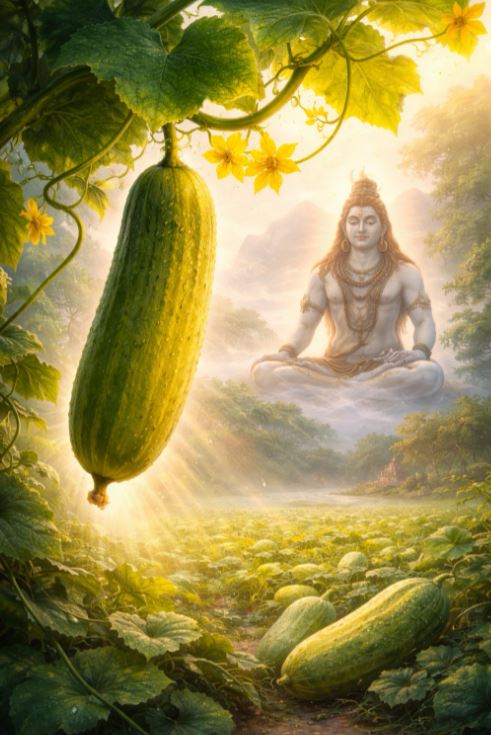
Among the loftiest metaphysical invocations of the Vedic world — a prayer to Shiva, the Three-Eyed Lord, conqueror of death — we find… a cucumber.
Not thunder. Not cosmic fire. Not celestial weapons. A vegetable!
And yet, in that vegetable lies one of the most profound spiritual metaphors ever composed.
The Mahāmrityuñjaya mantra — found in the Rigveda (7.59.12) and preserved in the Yajurveda — says:
Om Tryambakaṁ Yajāmahe
Sugandhiṁ Puṣṭi-vardhanam
Urvārukam iva Bandhanān
Mṛtyor Mukṣīya Mā’mṛtāt.
ॐ त्र्यम्बकं यजामहे
सुगन्धिं पुष्टिवर्धनम् ।
उर्वारुकमिव बन्धनान्
मृत्योर्मुक्षीय मामृतात् ॥
“We worship the Three-Eyed One, fragrant and nourishing all beings.
May He liberate us from the bondage of death,
like a ripe cucumber from its stem —
but not from immortality.”
‘Urvaruk’ means a cucumber or other vegetables of the same botanical family. “…May we be liberated from bondage like a ripe cucumber from its stem.”
Why a cucumber? Why not a sword cutting chains? Why not a storm shattering prisons?
Because the Vedic imagination understood something subtle about growth, maturity, and detachment — something modern seekers often miss.
The Botanical Genius of the Metaphor
You rightly note something beautiful: cucumbers and gourds belong to the Cucurbitaceae family. Botanists observe that when these vegetables ripen fully, they detach effortlessly from the vine. There is no tearing. No violence. No wrenching. They simply separate. The stalk yields. The fruit is ready. This is not forced separation. It is fulfillment.
The mantra’s phrase “Urvārukam iva bandhanān” literally invokes this natural agricultural observation. Ancient rishis were keen observers of nature. They did not derive spirituality
from abstraction alone, but from fields, rivers, seasons, and ripening crops. The cucumber does not detach because it hates the vine. It detaches because it has matured.
That distinction is everything.
Spiritual Ripening vs Spiritual Rejection
Many people imagine spirituality as dramatic renunciation — a violent rejection of the world. Leaving home. Abandoning family. Fleeing society. But the Mahāmrityuñjaya mantra
suggests something different. It does not advocate yanking oneself away from samsara. It suggests ripening within it. Just as a fruit draws nourishment from the vine until it is ready, the spiritual seeker lives in the world — works, loves, struggles, learns — until maturity naturally loosens attachment.
There is no bitterness. No resentment. No trauma. Only readiness.
This vision aligns beautifully with the Bhagavad Gita.
Krishna does not ask Arjuna to abandon action. He asks him to act without clinging.
“कर्मण्येवाधिकारस्ते मा फलेषु कदाचन”
You have authority over action, not over results. The Gita does not promote withdrawal. It promotes inner detachment amidst engagement. Ripening while still on the vine. Ripening is invisible work. No applause accompanies it. No announcement declares: “Now I am ready.” And then one day — not by violence, not by force — the stem softens.
The fruit slips free. It does not curse the vine. It does not cling to it. It does not fear the soil. It simply lets go. That is the poetry of the mantra.
The prayer is not: “Cut me loose.”
It is: “Let me ripen so completely that separation becomes natural.”
Harmony with Samsara
The cucumber metaphor implies something radical: The vine is not the enemy. The world is not the problem. The bondage lies in premature identification. The fruit that is still green
cannot detach without damage. If torn off early, it shrivels. Similarly, forced renunciation — emotional suppression, rejection of responsibilities, escapism disguised as spirituality — leads to imbalance.
Healthy spiritual development requires nourishment, participation, responsibility, experience, learning. The mantra suggests that samsara itself is the field of growth. Just as a medical professional matures through years of disciplined training — not by avoiding hospitals — the soul matures through living.
In Indian mythology, even great beings evolve through experience. Consider Rama in the Ramayana. He does not bypass suffering. He lives through exile, loss, and war. Or Krishna in the Gita — who engages fully in politics, strategy, and diplomacy. Neither advocates violent detachment. They embody mature participation.
The Movement Toward Turiya
The mantra beautifully invokes Turiya — the fourth state of consciousness described in the Mandukya Upanishad.
Waking.
Dreaming.
Deep sleep.
And the transcendent fourth — Turiya.
The cucumber metaphor fits perfectly here. The fruit remains attached during its stages of growth — just as consciousness cycles through waking, dreaming, and sleep. But when
realization dawns — when one recognizes the substratum beyond these states — detachment from fear of death occurs naturally.
Not through argument. Not through intellectual gymnastics. Through ripeness.
The mantra does not demand immortality. It asks: “Free me from the bondage of death — but not from immortality.” In other words: Let me detach from identification with the perishable, but not from my essential nature.
Death as Bondage, Not Biology
Notice again: the mantra does not say “prevent death.”
It says: “Liberate me from the bondage of death.”
Bondage is psychological. Fear. Clinging. Ego. Biological death is inevitable. Existential panic is optional. A ripe fruit does not fear falling. Only the unripe fruit resists.
Living the Metaphor Today
What does this mean for modern life? It suggests that spiritual development is not about fleeing responsibility but fulfilling it.A professional ripens through disciplined work. A parent
ripens through patient love. A thinker ripens through honest inquiry. When responsibilities are honored rather than resented, detachment becomes graceful.
Retirement without bitterness! Aging without panic! Death without terror!
The mantra does not promise biological immortality. It promises freedom from fear. Similes from Daily Life. We see this principle everywhere. A student who has mastered a subject
graduates without trauma. But one who is unprepared dreads exams. A professional who has fulfilled responsibilities retires gracefully. One who clings to titles suffers. Parents who
have raised children with wisdom eventually let them go. They do not yank them back from the world.
Ripeness leads to release. Immaturity leads to resistance.
The mantra encourages living fully, ethically, responsibly — so that when life naturally transitions, one slips free gently.
Mythological Echoes of Effortless Detachment
In the Mahabharata, Bhishma chooses the time of his death. He lies on a bed of arrows, waiting for the right cosmic alignment. He is not dragged by death. He releases himself when ready.
Similarly, sages like Markandeya — associated traditionally with this mantra — are said to have transcended death through devotion and knowledge. But the deeper symbolism is not literal immortality.
It is freedom from fear.
Does Other Traditions Share Similar Ideas?
A Comparative Reflection: Stoicism
Remarkably, similar intuitions appear in Stoic philosophy.
Marcus Aurelius writes of accepting death as naturally as a ripe olive falling from the tree — blessing the earth that bore it. The olive image mirrors the cucumber metaphor. Both
traditions see maturity, not violence, as the condition of release. For the Stoic, death is not catastrophe but completion of nature’s cycle. One lives according to reason, fulfills one’s role, and then departs without complaint.
The Stoic sage does not curse the vine. He ripens within it. Yet there is a difference. Stoicism emphasizes rational acceptance. The Vedic mantra integrates devotion — a relational surrender to the divine.
Stoicism says: align with nature. The Mahāmrityuñjaya says: align with the Three-Eyed Consciousness that illumines nature.
A Comparative Reflection: Buddhism
Buddhism approaches detachment through insight into impermanence (anicca) and non-self (anatta).
Clinging causes suffering. Release comes not through force but through seeing clearly. When attachment dissolves, liberation follows naturally. Here again, we find resonance with the cucumber metaphor. In Buddhism, one does not violently sever attachment; one understands its futility. Ripeness is insight. Yet the Vedic mantra adds another dimension: immortality (amrita). It does not merely seek freedom from clinging but remembrance of the deathless ground of being.
Where Buddhism emphasizes cessation of craving, the Mahāmrityuñjaya emphasizes reconnection with the immortal substratum.
In Christianity, the Gospel of John speaks of a grain of wheat that must fall to the ground and die to bear fruit. In Buddhism, detachment is not suppression but insight into impermanence. In Stoicism, Marcus Aurelius writes of accepting death as a natural process — like a ripe olive falling from the tree, blessing the earth that bore it. That image — the olive falling — is remarkably close to the cucumber metaphor.In Taoism, the sage does not force; he flows.
Across cultures, maturity precedes release. The Vedic contribution is its precision and agricultural intimacy.
The Three-Eyed Perspective
Why is this addressed to Shiva as Tryambaka — the Three-Eyed One?
Because ripeness requires vision. The two eyes see appearances. The third eye sees impermanence. When the third eye opens — metaphorically speaking — attachment loosens.
Not because one despises the world.But because one sees through it.
Spiritual Development Is Organic
Modern spirituality often suffers from impatience.
Retreat culture. Instant enlightenment. Quick transcendence.
But the cucumber grows through Sunlight. Water, Time, Seasons.It does not shout at the vine to let go. It becomes complete. Similarly, ethical living, disciplined work, compassion,
responsibility — these are not distractions from spirituality. They are its fertilizer.
The Isha Upanishad says:
“By renunciation, enjoy”.
This paradox makes sense only in the context of ripeness. Enjoy fully. But do not cling.
The Psychology of Effortless Detachment
Neuroscience even echoes this. Fear responses diminish when exposure is gradual and integrated. Avoidance intensifies anxiety. Engagement builds resilience. The mantra’s agricultural metaphor anticipates this psychological truth. Integration precedes transcendence.
A Civilization Comfortable with Nature
One of the remarkable aspects of Vedic spirituality is its comfort with nature. It does not isolate metaphysics from farming. The highest prayer references the simplest vegetable. It suggests a civilization where cosmic truth and daily agriculture were not separate domains.
This integration itself is instructive.
What This Means for Modern Life
In a world obsessed with achievement, longevity, and control, the Mahāmrityuñjaya mantra offers an alternative:
Live well. Grow fully. Detach naturally.Do not escape. Do not cling. Ripen.
Whether one interprets it metaphysically — merging into Turiya — or psychologically — achieving inner equanimity — the message remains luminous.
The Greatness of the Cucumber
There is quiet genius here. The mantra could have invoked lightning. Instead, it invoked botany. It tells us that the highest spiritual process is not dramatic.It is organic. Not violent.
Natural. Not escapist. Integrated. The fruit remains loyal to the vine until its work is done.
And then, when maturity is complete — It lets go. Effortlessly.