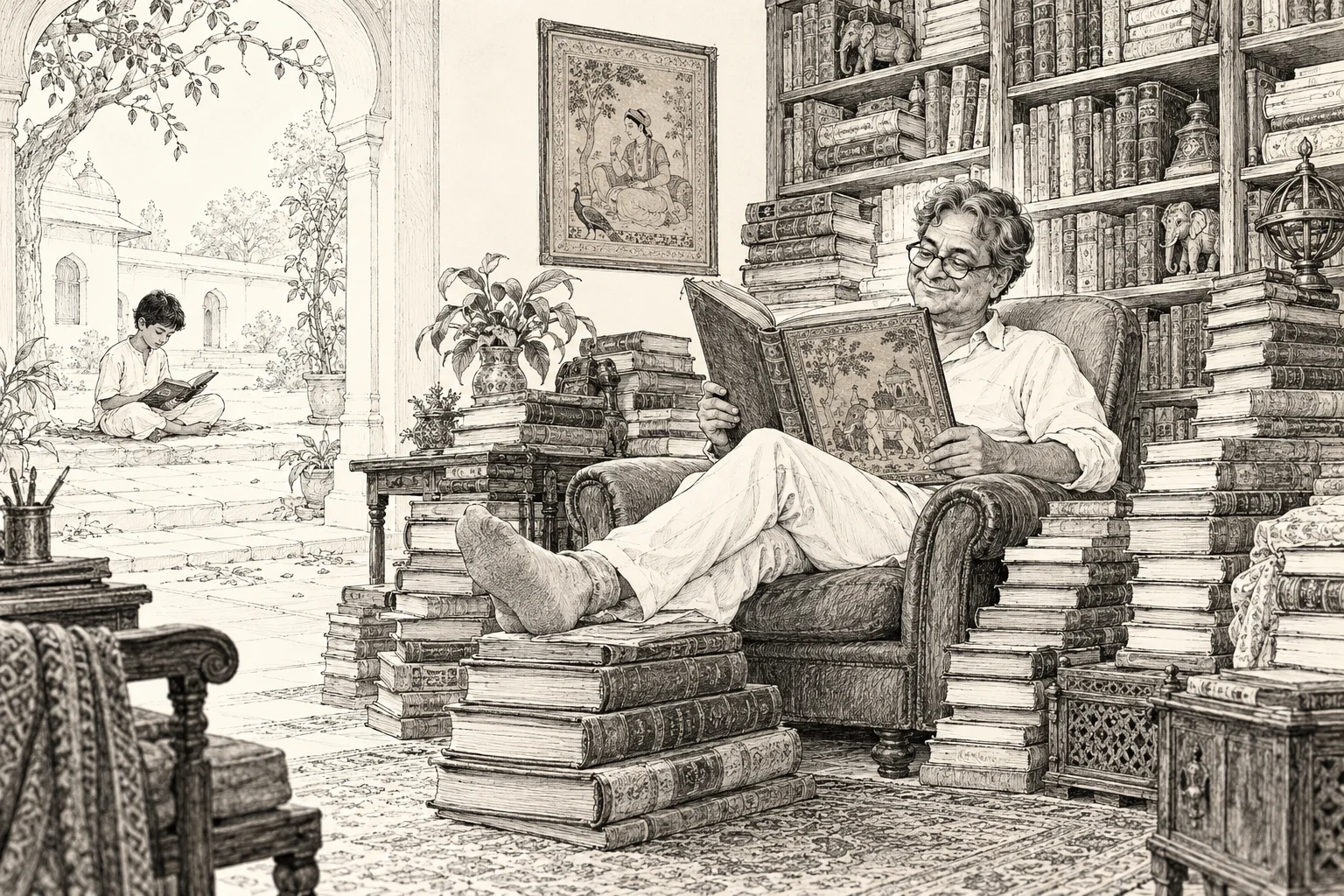
Some boys spend their childhood dreaming of scoring a century. Others dream of becoming film stars, driving fast cars, or attracting the attention of the girl in the next classroom.
I wanted a library.
Preferably a large one, with old books, subdued lighting, and the sort of silence in which turning a page feels like a significant public disturbance.
In retrospect, the warning signs were all there.
While other boys were playing cricket or discovering the opposite sex, I was discovering that a book could refer you to another book, which could refer you to three more, thereby making it entirely possible to spend the rest of your life pursuing a footnote. This struck me as an excellent arrangement. It still does.
I grew up in an ashram in India, in an environment that was, quite literally, monastic. Books, contemplation, religion and the life of the mind were part of my surroundings. Questions about God, existence and what lay beyond the visible world interested me at an age when most sensible boys were occupied with rather more immediate concerns.
I was good at my studies, curious about almost everything, and usually to be found with my face buried in a book. Whether this made me intellectually promising or merely socially inconvenient probably depended on whom you asked.
There was, I like to think, a certain mysterious appeal to all this. Some girls appeared to find the serious, bookish boy intriguing, although their interest generally remained at a respectful distance. Perhaps they sensed hidden depths. Perhaps they suspected that any romantic conversation might unexpectedly turn towards theology.
Either way, my principal relationship continued to be with books.
Libraries were my natural habitat. I loved their quietness, their dim corners, their atmosphere of accumulated thought. Above all, I loved the smell of paper, especially old paper: that peculiar fragrance which suggests that time itself has settled between the pages.
Some people walk into a luxury hotel and feel they have arrived. Put me in a room full of antique books and I experience much the same sensation, usually accompanied by an immediate concern about what I can afford.
Even then, I imagined having a library of my own. I could not have explained how I would build it, where it would stand, or how many shelves would eventually be required. The ambition existed long before the practical arrangements.
It also existed long before I understood that the practical arrangements would involve repeated negotiations over domestic space.
***
Eventually, reading books developed into buying books, and buying books developed into collecting them.
The distinction is important. A reader asks, “Would I enjoy reading this?” A collector asks that too, but may also ask about the edition, the binding, the illustrations, the provenance, and whether another copy is likely to appear within his remaining lifetime.
These additional questions can make a perfectly ordinary afternoon surprisingly expensive.
When I began, collecting antiquarian books was hardly a familiar pursuit in the India immediately around me. There were, of course, distinguished collectors and great collecting traditions. But within my own circle, buying old books with such enthusiasm was sufficiently unusual to require explanation.
My parents wondered why I was doing it.
My wife subsequently took over the wondering, bringing fresh energy and understandable practical concerns to the subject.
Over time, she has become more philosophical. My children now maintain the family tradition.
“Another book?”
It is a fair question, although I have never understood why it is considered decisive.
People who love clothes do not buy a new outfit only when the previous one has disintegrated. Nobody expects a wine enthusiast to demonstrate that every bottle in the cellar has been consumed before acquiring another. Yet the book collector is regularly asked whether he has finished reading everything he already owns.
Naturally, I have not.
I have a demanding professional life, numerous interests, and considerably less reading time than my purchases would suggest. My books arrive with a confidence in my future availability that I find both touching and optimistic.
I buy them partly for the person I am today, and partly for the person I imagine becoming: a gentleman with long, uninterrupted afternoons and no urgent emails.
This gentleman has yet to make an appearance, but I am preparing thoroughly for his arrival.
In this respect, I sometimes feel an affinity with the Egyptian pharaohs, who began making elaborate arrangements for their future while still fully occupied with the present. They built pyramids. I buy books.
My arrangements are somewhat less monumental, although anyone who has tried moving my collection may dispute that.
***
There is another question people ask: why accumulate physical books when so much can be read on a screen?
I use technology enthusiastically. Digital access is a wonderful thing. But an antiquarian book offers pleasures that extend beyond its text.
There is the weight of it in your hands, the texture of the paper, the impression of the printing, the craftsmanship of the binding. There are illustrations made with extraordinary patience, inscriptions from people long gone, and small signs that someone else once treasured the object now resting on your desk.
A book can preserve a history beyond the history it tells.
For me, books relating to India carry a particular emotional force. They offer encounters with my motherland across centuries: its landscapes, people, beliefs, architecture, natural history, and the many ways it has been observed and imagined.
Miniature paintings draw me into that world through another door. A gesture, a glance, an architectural detail, a tiny passage of colour: each can invite an absorbing journey of discovery.
Collecting these things has given my curiosity somewhere to live.
And somewhere, eventually, to become a business.
***
When I reached the stage of life at which people begin thinking seriously about legacy, I found that my answer had been taking shape for decades.
Some men acquire a sports car. I wanted to create a home for antiquarian books and miniature paintings connected with India.
The Eye of the Beholder grew from that desire.
I imagined it as a kind of mansion for the things I loved: a place of discovery, conversation and scholarship, where beautiful objects could find people capable of responding to them.
The business came later than the passion. Its foundations were laid in childhood, in the quiet of an ashram, when a small boy imagined a library that belonged to him.
Today, I have that library.
Occasionally, I stand among the shelves and remember how improbable it once seemed. Then I notice that the shelves are full and begin considering an extension.
Fulfilment, apparently, does not eliminate logistical difficulties.
***
This morning brought an unexpected moment.
A Google search included my name among prominent living collectors of antiquarian books relating to the Indian subcontinent.
I read it, then read it again.
I am aware that a Google result is not a scholarly verdict, and that search engines have not yet replaced the considered judgement of bibliographers. Nevertheless, seeing my name there gave me enormous pleasure.
For once, the technology that usually identifies another book I might buy had identified something about the life I had already built.
Beneath my amusement was real pride.
The boy who loved libraries had become a collector whose name appeared in connection with the very field that had fascinated him. A private enthusiasm, pursued across decades, had acquired a public presence.
I thought of my parents’ bewilderment, my family’s patient questions, the books bought when buying them seemed faintly eccentric, and all the years spent learning simply because I wanted to know more.
That small moment felt like an acknowledgement of the whole journey.
***
If there is something younger people might take from this, it is to pay attention to the interests that keep returning.
You do not need to know, at sixteen or twenty, what they will eventually become. Nor does every enthusiasm need a business plan. But an enduring curiosity deserves time, effort and respect, even when the people around you cannot quite see its purpose.
Learn carefully. Develop judgement. Stay open to correction. Find people who know more than you do. Give your interests the chance to deepen.
Much of what becomes meaningful in later life begins as something pursued without applause.
I am very happy that my collecting has brought me this far. I am proud of The Eye of the Beholder, and grateful that a childhood fascination has grown into something I can share.
There are still books to discover, paintings to understand, and shelves whose capacity I may have overestimated.
And somewhere, I hope, there is a young person dreaming an apparently impractical dream of their own.
I would encourage them to take it seriously.
Although, if the dream involves books, I would also recommend investing early in good shelving.