There are moments when one suddenly becomes aware that the world has changed. Not through a dramatic political upheaval, a revolution, or the collapse of an empire, but through something wonderfully trivial. A mispronounced name, for instance. Or a bewildered salesman in an extraordinarily expensive watch boutique.
I experienced both, about a year apart. And it was only today that I realised they were telling essentially the same story.
I was attending the Financial Times Global Pharma and Biotech Summit in London. A rather distinguished gathering, as these things go. The room was populated by senior industry executives, scientists, policymakers, investors, and the occasional person whose job title required three lines on the conference programme. The discussions were intellectually stimulating, the questions refreshingly serious, and the journalists from the Financial Times were doing what good journalists do: asking intelligent questions, challenging comfortable assumptions, and occasionally making important people rather uncomfortable.
It was an excellent event, and I thoroughly enjoyed participating in it.
But something rather curious caught my attention.
One of the senior FT journalists, an exceptionally capable and articulate interviewer, was having some difficulty pronouncing my name. Nothing unusual there. My name, after all, was not designed with the convenience of English phonetics in mind. I have spent much of my professional life watching Europeans approach it with the same apprehension that a novice mountaineer might display before attempting the north face of the Eiger.
I am accustomed to this, and it has never particularly bothered me.
Then I noticed the same journalist struggling with the name of another very senior industry executive of Asian origin. And as the day progressed, I began noticing similar little moments elsewhere. Names that required a second attempt. Introductions accompanied by a momentary hesitation. Familiar linguistic confidence giving way, ever so briefly, to uncertainty.
These were sophisticated, internationally experienced journalists. People who could move effortlessly from geopolitics to molecular biology, from pharmaceutical regulation to the economics of drug development. They could pronounce the names of obscure scientific compounds without batting an eyelid.
But occasionally, an Indian name defeated them.
And suddenly, I found the whole thing rather amusing.
Not because I thought there was anything wrong with mispronouncing an unfamiliar name. There isn't. Languages are complicated, and human tongues were not manufactured to universal specifications. I would probably make an equally spectacular mess of certain Welsh or Polish surnames.
What struck me was something entirely different.
**For a very long time, it was we who had to learn their names. Now, increasingly, they have to learn ours.**
And that, I realised, is a rather significant change in the affairs of the world.
Consider the traditional architecture of global corporate leadership. For much of the twentieth century, particularly in the Western-dominated multinational world, the people at the top were disproportionately white, Western, and male. They had names like John, Peter, Robert, Stephen, and occasionally something more adventurous, like Boris.
The geography of power was relatively predictable. So was its vocabulary.
An ambitious young Indian professional entering that world learned very quickly how to adapt. One learned to pronounce unfamiliar European names, understand British humour, navigate German business etiquette, and distinguish between the varieties of Swiss reserve. One learned when to laugh, when to remain silent, what to wear, how firmly to shake hands, and precisely how many minutes late constituted a diplomatic incident.
One learned that a working lunch might consist of a cold sandwich of deeply questionable vegetarian credentials, and that declining a glass of wine sometimes required a more elaborate explanation than declining a job offer.
There were cultural references to master, accents to decipher, and small social rituals to memorise. An astonishing amount of one's professional education involved learning things that had absolutely nothing to do with one's profession.
And we did it.
Not necessarily because we were particularly enthusiastic about the exercise, but because that was the price of admission.
If you wanted to succeed in their world, you had to understand their world.
The reverse obligation was considerably less pressing.
A European executive could build an immensely successful international career without knowing much about Indian literature, Chinese social etiquette, or the difference between Diwali and Durga Puja. An American business leader might know every detail of the Masters golf tournament while remaining blissfully ignorant of the cultural significance of a Bengali wedding.
Nobody considered this a serious professional deficiency.
Why would they? The centre of gravity was elsewhere.
But centres of gravity have an inconvenient habit of moving.
Today, Satya Nadella leads Microsoft, Sundar Pichai leads Alphabet and Google, Vas Narasimhan leads Novartis, and Leena Nair leads Chanel. These are not peripheral companies operating in some exotic corner of the global economy. They are institutions at the very heart of technology, pharmaceuticals, and luxury.
And these individuals are only a few visible examples of a much broader transformation.
Across industries, people with backgrounds, accents, names, and cultural experiences that once sat outside the traditional Western establishment increasingly occupy influential positions within it.
The old establishment has not disappeared, of course. Nor has power suddenly migrated wholesale from Zurich, London, and New York to Mumbai, Shanghai, and Singapore. That would be a rather silly exaggeration.
But the composition of the room has changed.
And, more importantly, so has the identity of the person whom everyone in the room wants to impress.
Which brings me to a delightful little episode from Basel.
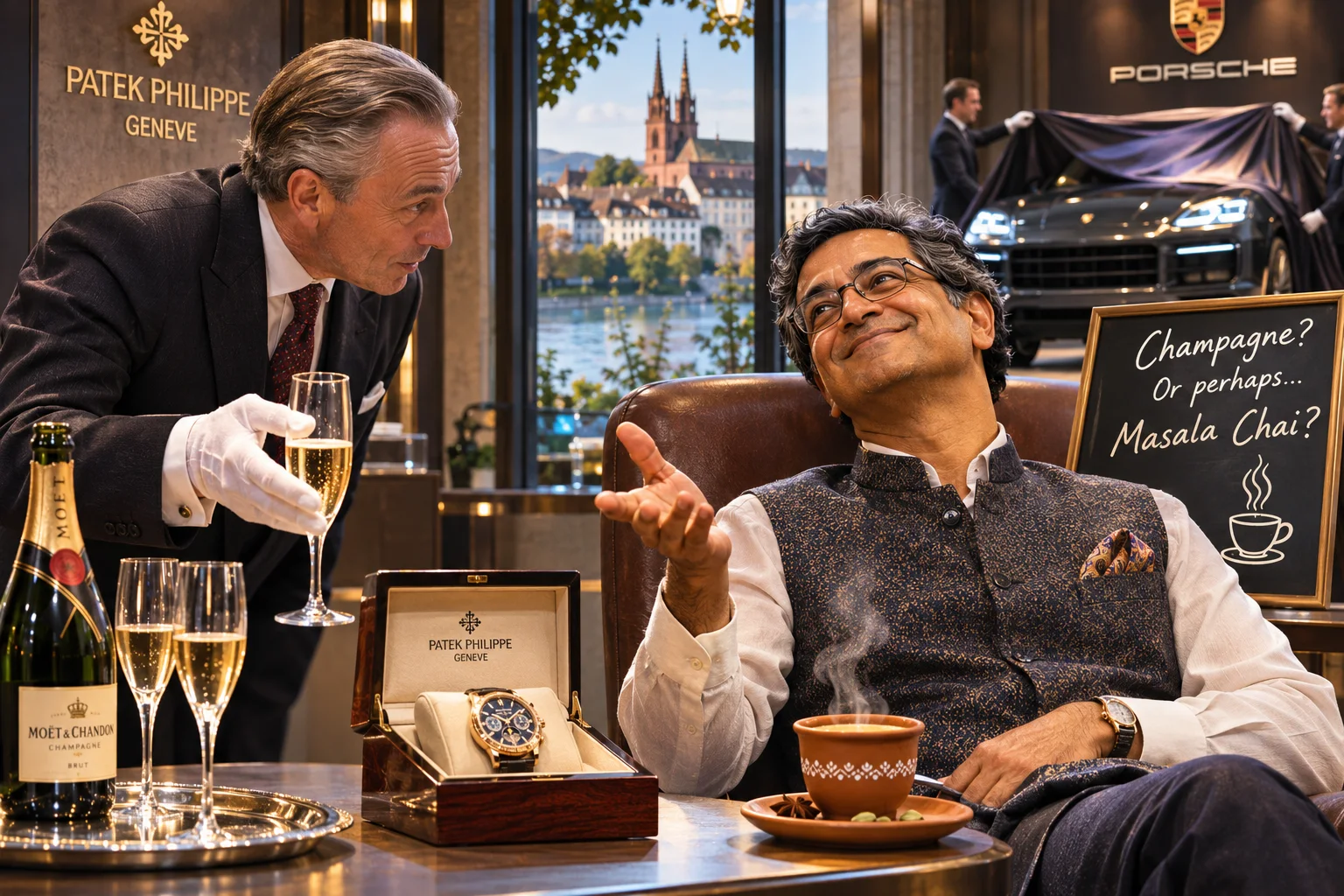
About a year ago, I visited an exclusive watch boutique in my home city with the intention of purchasing a Patek Philippe Grand Complication.
For those unfamiliar with the peculiar world of *haute horlogerie*, a Grand Complication is not merely an expensive wristwatch. It is a triumph of mechanical ingenuity, an extraordinary expression of craftsmanship, and, depending on the model, a rather effective way of spending the price of a respectable house on something that tells you what your mobile phone already knows.
Naturally, I wanted one.
Now, Basel is a city with an exceptionally refined understanding of discreet wealth. There are families whose fortunes, social standing, and business connections have been established over generations. Their names are embedded in the city's history, sometimes quite literally on its buildings.
One can imagine the traditional clientele of such a watch boutique.
Herr Müller, for example, whose grandfather had been an important industrialist, might arrive with his son on the occasion of the young man's thirtieth birthday. The son, having completed his education and joined the family business, would receive a Patek Philippe as a symbol of continuity, achievement, and the solemn responsibilities of inherited privilege.
The salesman would recognise the family, or at least understand its social universe. Greetings would be exchanged in polished German. There would be discreet conversation about family traditions, perhaps a passing reference to the grandfather's watch, and a shared appreciation of the fact that certain things in life should never be discussed too loudly.
And naturally, there would be champagne.
Not just any champagne, of course. Something appropriately distinguished. Moët & Chandon, perhaps, or Ruinart. Something befitting a transaction that involved a substantial amount of money and several generations of Swiss horological tradition.
The transaction would proceed with exquisite elegance.
Patek Philippe's celebrated advertising campaign captured this world beautifully: *“You never actually own a Patek Philippe. You merely look after it for the next generation.”*
It remains one of the finest advertising ideas ever conceived.
In that setting, a senior watch salesman was not simply selling a watch. He was participating in a social ritual. He understood the language, the expectations, the codes, and the choreography.
He knew precisely what to do.
And then, one day, I walked in.
The boutique's senior salesman approached with impeccable courtesy and began addressing me in wonderfully polished, elevated German.
I looked at him blankly.
He continued.
I continued looking blankly.
It soon became apparent that, despite having lived in Switzerland for years, my command of German was essentially nonexistent.
This created a minor crisis.
The gentleman switched to English, a language in which he was clearly less comfortable than he had been in German. Suddenly, a man who had probably spent decades mastering the finer points of dealing with extremely discerning clients found himself operating outside his natural environment.
And the difficulties were not merely linguistic.
He had no obvious way of placing me socially. He did not know what cultural references might resonate with me, what sort of humour I would appreciate, what conventions I regarded as important, or what personal experiences had shaped my tastes.
And then came the champagne.
With impeccable courtesy, he offered me a glass of what was undoubtedly a very fine champagne, precisely the kind of gesture that would have delighted generations of distinguished clients before me.
There was just one small problem.
I don't drink alcohol.
I had given it up many years earlier, and the prospect of drinking champagne, however expensive or illustrious its pedigree, held absolutely no attraction for me.
I genuinely felt rather bad for him. Here was a man offering me what, in his professional universe, represented the very pinnacle of refined hospitality. And the gesture, though entirely gracious and well intended, was completely lost on its intended recipient.
What I would really have enjoyed, sitting there discussing the intricacies of a remarkable Patek Philippe movement, was a nice, steaming cup of masala chai. Or even an ordinary cup of Indian milk tea.
Imagine that.
A transaction involving one of the world's most coveted Swiss watches, accompanied not by the delicate effervescence of vintage champagne, but by a robust cup of tea, generously enriched with milk, perhaps a little ginger and cardamom.
I would have been delighted.
The salesman, I suspect, might have needed a few moments to recover.
The extraordinary thing was that nothing about the quality of his hospitality had changed. The champagne was excellent, the setting impeccable, the courtesy beyond reproach. The only thing missing was a proper understanding of the person sitting across the table.
**He knew his watches. Of that I had no doubt.**
**But he did not know his customer.**
And this reminded me of another, equally delightful incident.
A couple of years earlier, when I purchased my Porsche Cayenne, I was treated to the elaborate delivery ceremony that luxury car dealerships have perfected into something approaching a minor theatrical production.
The new car stood concealed beneath an elegant black satin cover, rather like an important monument awaiting its unveiling. There was a certain amount of ceremony, an atmosphere of anticipation, and then, with a magnificent flourish, the satin was pulled away to reveal the gleaming vehicle underneath.
It was all rather splendid.
And naturally, there was champagne.
A large bottle of very good champagne, ceremoniously presented to mark the occasion.
Once again, I accepted it with immense gratitude. It was an extremely thoughtful gesture, perfectly consistent with the dealership's understanding of what a discerning customer ought to appreciate.
In truth, however, I would probably have been considerably happier with a tall glass of chilled mango lassi. Or, depending on the weather, another cup of chai.
But one does not interrupt a carefully choreographed Porsche delivery ceremony to enquire whether the establishment might have a little cardamom and some fresh ginger in the kitchen.
So I smiled, thanked everyone, admired the car, and took the champagne home.
And there it remained.
Unopened.
For two entire years.
It sat in my possession, an elegant souvenir of an exceptionally expensive purchase, awaiting a celebration that, as far as the bottle was concerned, never arrived.
Very recently, I finally gave it away to somebody else.
Thus ended my two-year custodianship of a bottle of fine champagne.
Patek Philippe may believe that one never truly owns its watches but merely looks after them for the next generation. In my case, the principle seems to have applied rather more literally to Porsche's champagne.
I was merely looking after it for the next person who might actually drink it.
There is something rather comical about these encounters. Two exceptionally accomplished European luxury businesses, both entirely sincere in their efforts to make me feel special, had selected what they regarded as the ultimate symbol of celebration.
And in both cases, the customer would have preferred a humble cup of Indian tea.
I do not recount these stories to criticise either establishment. Their gestures were gracious, generous, and professionally impeccable. Nor do I suggest that an Indian customer necessarily prefers tea to champagne; plenty would happily choose the latter.
But the stories illustrate something rather important.
The world of the customer was changing faster than the rituals designed to serve him.
The salesman in Basel was an accomplished professional, courteous and well intentioned, doing his very best to deliver the standard of service that his establishment promised. Yet much of his accumulated expertise in managing relationships with affluent clients had been developed within a cultural framework that no longer described everyone who walked through the door.
He had the right product, the right manners, and the right intentions.
Unfortunately, he had the wrong script.
The irony was delicious.
For decades, luxury brands in Europe had trained their salespeople to understand the expectations of a relatively familiar clientele. Now the customers might be Indian entrepreneurs, Chinese technology founders, Middle Eastern investors, African industrialists, or second-generation immigrants who had acquired substantial wealth without inheriting the cultural habits that traditionally accompanied it.
Their financial capacity could be entirely familiar.
Their cultural operating systems were not.
And the salesman could no longer assume that an expensive suit, a Swiss address, and an interest in mechanical watches implied a particular linguistic or social identity.
The gentleman in Basel had encountered a professional challenge for which his previous experience had not entirely prepared him.
I suspect there are many more such encounters taking place in luxury boutiques, private banks, art galleries, auction houses, and boardrooms across Europe.
The new customer does not necessarily want to discuss skiing in St. Moritz. He may prefer talking about Mughal painting, Sanskrit poetry, or the merits of a particular Burgundy. He may speak impeccable English but not a word of German. He may be a vegetarian who knows more about European history than the person serving him.
And, perhaps most disconcertingly, he may possess enough money to be extremely desirable as a customer without possessing any particular desire to imitate the people who traditionally occupied that position.
The old formulas suddenly become rather unreliable.
Of course, this is not to suggest that Europeans are incapable of cultural adaptation, or that Asian customers arrive fully equipped with an enlightened understanding of everyone else's traditions. Cultural incompetence is a splendidly international phenomenon.
Nor is this transformation unique to the present moment. Great merchants, diplomats, and luxury houses have always understood the importance of adapting to foreign customers.
What is different today is the scale, visibility, and normality of the change.
These are no longer occasional exceptions requiring special treatment. Increasingly, they are part of the ordinary composition of global business.
And that changes everything.
It changes what constitutes sophistication. It changes what a senior executive needs to know. It changes the cultural repertoire expected of an accomplished journalist, banker, diplomat, or salesman.
Even humour requires recalibration.
A joke that reliably delighted a room full of middle-aged European gentlemen may fall rather flat before an audience whose members grew up in Bangalore, Lagos, Dubai, and Seoul.
A reference to cricket may be entirely wasted on an Indian who has never watched a match. Equally, the assumption that an Asian professional knows nothing about European classical music could produce a rather embarrassing conversation.
The challenge is not simply to avoid giving offence. That is the rather uninteresting minimum requirement.
The real challenge is to develop sufficient curiosity about other people to connect with them intelligently.
There is a difference between cultural politeness and cultural fluency.
The former can be learned from a corporate training programme. The latter requires attention, experience, humility, and the willingness to accept that one's own cultural universe is no longer the default setting for everyone else.
And yes, that includes learning to pronounce unfamiliar names.
If generations of Asians could learn to say Schwarzenegger, Tchaikovsky, and Worcestershire, surely the Western professional establishment can make a reasonable attempt at Narasimhan or Shreeram.
We need not demand phonetic perfection. A little preparation and genuine effort will do nicely.
After all, a person's name is not an obscure technical detail. It is usually the first piece of information one learns about them.
There is something rather touching about this reversal of circumstances.
I think of the thousands of young Asians who travelled to Western universities and corporate headquarters over the decades, struggling with accents, social conventions, unfamiliar food, and sometimes painfully cold weather. They learned not only the subjects they had come to study but also the unwritten rules of the societies they hoped to enter.
Many succeeded spectacularly.
Their success, and that of the generations following them, has now begun to change the very institutions to which they once sought admission.
And the adjustment that was once overwhelmingly expected of the newcomer is gradually becoming a responsibility shared by everyone.
This is not a triumph of one race over another. Nor should it become an invitation to reverse old prejudices. The world has quite enough of those already.
Indeed, the point would be entirely lost if the formerly excluded simply reproduced the arrogance of those who once excluded them.
The real transformation is subtler, more interesting, and ultimately more promising.
**Cultural adaptability is ceasing to be the obligation of the outsider and becoming an essential qualification of the insider.**
That is a considerable advance.
It means that being internationally sophisticated can no longer be measured merely by one's familiarity with Paris, London, New York, or the customs of an old European establishment. It requires an expanding understanding of a world whose influence is increasingly distributed across many countries and cultures.
And there is a certain quiet justice in that.
The people who once had to spend years understanding the cultural expectations of others now find that others have a professional reason to understand them.
Not out of charity.
Not because of political correctness.
But because the world of influence, expertise, and purchasing power has changed, and successful professionals must change with it.
Which is why I remember that salesman in Basel with considerable affection.
He was a gentleman, doing his job in the best way he knew. And I would not be surprised if, given enough time, he became exceptionally good at dealing with customers like me.
Perhaps the next time an Indian customer enters his boutique, he will begin by asking a simple question: "What would you like to drink?"
And perhaps, somewhere in the establishment, alongside the chilled champagne, there will be a little tin of Darjeeling tea.
That would be progress indeed.
But he had an important lesson to learn, just as generations of people like me once had lessons to learn.
The world was no longer quite the world for which he had been trained.
And it was not going to rearrange itself for his convenience.
The same thought occurred to me today, watching those accomplished Financial Times journalists navigating a succession of unfamiliar Asian names. Their occasional hesitation was not a failing of intellect or professionalism. It was a small, almost endearing reminder that even the most sophisticated people must continually update their understanding of the world.
I rather liked the symbolism.
The names on the conference programme were changing. The accents on the stage were changing. The identities of the people setting the intellectual agenda were changing.
And those entrusted with interpreting the world were having to learn some new vocabulary.
There is an old line from the *Rubáiyát of Omar Khayyám*, in Edward FitzGerald's famous rendering, about the Moving Finger that writes and, having written, moves on.
History has always been rather indifferent to the comfort of those accustomed to its previous arrangements.
Empires rise and fall. Fortunes migrate. Cultural fashions change. Yesterday's outsiders become today's establishment, and yesterday's establishment discovers that the rules of admission have been quietly rewritten.
Sometimes the evidence is dramatic.
Sometimes it is nothing more than a senior journalist struggling with an Indian name, a distinguished Swiss watch salesman discovering that impeccable German and impeccable champagne are not quite enough, or a bottle of expensive French bubbly spending two lonely years in the home of a man who would have been perfectly content with a mango lassi.
I find all three rather reassuring.
The world is moving on.
And this time, for a change, **it is someone else's turn to learn how to pronounce our names.**