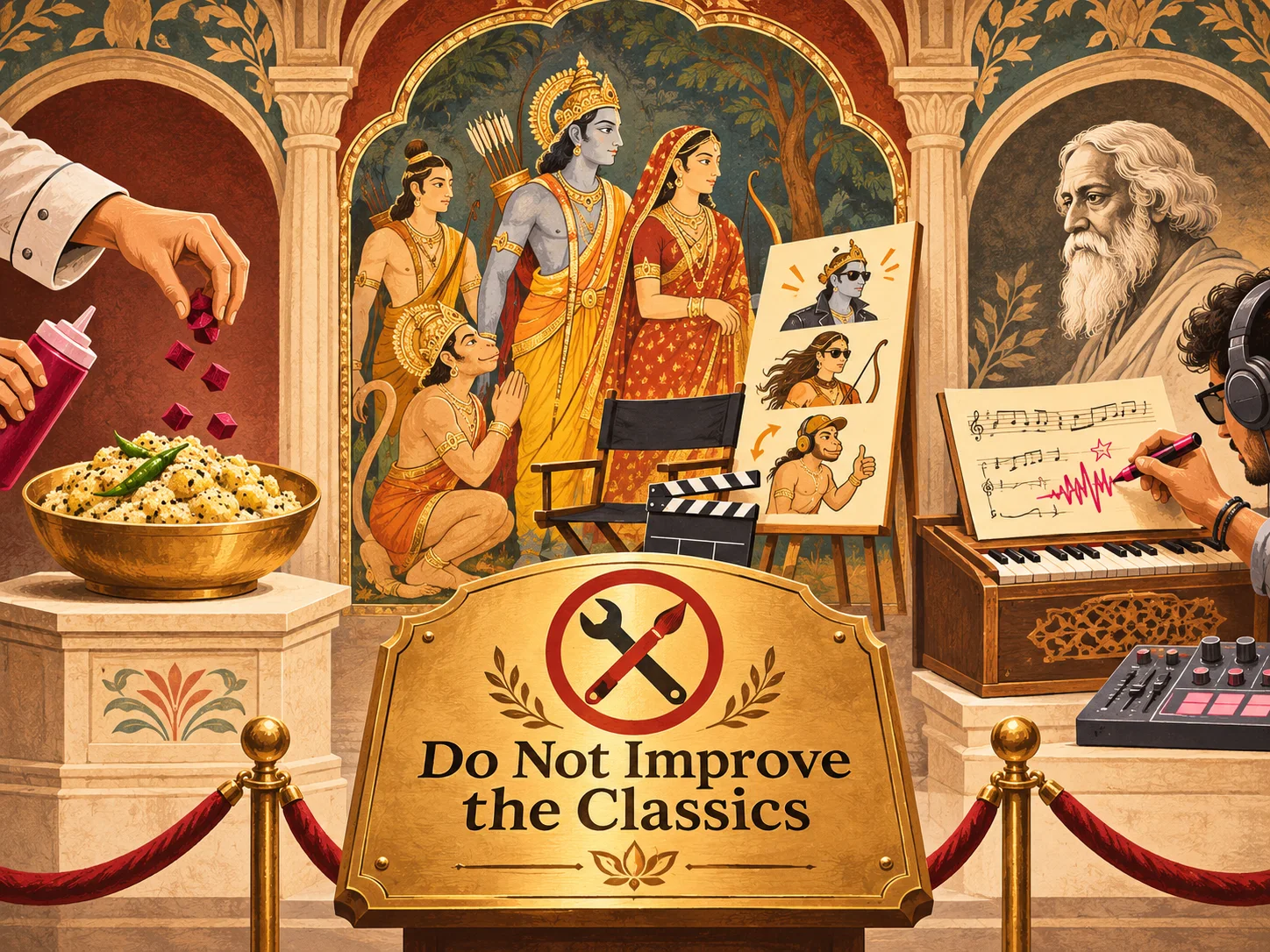
*On the modern obsession with improving things that were never broken*
There is a peculiar disease afflicting modern civilisation, and I suspect it is spreading faster than most epidemiologists would care to acknowledge. It is called innovation. Not innovation in the admirable sense of discovering a new medicine, inventing a better engine, or finding a way to make human life more comfortable. Those are perfectly respectable pursuits, and I have nothing against them. I am talking about another variety altogether: the compulsive, almost pathological urge to improve things that have already been improved over centuries, have reached a state of near perfection, and have subsequently been embraced by generations of perfectly sensible human beings. Things that nobody was complaining about in the first place.
Somewhere along the way, we seem to have forgotten a rather elementary principle: **not everything that can be changed needs to be changed.** And more importantly, not every change represents progress. Sometimes it merely represents the inability of an otherwise intelligent person to leave well enough alone.
This afternoon, we are going to watch the new cinematic adaptation of the *Ramayana*. I understand that the cinematography is spectacular, the special effects extraordinary, the music magnificent, and the production values worthy of the substantial investment that such an undertaking demands. All very commendable. Modern technology can bring to life the forests of Dandakaranya, the palaces of Ayodhya, the splendour of Lanka, and the battles between Rama and Ravana in ways that would have been unimaginable even a generation ago. That, to my mind, is precisely where innovation has an important role to play.
But I also hear, somewhat ominously, that the filmmakers have exercised their creative liberties with the storyline, supposedly introducing contemporary ideas of political correctness and modern social sensibilities into an ancient narrative. I shall reserve judgment until I have seen the film. Nevertheless, the very possibility raises a question that has been bothering me for years.
Why?
Why must we feel compelled to renovate a story that has survived thousands of years of human civilisation? The *Ramayana* is not merely a religious scripture, although it certainly is that to millions. It is also one of humanity's great literary and cultural inheritances. Its characters have entered our collective imagination so thoroughly that Rama, Sita, Lakshmana, Hanuman, and Ravana have become more than literary figures. They are part of the vocabulary through which millions of people understand loyalty, courage, sacrifice, temptation, duty, betrayal, and the complexities of human existence.
Even those who have never read the *Ramayana* recognise its characters. Its episodes inhabit everyday conversation. Its moral dilemmas continue to provoke discussion. Its imagery has travelled across India, Southeast Asia, and the global diaspora, acquiring extraordinary cultural permanence.
A story does not achieve this kind of longevity by accident. It survives because successive generations find something in it worth preserving. It has undergone the most demanding examination imaginable: the judgment of time.
Of course, there have always been different tellings of the *Ramayana*. Valmiki, Krittibas, Tulsidas, Kamban, and the great traditions of Southeast Asia have each given the epic their distinctive literary and cultural expression. Such diversity is itself part of the tradition. But there is a fundamental difference between a civilisation organically developing its inherited narratives over centuries and a contemporary filmmaker feeling obliged to make an ancient story conform to the ideological fashions of the present decade.
One is the evolution of tradition. The other risks becoming the vanity of the interpreter.
And fashions, as we know, have a rather unfortunate habit of changing. What is considered politically correct today may become embarrassing tomorrow. The *Ramayana*, meanwhile, will still be there.
If somebody wishes to create a story reflecting contemporary political or social concerns, splendid. Write one. There is no shortage of human experience from which to draw inspiration. But why must an existing masterpiece be conscripted into the service of every passing intellectual fashion?
I am reminded of a deeply traumatic culinary experience from several years ago, the emotional scars of which have not entirely healed.
I was staying at a prominent five star Hotel in Kolkata when a friend dropped by unexpectedly. We decided to have dinner together. Having been away from India for some time, and finding myself once again in Bengal, I experienced an overwhelming desire for something very simple and very Bengali: *alu posto*.
Now, those unfamiliar with Bengali cuisine may find this difficult to appreciate. Alu posto is not merely a preparation of potatoes and poppy seeds. It is an institution. It is a civilisational achievement. It is evidence that human ingenuity, when properly directed, can transform two exceedingly ordinary ingredients into something approaching metaphysical satisfaction.
There is nothing complicated about it. Potatoes, poppy-seed paste, mustard oil, green chillies, and a few other modest ingredients, handled with the restraint and wisdom that generations of Bengali kitchens have perfected. Its beauty lies precisely in its simplicity. Like a well-composed Sanskrit verse, it has no unnecessary embellishment.
When the dish arrived, however, I noticed something profoundly disturbing.
It was reddish.
Alu posto, as any respectable Bengali will confirm, is not reddish. It has never aspired to be reddish. Its pale, unassuming appearance is part of its personality. Initially, I assumed that the waiter had brought the wrong dish. Perhaps some unfortunate potato preparation intended for a less discerning table.
No, I was informed. This was indeed alu posto.
The chef had added beetroot.
Beetroot!
Apparently, this was an innovation.
I remember looking at the dish with the bewilderment of an archaeologist who has just discovered that somebody has painted a moustache on the Mona Lisa. The chef, I was assured, was being creative. He was adding a contemporary touch to a traditional preparation.
But who had asked him to?
Had there been a public movement demanding the introduction of beetroot into alu posto? Had generations of Bengalis been secretly dissatisfied with the colour of their beloved dish? Was there some newly discovered nutritional deficiency that could only be remedied by turning a perfectly respectable preparation into something resembling the aftermath of a minor surgical procedure?
The absurdity was almost philosophical.
The chef had not improved alu posto. He had merely demonstrated that he possessed beetroot and was prepared to use it.
I have encountered similar outrages in the world of music, particularly in the increasingly popular practice of rearranging Rabindra Sangeet.
Now, let me make a distinction. I have no objection whatsoever to a gifted musician interpreting Tagore with sensitivity, emotional intelligence, and individual expression. Music would be a dreadful thing if every performance were mechanically identical. But there is a difference between interpretation and vandalism.
Rabindranath Tagore did not merely write lyrics. He composed songs in which poetry and melody exist in an extraordinarily intimate relationship. The words inhabit the music, and the music illuminates the words. Together they create something greater than the sum of their parts.
Yet every so often, some enterprising musician decides that a perfectly beautiful Rabindra Sangeet would benefit from a new tune, a jazz arrangement, a fashionable beat, or an assortment of electronic noises apparently considered indispensable to modern musical enjoyment.
Why?
If one possesses sufficient musical genius to improve upon Tagore's composition, surely one possesses enough genius to compose an original song. The world would welcome it. There is ample room in the musical universe for new melodies. But why must originality be demonstrated by rearranging somebody else's masterpiece until it becomes barely recognisable?
It is rather like taking a perfectly preserved eighteenth-century miniature painting, adding a pair of sunglasses to Krishna, and announcing that one has made the work more relevant to contemporary audiences.
One has certainly made it contemporary. Whether one has made it better is another matter altogether.
The problem, I suspect, lies in our increasingly confused understanding of creativity. We have developed a culture in which originality is assumed to require visible departure from precedent. A chef must introduce an unexpected ingredient. A filmmaker must reinterpret a familiar narrative. A musician must rearrange a beloved composition. An architect must place something aggressively modern beside something magnificently old.
The resulting product may be different, but difference is not synonymous with excellence.
Indeed, some of the most extraordinary achievements of human civilisation are the products of gradual, cumulative refinement rather than sudden flashes of revolutionary originality. Classical architecture, traditional cuisines, musical forms, literary conventions, and artisanal techniques have often achieved their elegance through innumerable small improvements made by generations of practitioners.
Each generation inherited something, experimented with it, discarded what did not work, retained what did, and passed on a gradually refined version to the next. Over centuries, this process produced forms of remarkable coherence and beauty.
There is a reason a beautifully proportioned classical building continues to delight the human eye. There is a reason certain recipes remain virtually unchanged across generations. There is a reason a raga, performed within the discipline of its inherited grammar, can move audiences hundreds of years after its emergence.
These things represent accumulated human intelligence.
To dismiss that inheritance merely because it is old is not modernity. It is intellectual arrogance.
I should emphasise that this is not an argument against innovation itself, nor a declaration that everything inherited from the past is beyond criticism. Humanity has preserved its share of follies, injustices, and undesirable customs, and some traditions deserve to be questioned, reformed, or abandoned altogether. Nor does every artistic experiment amount to an assault on civilisation. New interpretations can sometimes reveal dimensions of familiar works that earlier generations overlooked.
But there must be discernment. We should distinguish between something that genuinely needs improvement and something that has already achieved an extraordinary degree of refinement. Between creative exploration and gratuitous alteration. Between adding value and merely leaving one's fingerprints on an object of inherited beauty.
The highest form of artistic intelligence is not always knowing what to change. Sometimes it is knowing what must remain untouched.
This is particularly important because familiar cultural forms provide something beyond aesthetic pleasure. They provide continuity. They connect us to our childhoods, our families, our ancestors, and the collective experiences of societies to which we belong.
When I order alu posto in Kolkata, I am not merely ordering potatoes. I am expecting something familiar, something that connects me to a thousand meals eaten over a lifetime, to the kitchens of my childhood, and to the quiet reassurance of belonging somewhere.
When I listen to Rabindra Sangeet, I am not necessarily seeking the latest musical experiment. I am seeking the particular emotional world that Tagore created.
And when I watch the *Ramayana*, I do not particularly wish to discover that its characters have been extensively remodelled to accommodate the fashionable sensibilities of the current century. I wish to encounter the story I know, presented with all the grandeur that modern filmmaking can offer.
There is, incidentally, an additional irony in the commercial argument for these innovations. Filmmakers, musicians, and restaurateurs frequently justify their experiments by claiming that contemporary audiences demand novelty. But do they? If audiences truly wished to encounter something entirely unfamiliar, why would they return repeatedly to the same stories, the same songs, and the same recipes?
Perhaps the enduring appeal of these works lies precisely in their familiarity. Perhaps audiences are not clamouring for their cherished inheritance to be reinvented. Perhaps they merely want it presented beautifully, faithfully, and with the respect it deserves.
Innovation has its place, certainly. Let us innovate in medicine, science, technology, transportation, energy, and the countless areas in which humanity continues to confront genuine limitations. Let us create new literature, new music, new art, and new culinary traditions. There is an entire universe of unexplored possibilities awaiting human imagination.
But let us also cultivate the increasingly rare virtue of restraint.
Not every old building requires a glass extension. Not every classical composition requires a synthesiser. Not every ancient epic requires ideological refurbishment. And not every Bengali potato needs to make the acquaintance of a beetroot.
Sometimes the most intelligent, sophisticated, and courageous thing a creative person can do is to recognise that something wonderful already exists, and to resist the temptation to improve it.
After all, perfection is difficult enough to achieve. It seems rather unreasonable that, having finally approached it through centuries of collective human effort, we should then feel compelled to start all over again.
And if there is one principle on which I am prepared to remain unashamedly, uncompromisingly conservative, it is this:
**For heaven's sake, leave the alu posto alone.**