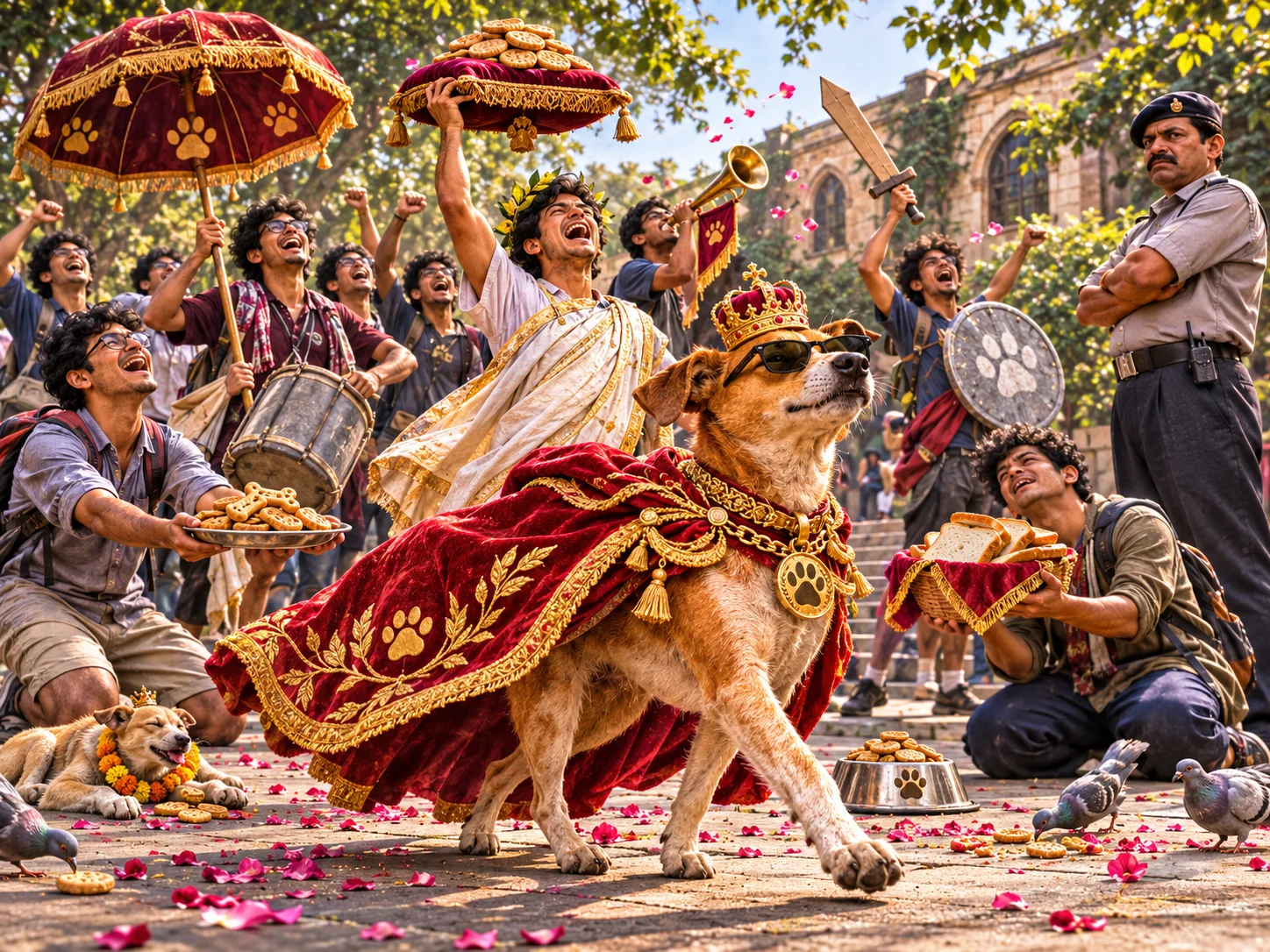
There was a time in our lives when we were young, idealistic, reasonably well educated, and almost entirely devoid of common sense. This was in Pune, some thirty years ago as students living in hostels, pursuing higher education, and occasionally demonstrating that education and intelligence are two entirely unrelated accomplishments. We were, by and large, good boys. We studied, read books, debated philosophy, worried about examinations, and entertained the usual ambitions of becoming distinguished scholars, successful professionals, or, in particularly optimistic moments, irresistible to the opposite sex. It was in the pursuit of this last objective that some of our most remarkable intellectual failures occurred.
The university authorities, evidently acquainted with the nature of the adolescent male mind, had devised an ingenious system of geographical segregation. The boys' hostels were situated at one end of the sprawling campus, while the girls' hostels occupied the other, at a distance apparently calculated to discourage not merely romantic adventure but even the contemplation of it. The girls, moreover, were subject to strict curfew regulations. Eight o'clock in the evening was the absolute deadline, after which the gates were shut, movement was forbidden, and the hostel assumed the character of a medieval fortress. Presiding over its entrance was a formidable security guard, a gentleman of distinctly forbidding appearance, who seemed to regard every approaching male as a potential threat to civilisation. His powers were considerable. He could question, obstruct, dismiss, and generally make life unpleasant for any young man whose intentions, however innocent, involved the possibility of meeting a girl. In retrospect, he was probably the only person on the entire campus who exercised any genuine sovereignty over the girls' hostel.
Nature, however, has never been particularly respectful of administrative arrangements. From time to time, a boy in our hostel would develop what might charitably be described as a romantic attachment to a girl residing in one of the distant fortresses. These afflictions descended upon us rather like seasonal influenza, frequently without warning, occasionally with considerable severity, and generally without the slightest participation of the unfortunate girl concerned. Indeed, in many cases, she remained blissfully unaware that she had become the central figure in a romantic drama of extraordinary complexity. The boy, meanwhile, would confide in his closest friends, who, having very little useful advice to offer, would enthusiastically assist in constructing an elaborate imaginary relationship. A chance encounter at the university library became evidence of mutual attraction. A polite smile was interpreted as encouragement. The acceptance of a borrowed pen might acquire the significance of a matrimonial proposal. Entire futures were planned, careers adjusted, and hypothetical children discussed, all without the girl having contributed so much as a single informed opinion.
What made these imaginary romances particularly interesting was that they occasionally produced entirely real rivalries. Another boy might happen to admire the same girl, or be suspected of admiring her, or simply possess the misfortune of being seen speaking to her. This was sufficient to create competing factions, elaborate alliances, and situations of considerable diplomatic sensitivity. India being India, regional loyalties complicated matters further. A boy from Bengal, for example, might feel that a Bengali girl naturally fell within his sphere of influence, while a gentleman from Maharashtra could entertain similar territorial sentiments regarding a Maharashtrian girl. These were not merely romantic preferences but questions of regional prestige, cultural identity, and, in particularly advanced cases of stupidity, sovereign entitlement. The underlying proposition appeared to be that the male population of any Indian state enjoyed some form of hereditary right of first refusal over the female population of that state. Nobody had thought to consult the women on this remarkable constitutional principle. Had we done so, the entire edifice would almost certainly have collapsed, depriving us of a great deal of unnecessary excitement.
It was against this background that one of the most extraordinary episodes of my university life unfolded. A certain young man, whose identity I shall discreetly withhold in the interests of historical reconciliation, developed a passionate attachment to a girl in one of the hostels. The attachment, as far as I can remember, was entirely unilateral, but this did not diminish its intensity. Nor, apparently, did it satisfy his ambitions. With the encouragement of several equally imaginative companions, he arrived at the conclusion that merely asserting a claim over one girl was an unnecessarily modest undertaking. Why not establish sovereignty over the entire hostel? After all, if one was going to be ridiculous, there seemed little point in observing artificial limits.
Fortunately, we were students of a civilisation with a rich and distinguished history of imperial ambition, and our ancestors had already furnished a useful precedent. In ancient India, powerful kings sometimes performed the Ashwamedha Yajna, the great horse sacrifice, as a demonstration of sovereign authority. A consecrated horse was allowed to wander through neighbouring territories, accompanied by the king's warriors. Rulers who permitted its passage acknowledged the sponsoring monarch's supremacy; those who challenged it risked war. The Rajasuya Yajna, another grand royal ritual, likewise celebrated imperial sovereignty, although through rather different ceremonies. Our aspiring emperor and his advisers, evidently drawing upon a somewhat liberal interpretation of these ancient traditions, decided that what had worked for the great kings of India might reasonably be adapted to the circumstances of a university hostel.
There was, unfortunately, one small logistical difficulty. We did not possess a horse.
A magnificent white stallion, appropriately decorated and bearing the insignia of a conquering emperor, would undoubtedly have lent greater dignity to the proceedings. But horses were in short supply in the immediate vicinity of the boys' hostel, and the acquisition of one would have raised questions of finance, transportation, accommodation, and possibly university discipline. Nor could we reasonably expect a horse to wander inconspicuously around a girls' hostel without attracting the attention of the security guard. It was therefore decided, in a moment of remarkable practical ingenuity, that a dog would serve equally well.
The dog in question was a thoroughly undistinguished mongrel who lived around our hostel. He possessed no pedigree, no identifiable employment, no fixed address, and, as far as we could determine, no ambitions beyond the procurement of his next meal. He spent his days wandering aimlessly from one building to another, occasionally sleeping in the shade, and surviving on the biscuits, scraps of bread, and miscellaneous offerings supplied by sympathetic students. His relationship with us was cordial but fundamentally commercial. We supplied food; he supplied companionship, or at least the appearance of it. He had never displayed the slightest interest in politics, territorial expansion, or the affairs of women. Of all the creatures available to us, he was probably the least suitable candidate for an imperial expedition, which may explain why we found him irresistible.
And so began what must surely rank among the most unusual adaptations of the Ashwamedha ritual in the history of the Indian subcontinent. The dog was recruited, encouraged, and, through the judicious distribution of biscuits and pieces of bread, persuaded to undertake a journey towards the girls' hostel. His progress was not entirely straightforward. Unlike the consecrated horses of antiquity, he showed an unfortunate tendency to abandon his mission whenever an interesting smell presented itself. He would wander off, investigate roadside vegetation, greet other dogs, and occasionally sit down for no apparent reason. His handlers, who had assumed responsibility for this momentous enterprise, were obliged to display considerable patience. Whether the animal ever appreciated the historical significance of his undertaking is doubtful. He appeared to regard the entire exercise as an unusually elaborate feeding arrangement.
Nevertheless, after repeated encouragement and considerable expenditure on provisions, the expedition achieved a measure of success. The mongrel made his way towards the girls' hostel and wandered around its vicinity, apparently without encountering serious opposition. There was no resisting army, no hostile king, no challenge to his passage. The formidable security guard, who could detect improper intentions in a male undergraduate at a hundred paces, had no apparent objection to a dog. The animal thus accomplished with astonishing ease what generations of young men had found nearly impossible: he approached the forbidden territory without being interrogated, threatened, or sent away.
The consequences were immediate. Our aspiring emperor and his supporters declared the expedition a success and announced that, in accordance with the venerable traditions of the Ashwamedha, sovereignty over the girls' hostel had now passed into their hands. What precisely this sovereignty entailed was never satisfactorily explained. It certainly did not permit entry into the hostel, access to its residents, relaxation of the curfew, or any of the other privileges normally associated with territorial control. It existed entirely as a theoretical proposition, sustained by the collective imagination of a few young men and the wanderings of a dog. But theoretical propositions, as history repeatedly demonstrates, can be extraordinarily dangerous when taken seriously by people with too much time on their hands.
The declaration naturally provoked outrage among a rival faction, whose members disputed both the legitimacy of the expedition and the resulting claims of sovereignty. Why should a dog wandering around a building establish anyone's rights over its occupants? This was, admittedly, a perfectly reasonable question, but reason had long since ceased to have any influence over events. The opposing group considered the entire exercise an intolerable act of aggression. Questions were raised about the validity of the ritual, the status of the dog, and the authority of those who had sponsored the expedition. Whether a mongrel could legally substitute for a horse in a Vedic sacrifice was apparently a matter of profound constitutional importance. The fact that the supposed territory consisted of a hostel occupied by several hundred independent young women, none of whom had consented to being ruled by anybody, was not regarded as a particularly relevant objection.
What followed was an escalating diplomatic crisis. There were heated arguments, accusations of illegitimate territorial claims, declarations of defiance, and the formation of rival alliances. Representatives of both sides engaged in discussions that must have resembled the deliberations of the United Nations, had the United Nations been staffed entirely by adolescent males suffering from romantic frustration. Eventually, diplomacy failed, as diplomacy often does when conducted without intelligence, restraint, or a clearly defined objective. Words gave way to shoving, shoving to fists, and the great question of who possessed sovereign authority over the girls' hostel became the cause of a minor civil war. It required considerable diplomatic intervention, physical restraint, and appeals to the better judgement of the combatants, of which there was precious little available, to prevent further escalation.
Throughout this extraordinary drama, there was one group of people who remained completely oblivious to the proceedings: the girls themselves. While rival armies assembled, sovereign rights were asserted, ancient rituals reinterpreted, and blood was very nearly shed in their names, the supposed subjects of this imperial adventure continued with their ordinary lives. They attended lectures, studied for examinations, met friends, ate in the hostel dining room, and presumably worried about matters considerably more consequential than the political fantasies unfolding at the other end of the campus. As far as I know, not one of them ever discovered that she had been incorporated into a newly established empire, that the legitimacy of this empire had been challenged, or that several young men had risked bodily injury over the question of her allegiance.
When I think about this episode today, some thirty years later, I find myself laughing. But beneath the laughter lies a certain affection for the absurd innocence of those years. We were capable of taking ourselves with extraordinary seriousness while engaging in activities of almost unimaginable silliness. We invoked the great traditions of Indian civilisation to justify our romantic insecurities. We spoke of sovereignty without possessing authority, defended honour without understanding whose honour was supposedly at stake, and nearly fought a war over relationships that existed principally in our own heads. It was a time when imagination frequently outran experience, when the slightest romantic possibility could assume epic proportions, and when the vast distance between the boys' and girls' hostels seemed greater than that between rival kingdoms of antiquity.
As for the dog, I often wonder what became of him. He was, in a sense, the only genuine beneficiary of the entire affair. Without ambition, ideology, regional prejudice, romantic disappointment, or the slightest knowledge of Vedic ritual, he had secured several days of unusually generous meals, enjoyed an extended excursion around the university campus, and unwittingly precipitated a constitutional crisis. He had neither sought an empire nor cared to defend one. Having completed his historic mission, he presumably returned to his customary existence, sleeping in the shade and waiting for the next biscuit.
Of all of us, I suspect he was the wisest.
And perhaps that was the true lesson of the great Pune University Ashwamedha: that while men may devote themselves to the pursuit of power, prestige, romance, and sovereignty, the genuinely enlightened creature is often the one who is perfectly content with a piece of bread and a comfortable place to sleep.